Michigan Tech’s research experience for undergraduates (REU) continues to expand across campus and is now offered in the College of Sciences and Arts (CSA). The program, which pairs undergrad students with faculty researchers, initially kicked off in the College of Engineering (COE) in 2024. It was introduced in CSA during the 2025-26 academic year. In fall 2026, REU will also be taking place in the College of Computing.
CSA Dean LaReesa Wolfenbarger says the program is part of the College’s commitment to increase student participation in meaningful research early in their academic careers. “I’m so happy that we’ve been able to add capacity and join the REU program that the COE started offering in 2024,” said Wolfenbarger. “By broadening opportunities for students to engage in research and creative activities, we ensure that these students receive the best education possible.”
REU is modeled after the National Science Foundation Research Experiences for Undergraduates program. It provides funding for undergraduate students to work with faculty and lab groups for 10 hours a week for up to an entire semester, at $15 per hour. Participating students conduct research alongside faculty, building their knowledge and skills, connecting with graduate students who are also involved in the research, and learning about educational and career pathways in the sciences, arts, or humanities.
Eleven students participated in the program during the spring semester, including Huskies who were able to apply the funding to ongoing, long-term projects.
“I was really pleased to see some second-semester students who cold emailed a professor they had met at orientation,” said Wolfenbarger. “Experiencing research as a first or second year student is ideal. It provides connections between the foundational knowledge of a discipline and the hands-on experience of uncovering new knowledge or making improvements in existing processes.”
Project: Analyzing the Psychology of Injury
Students explored a wide variety of topics during the program’s inaugural semester. They communicated their findings through recording and editing short videos about their projects. Micaela Geborkoff ‘26, a medical laboratory science student, explored the psychology of injury recovery.
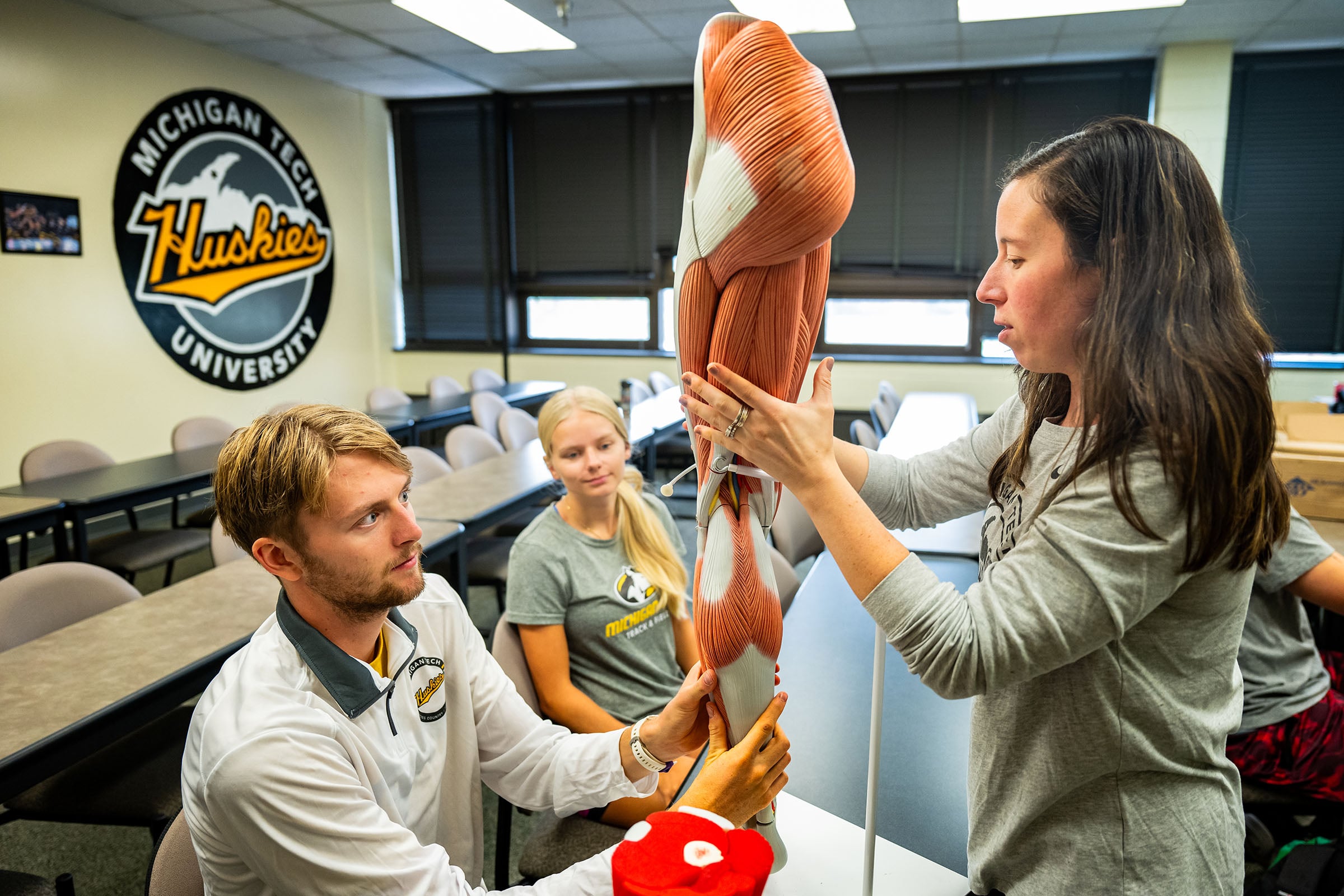
In her video, Geborkoff explained that the project involved helping patients recover from anterior cruciate ligament (ACL) injuries by identifying unique psychological readiness trajectories that patients follow during their recovery period.
The ACL connects the thigh bone to the shin bone and is vital for knee stabilization. Working with Erich Petushek, associate professor of psychology and human factors, the research team that Geborkoff was on analyzed data to discover how patients’ confidence in using their knees changed in the 12 months following ACL surgery. The data showed three distinct psychological readiness trajectory classes: one with continually low readiness, one with persistently high readiness, and one class whose confidence in their knees grew over time.
“This project is really interesting and fascinating for a couple of reasons,” said Petushek. “It shows us that there isn’t a one-size-fits-all approach to patient care after ACL injuries. This work helps us determine distinct subgroups that follow dynamic trajectories after recovery so we can better personalize recovery and therapy to identify individuals at risk.”
Project: Data, Balance, and Elder Independence
Exercise science student Leah Berkey completed her REU in Tech’s human biomechanics lab, where Carolyn Duncan, assistant professor of kinesiology and integrative physiology, develops technology aimed at preventing falls.
“For many older adults, successful mobility in the home includes appropriate fall prediction, prevention, and detection protocols,” Berkey said in her video presentation.
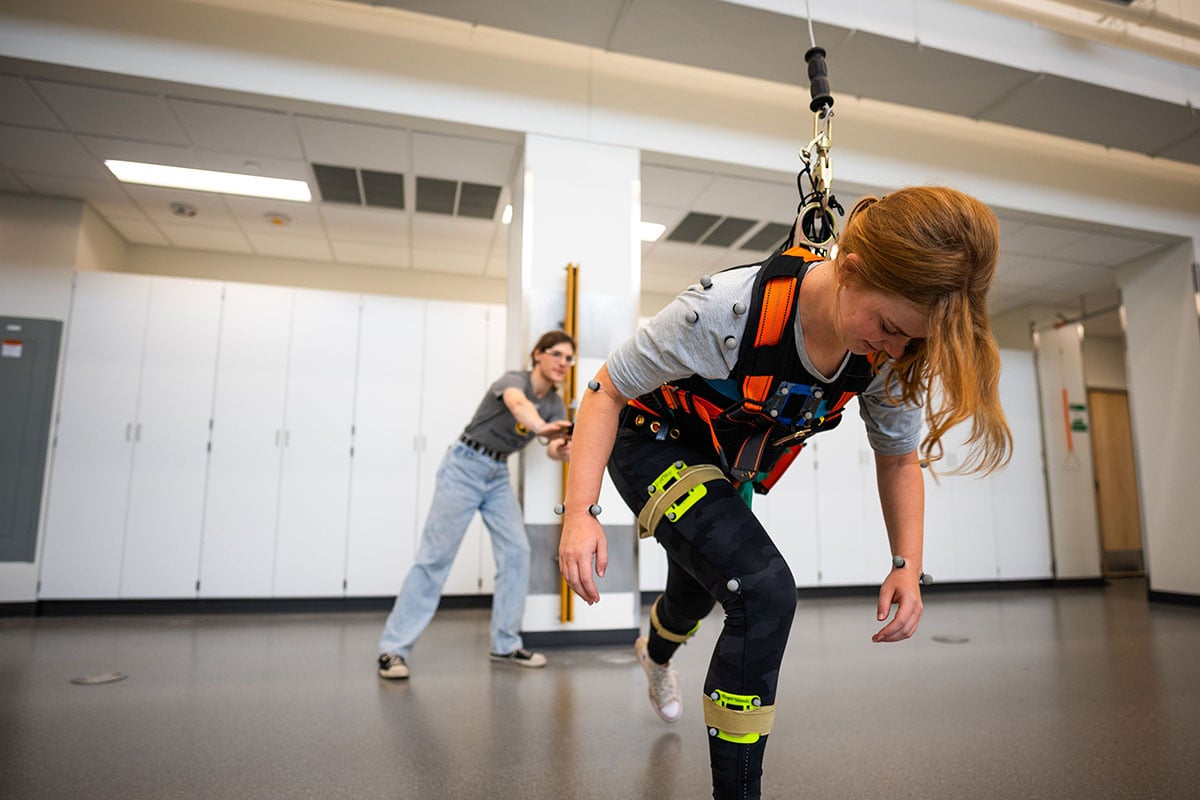
On Duncan’s team, Berkey explored a low-interference in-home system that can monitor how a person walks using floor vibration sensors. The data can provide insight into long-term trends in a person’s gait and identify potential abnormalities and locations in the home where people most frequently lose their balance.
“Unlike existing gait monitoring technologies, such as wearables or video-based systems, this system is non-invasive, easy to use, and relies only on footstep-induced floor vibration signals,” Berkey said.
The technology could provide actionable insights for clinicians, helping them improve mobility and independence for their patients.
Project: Little Molecules, Big Impact
Alivia Lamacchio, a chemistry major, used her video presentation on her quantum mechanics research to ask viewers whether they’ve ever imagined shrinking into the quantum realm like a well-known superhero.
“You don’t have to be a super genius to understand the basics,” Lamacchio said. “Quantum itself means a discrete or distinct quantity, particularly in terms of electronic movement.”
Her interest in quantum mechanics centers around the field’s chemical applications, and Lamacchio often works computationally to write calculations on molecules. This type of modeling helps predict how a molecule’s electronic structure impacts its stability. For her project, Lamacchio looked at four types of butylene molecules with differently arranged atoms to identify which were the most stable.
This exploration accomplished the goal at the heart of REUs: strengthening the undergraduate student’s understanding of the field while deepening her curiosity about its applications.
“It’s thanks to our understanding of quantum chemistry that we can rely on MRI for medical diagnostics, photovoltaic cells for renewable energy, and GPS to keep us from getting lost in the woods,” said Lamacchio. “So what else can we do with quantum mechanics and chemistry? I’d sure like to find out.”
About the College of Sciences and Arts
The College of Sciences and Arts is a global center of academic excellence in the sciences, humanities, and arts for a technological world. Our teacher-scholar model is a foundation for experiential learning, innovative research and scholarship, and civic leadership. The College offers 33 bachelor’s degrees in biological sciences, chemistry, humanities, kinesiology and Integrative physiology, mathematical sciences, physics, psychology and human factors, social sciences, and visual and performing arts. We are home to Michigan Tech’s pre-health professions and ROTC programs. The College offers 25 graduate degrees and certificates. We conduct approximately $12 million in externally funded research in health and wellness, sustainability and resiliency, and the human-technology frontier.
Follow the College on Facebook, Instagram, LinkedIn, X and the CSA blog. Questions? Contact us at csa@mtu.edu.