
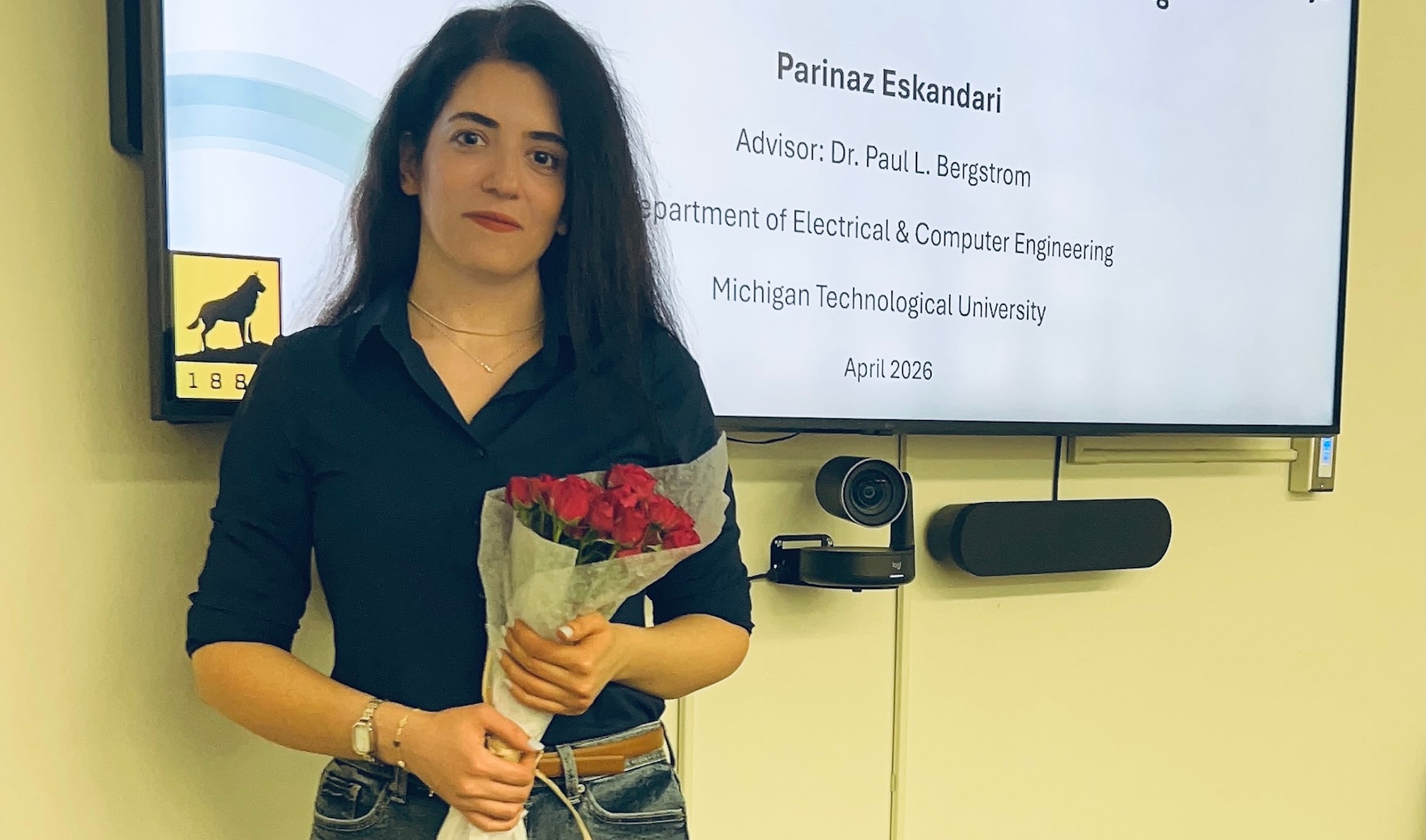
It’s been just a few months since Dr. Parinaz Eskandari graduated with her PhD in Electrical Engineering.
During her time at Michigan Tech, Eskandari tirelessly explored semiconductor devices alongside her advisor, Dr. Paul Bergstrom. She worked on the development of silicon-based platforms for sensitive and reliable detection of biological analytes. In particular, she focused on nanoscale surface engineering, achieving targeted improvements in electrochemical device performance and sensing capabilities.
This research breakthrough did not happen overnight. Over a period of roughly 3 years, Eskandari spent several thousand hours in the lab fabricating and characterizing semiconductor structures. Her intensive workload spanned the entire development process—combining cleanroom microfabrication techniques with electrical and electrochemical analysis, and bridging the gap from initial device design and modeling to testing, data analysis, and interpretation.
Beyond the complex engineering milestones, time in the lab taught Eskandari a deeper set of truths. She took some time out to share what she has learned.
Q: Please describe your path toward your PhD. What twists and turns did it take, and what have you learned from your varied experiences?
A: My path to a PhD was not a straight line. There were unexpected challenges, changes in research direction, and moments of uncertainty that forced me to adapt. Moving to a new country and pursuing advanced research while balancing teaching responsibilities required resilience and flexibility. Looking back, I realize that growth often happens in those difficult moments when things do not go according to plan. I learned that perseverance is not simply about working harder; it is about remaining open to learning, adjusting your approach, and continuing to move forward even when the destination seems unclear.
Q: Do you have any thoughts on patience, motivation, drive, and/or singular focus that you’d like to share?
A: I have learned that patience and persistence are just as important as intelligence. Research rarely provides immediate answers. Experiments fail, manuscripts require revisions, and progress can be slow. Motivation comes and goes, but commitment is what carries you through difficult periods. Rather than waiting to feel inspired every day, I believe in consistently taking small steps forward. Over time, those small efforts accumulate into meaningful accomplishments.
Q: What is your approach to teaching students in the lab?
A: I try to create a learning environment where students feel comfortable asking questions and making mistakes. Laboratories can be intimidating, especially when students are using sophisticated equipment for the first time. I emphasize hands-on learning, encourage curiosity, and guide students through the reasoning behind each procedure instead of simply asking them to follow instructions. My goal is to help students develop confidence and independence as problem-solvers.
Q: What are the most important things you seek to teach?
A: Beyond technical knowledge, I hope to teach students how to think critically, troubleshoot systematically, and communicate effectively. I want them to understand that science and engineering are not about memorizing answers; they are about asking good questions and learning how to approach unfamiliar problems. Integrity, attention to detail, and persistence are qualities that I believe are just as valuable as technical skills.
Q: What do you enjoy most about interacting with students?
A: One of the most rewarding parts of teaching is witnessing the moment when something finally clicks for a student. I enjoy helping students recognize their own potential and gain confidence in abilities they may have doubted. Students often bring fresh perspectives and thoughtful questions that challenge me to think differently as well. Teaching is a two-way learning experience, and I value that exchange greatly.
Q: Any specific career goals now that you have earned your PhD?
A: Looking ahead, I hope to build a career that brings together my interests in semiconductors, photonics, and optoelectronic systems. I am particularly drawn to the process of transforming research concepts into reliable, real-world technologies through product development, testing, and validation. I enjoy the collaborative nature of this work, partnering with multidisciplinary teams to solve complex problems, improve performance, and ensure that innovative ideas can successfully transition from the laboratory to practical applications. Whether contributing to sensing technologies, integrated photonic systems, or next-generation optical devices, I am excited by opportunities to help develop technologies that make a meaningful impact.
Q: If you could create any business/invention, what would it be?
A: If I could create any invention, it would be one that genuinely makes people’s lives easier and improves their quality of life. I am inspired by technologies that solve real-world problems and have a meaningful impact on society. Whether through accessible diagnostic tools, smarter sensing systems, or other innovations that simplify daily challenges, I would want to develop solutions that are practical, affordable, and widely available. To me, the most rewarding aspect of engineering is knowing that something you helped create has the potential to positively affect people’s lives and, in some small way, make the world a better place.
Q: What’s the best advice you can give/have been given?
A: One piece of advice that has stayed with me is: “Do not compare your journey to someone else’s timeline.” Everyone’s path is different. Success is rarely linear, and setbacks do not define your future. Focus on continuous growth, stay true to your values, and trust that persistence will eventually open doors you cannot yet see.
Q: Anything else you’d like to add?
A: I would like to express my sincere gratitude to the mentors, friends, and students who have been part of my journey at Michigan Tech. I am deeply thankful to my advisor, Dr. Paul Bergstrom, for his guidance, encouragement, and support throughout my PhD. During challenging moments, he reminded me not to give up and taught me the importance of resilience and perseverance in both research and life. Those lessons have shaped not only the scientist and educator I have become, but also the person I aspire to be. I am proud of what I have accomplished and excited for the opportunities and challenges that lie ahead.