Category: Outreach

From Nanoscale Research to Real-World Impact: Celebrating Dr. Parinaz Eskandari

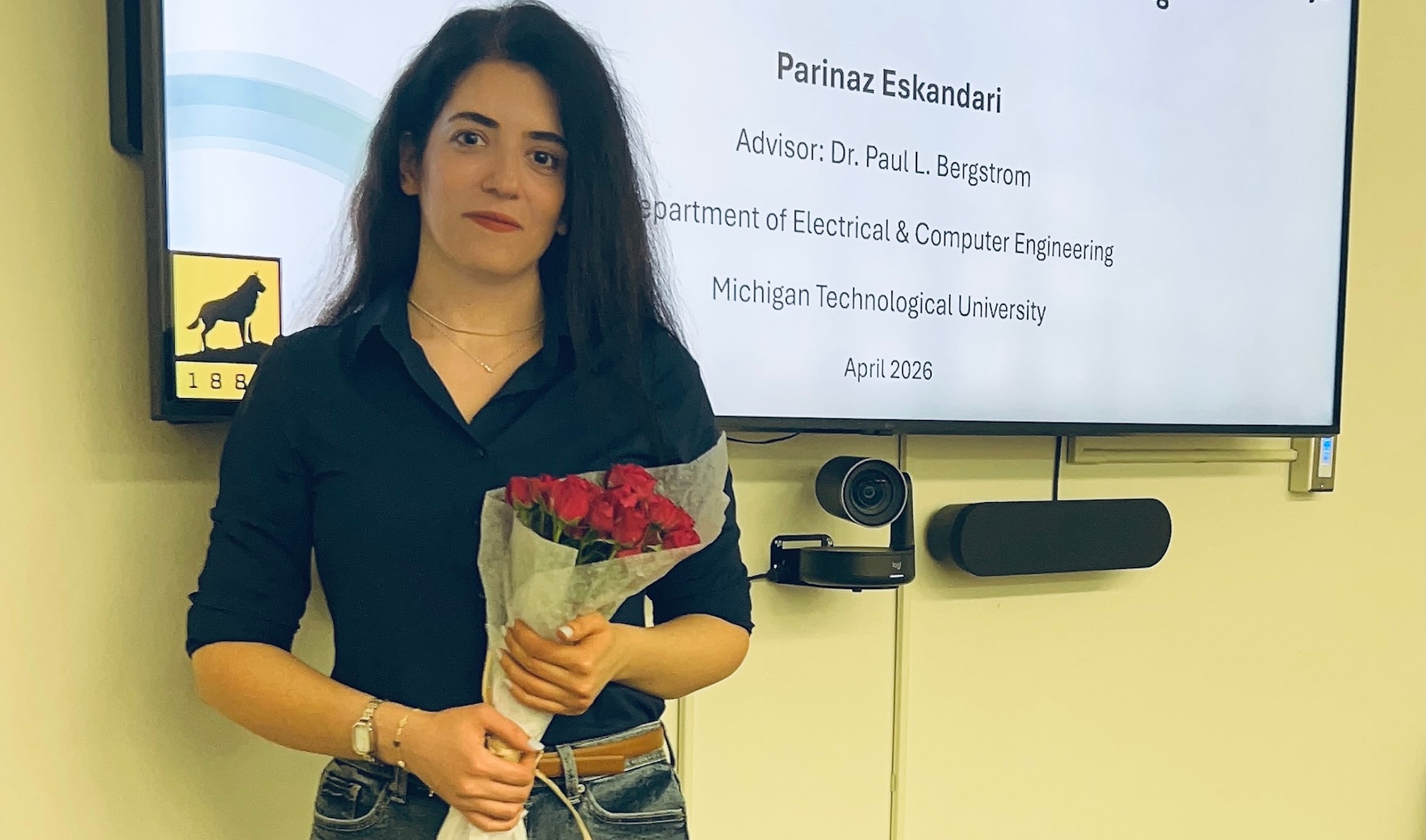
Dr. Parinaz Eskandari successfully defended her PhD dissertation, “Design, Modeling and Experimental Development of Nanoscale Confinement Structures on Planar Silicon-based Microelectrode Arrays for Single Entity Electrochemical Sensing,” this past April. 

It’s been just a few months since Dr. Parinaz Eskandari graduated with her PhD in Electrical Engineering.

During her time at Michigan Tech, Eskandari tirelessly explored semiconductor devices alongside her advisor, Dr. Paul Bergstrom. She worked on the development of silicon-based platforms for sensitive and reliable detection of biological analytes. In particular, she focused on nanoscale surface engineering, achieving targeted improvements in electrochemical device performance and sensing capabilities.

This research breakthrough did not happen overnight. Over a period of roughly 3 years, Eskandari spent several thousand hours in the lab fabricating and characterizing semiconductor structures. Her intensive workload spanned the entire development process—combining cleanroom microfabrication techniques with electrical and electrochemical analysis, and bridging the gap from initial device design and modeling to testing, data analysis, and interpretation.

Beyond the complex engineering milestones, time in the lab taught Eskandari a deeper set of truths. She took some time out to share what she has learned.

Q: Please describe your path toward your PhD. What twists and turns did it take, and what have you learned from your varied experiences?

A: My path to a PhD was not a straight line. There were unexpected challenges, changes in research direction, and moments of uncertainty that forced me to adapt. Moving to a new country and pursuing advanced research while balancing teaching responsibilities required resilience and flexibility. Looking back, I realize that growth often happens in those difficult moments when things do not go according to plan. I learned that perseverance is not simply about working harder; it is about remaining open to learning, adjusting your approach, and continuing to move forward even when the destination seems unclear.

Q: Do you have any thoughts on patience, motivation, drive, and/or singular focus that you’d like to share?

A: I have learned that patience and persistence are just as important as intelligence. Research rarely provides immediate answers. Experiments fail, manuscripts require revisions, and progress can be slow. Motivation comes and goes, but commitment is what carries you through difficult periods. Rather than waiting to feel inspired every day, I believe in consistently taking small steps forward. Over time, those small efforts accumulate into meaningful accomplishments.

Q: What is your approach to teaching students in the lab?

A: I try to create a learning environment where students feel comfortable asking questions and making mistakes. Laboratories can be intimidating, especially when students are using sophisticated equipment for the first time. I emphasize hands-on learning, encourage curiosity, and guide students through the reasoning behind each procedure instead of simply asking them to follow instructions. My goal is to help students develop confidence and independence as problem-solvers.

Q: What are the most important things you seek to teach?

A: Beyond technical knowledge, I hope to teach students how to think critically, troubleshoot systematically, and communicate effectively. I want them to understand that science and engineering are not about memorizing answers; they are about asking good questions and learning how to approach unfamiliar problems. Integrity, attention to detail, and persistence are qualities that I believe are just as valuable as technical skills.

Q: What do you enjoy most about interacting with students?

A: One of the most rewarding parts of teaching is witnessing the moment when something finally clicks for a student. I enjoy helping students recognize their own potential and gain confidence in abilities they may have doubted. Students often bring fresh perspectives and thoughtful questions that challenge me to think differently as well. Teaching is a two-way learning experience, and I value that exchange greatly.

Q: Any specific career goals now that you have earned your PhD?

A: Looking ahead, I hope to build a career that brings together my interests in semiconductors, photonics, and optoelectronic systems. I am particularly drawn to the process of transforming research concepts into reliable, real-world technologies through product development, testing, and validation. I enjoy the collaborative nature of this work, partnering with multidisciplinary teams to solve complex problems, improve performance, and ensure that innovative ideas can successfully transition from the laboratory to practical applications. Whether contributing to sensing technologies, integrated photonic systems, or next-generation optical devices, I am excited by opportunities to help develop technologies that make a meaningful impact.

Q: If you could create any business/invention, what would it be?

A: If I could create any invention, it would be one that genuinely makes people’s lives easier and improves their quality of life. I am inspired by technologies that solve real-world problems and have a meaningful impact on society. Whether through accessible diagnostic tools, smarter sensing systems, or other innovations that simplify daily challenges, I would want to develop solutions that are practical, affordable, and widely available. To me, the most rewarding aspect of engineering is knowing that something you helped create has the potential to positively affect people’s lives and, in some small way, make the world a better place.

Q: What’s the best advice you can give/have been given?

A: One piece of advice that has stayed with me is: “Do not compare your journey to someone else’s timeline.” Everyone’s path is different. Success is rarely linear, and setbacks do not define your future. Focus on continuous growth, stay true to your values, and trust that persistence will eventually open doors you cannot yet see.

Q: Anything else you’d like to add?

A: I would like to express my sincere gratitude to the mentors, friends, and students who have been part of my journey at Michigan Tech. I am deeply thankful to my advisor, Dr. Paul Bergstrom, for his guidance, encouragement, and support throughout my PhD. During challenging moments, he reminded me not to give up and taught me the importance of resilience and perseverance in both research and life. Those lessons have shaped not only the scientist and educator I have become, but also the person I aspire to be. I am proud of what I have accomplished and excited for the opportunities and challenges that lie ahead.
Beyond the Classroom: Electronics Hub Summer Spotlights

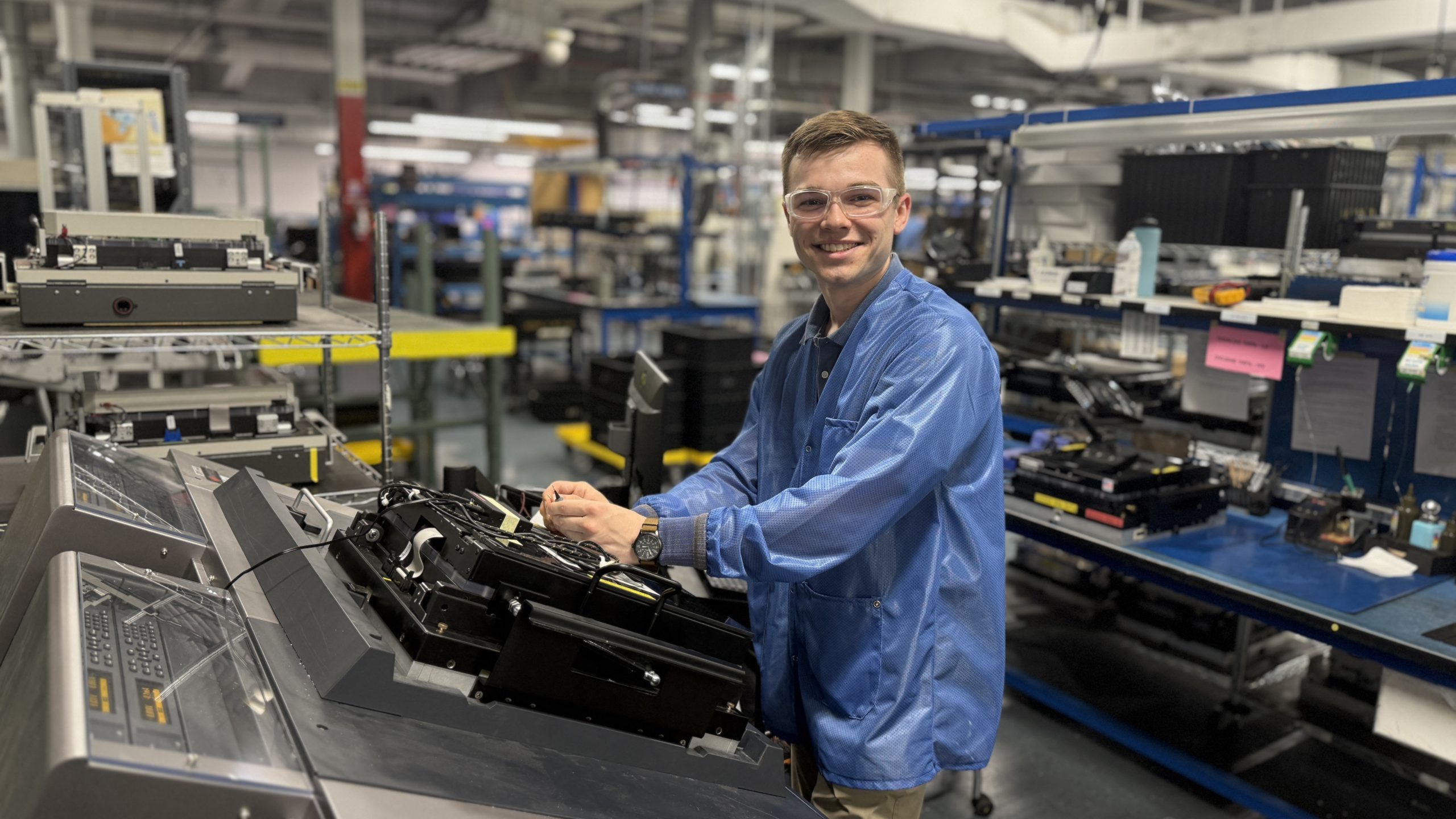
 Peter Kocour debugs an in-circuit test fixture at Miller Electric Manufacturing

Electrical engineering senior Peter Kocour from Chassell, Michigan is undertaking his second internship at Miller Electric Manufacturing. Going into the summer, he was fairly set on Printed Circuit Board (PCB) design as a future career. Within just a few weeks, however, his perspective began to shift. 

What are you doing this summer?

I’m working at the Components Division of Miller Electric Manufacturing, based in Appleton, Wisconsin. I’m working as an Electrical Engineering Intern.

What has been the most challenging aspect so far?

I’m still pretty early into my internship, but so far it’s been figuring out what I might want to pursue for a full-time career. In my first couple of weeks back at Miller I’ve been exposed to a wide range of potential career paths. For instance, I’ve had the opportunity to work on designing and modifying in-circuit test (ICT) fixtures, as well as debugging tests and boards. I’ve started to learn more about in-circuit and functional testing, PCB layouts, component sourcing. I’ve really found myself enjoying the problem-solving side of test engineering.

What is the best part?

The true diversity of work and the amazing people I get to work with! Whether its PCB design, supply chain management/component sourcing, or in-circuit test design, Miller has been able to broaden my exposure to many aspects of my field.

How did you get interested in electronics?

My parents got me interested in electronics and robotics at a very early age. First in elementary school with RC cars/planes/helicopters and Lego Mindstorm robots. That quickly turned into FPV drones, autonomous model rockets, electronics repair, Arduinos and more complex robots in middle school. Which then turned into more complex electronics projects in high school–and ultimately helped me choose Electrical Engineering as my major at Michigan Tech!

What are your career goals?

My current career goals once I graduate next spring is to land a job in Test Engineering or PCB Design.

If you could create any company or invention what would it be?

If I could start my own business I would probably go after designing aircraft avionics such as flight displays and instruments like Garmin or Dynon Avionics.

What do you like to do for fun in your spare time?

In my spare time I really enjoy design and working on various electronics projects, playing videogames, riding motorcycles, and getting outside whenever I can!

The Power of Hands-On Learning: MTU EE Students Share Their Passion for Electronics at Superior Makerfest

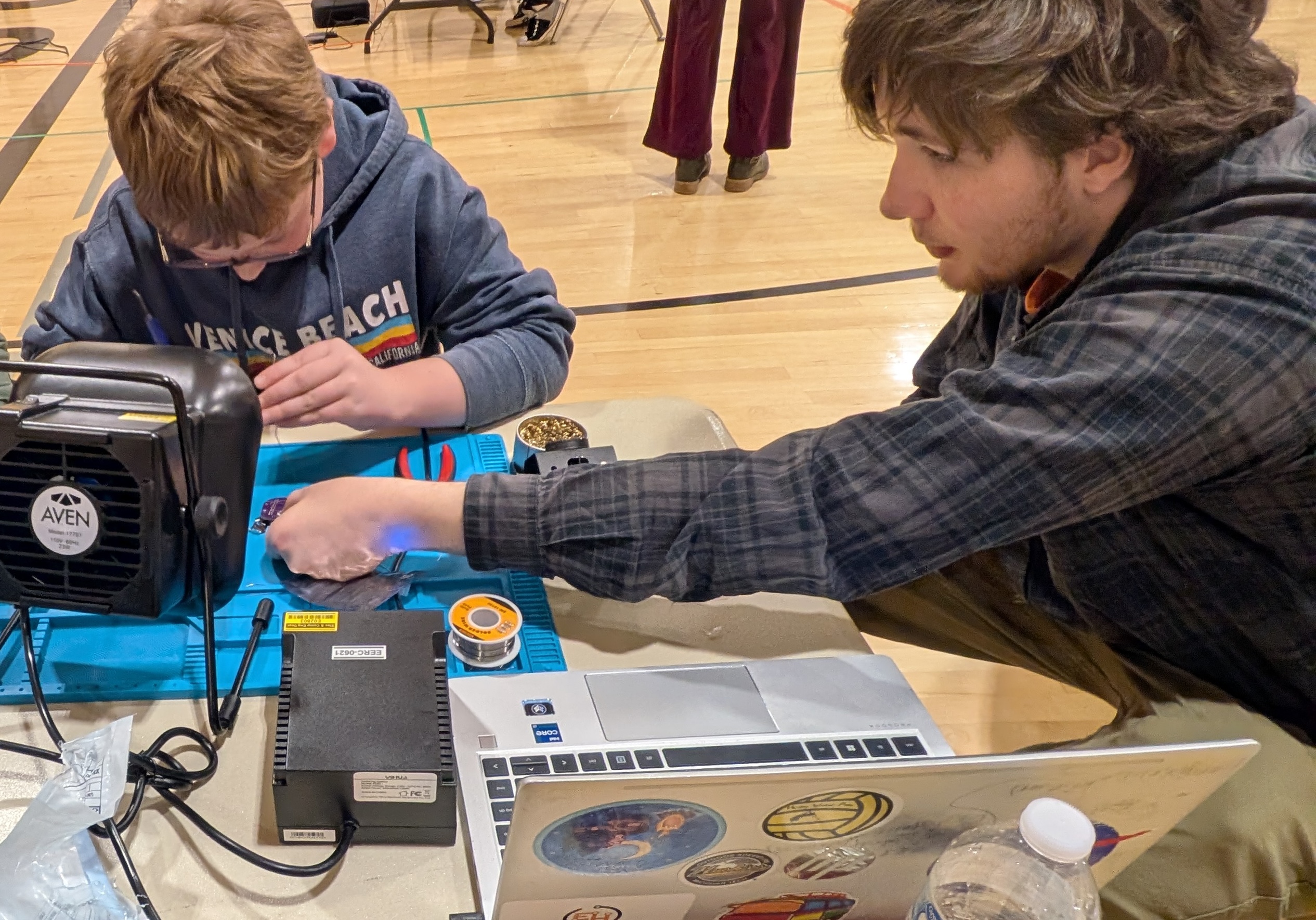
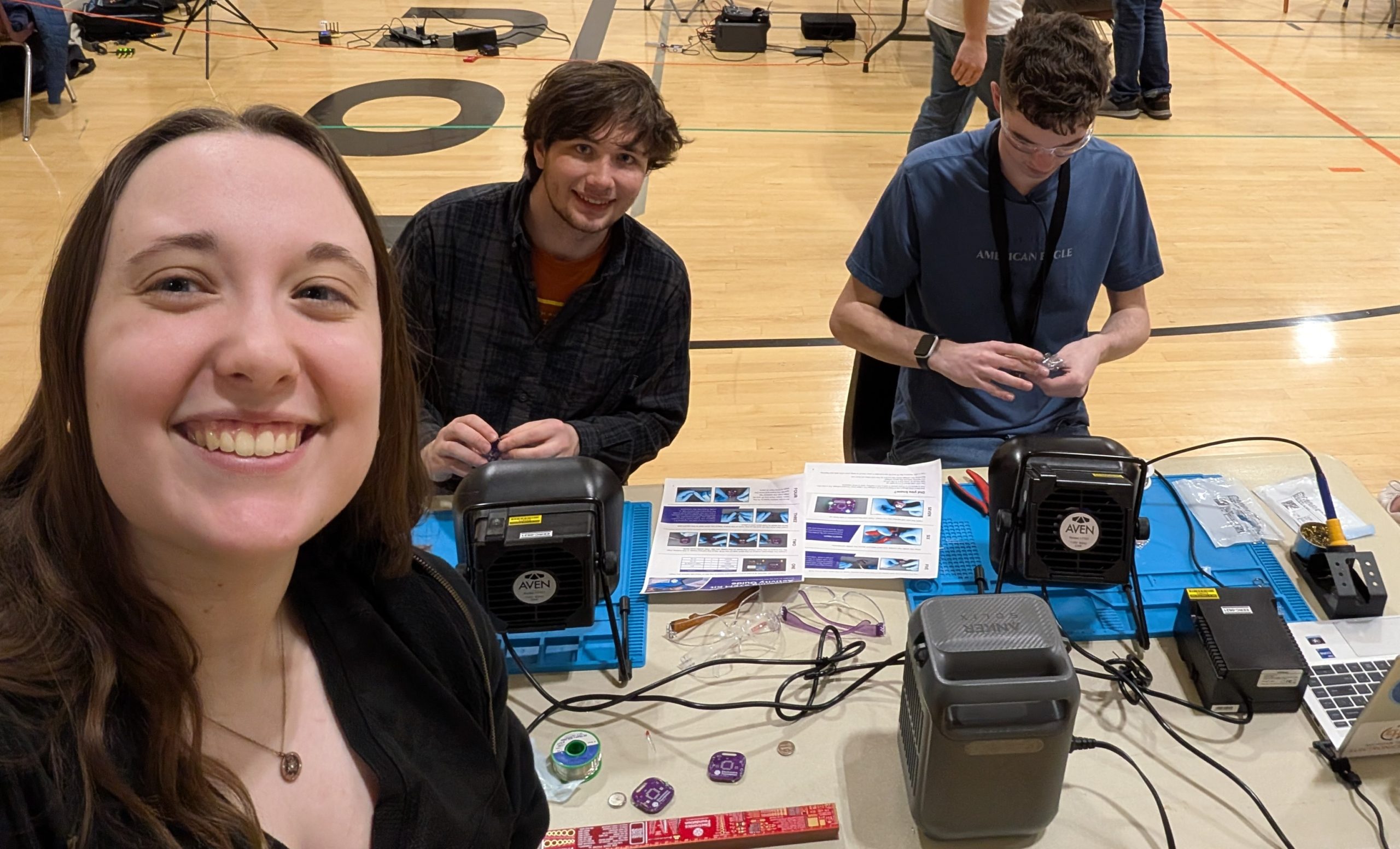
Katelyn Spolnicki and Alex Ossenheimer with a student in a gymnasium using electrical equipment
Katelyn Spolnicki and Alex Ossenheimer spent the Pi Day at Superior Makersfest.

This past Pi Day, a group of students from the Michigan Tech IPC & Electronics Student Chapter headed to Houghton High School. Senior Katelyn Spolnicki, second year-student Alex Ossenheimer, and third-year Sam Freye spent the day at Superior Makerfest, hosted by Superior Fab Lab. They taught attendees of all ages—some as young as five—the essential skill of soldering.

The three electrical engineering students taught attendees how to solder a mini flashlight. The flashlight kits–—boards, components, and a ruler – multifunctional PCB engineering scale printed circuit board ruler measuring tool—were donated by the Electronics Foundation.

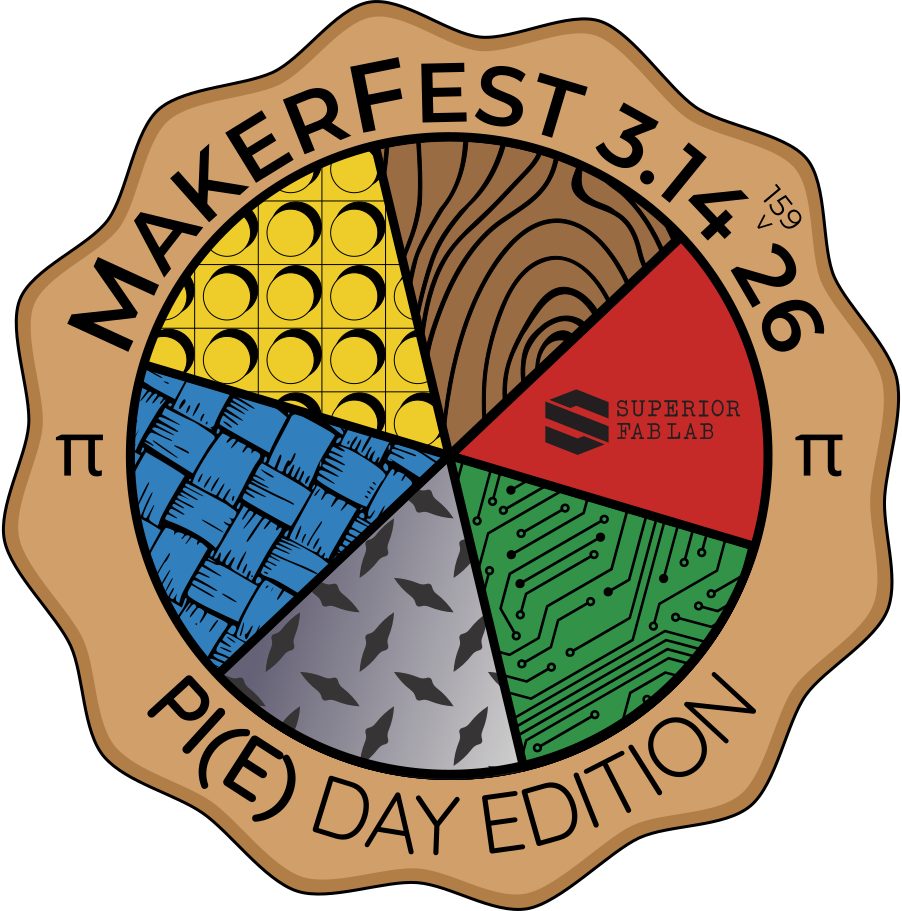
Superior Makerfest logo. Detailed description in caption below image
Logo for Superior Fab Lab’s MakerFest 3.14.26, Pi(e) Day Edition — a circular pie chart styled as a pie crust, with six slices depicting different maker materials: LEGO bricks (yellow), wood grain (brown), woven fabric (blue), diamond-plate metal (gray), circuit board (green), and the Superior Fab Lab logo on red. The text “MakerFest 3.14.26” arcs across the top and “Pi(e) Day Edition” along the bottom, with π symbols on both sides.

“It was amazing to see people of all ages get excited about learning to solder,” says Katelyn Spolnicki.

“Being part of the IPC student chapter has been one of the best parts of my college experience. It’s given me hands-on experience, industry connections, and a community of people who share the same interests,” she adds.

Her advice to anyone interested in electronics or electrical engineering? “Get involved early, try new things, and take advantage of opportunities like IPC.”

Spolnicki will graduate from Michigan Tech in just a few weeks. In the short term, she hopes to keep encouraging more students to explore electronics on campus. “Long term I want to work in the electronics industry on meaningful projects, and eventually mentor others entering the field.”

“I’m grateful I had the chance to help at Makerfest,” adds Spolnicki. “Events like this really show how fun and welcoming the electronics community can be.”

I really enjoyed meeting all the kids who stopped by our table to learn about electronics assembly and hand soldering,” adds Ossenheimer.

“I’m a relatively new member of the IPC &  Electronics student chapter. It’s been a fulfilling and refreshing experience to be a part of this group, to have the chance to experience the different facets of electronics and semiconductor engineering and manufacturing firsthand,” he says. “It’s something I plan to keep doing throughout my time at Michigan Tech.”

Alex Ossenheimer helping a student build a mini flashlight
Alex Ossenheimer teaches a student to solder a mini flashlight at the Superior Makerfest.

Ossenheimer is majoring in electrical engineering with a concentration in photonics. Similar to electronics, which involves the control of electrons, photonics deals with the control of photons in terms of generating and harnessing light and other forms of radiant energy.

His advice to a younger person interested in electronics: “Start by experimenting with the plethora of free tools out there—websites like Circuit Lab and Multisim Live for simulating circuits, and CAD software like KiCad for designing PCBs and schematics. YouTube is a good resource, too. A lot of people are making amazing videos on a wide variety of topics related to electronics.”

Whether you’re a student, job-seeker, veteran, or a professional, there’s a place for you in the electronics community. Feel free to reach out to ECE Professor Christopher Middlebrook for more information at the Michigan Tech Electronics Hub for ongoing workforce development opportunities in Michigan and beyond.

Oberloier and Forney Celebrate Maker Fest 2024

Shane Oberloier (ECE), Ian Raymond (HU) and undergraduate student William Forney (robotics engineering) were quoted by the Daily Mining Gazette in a story about the 2024 Maker Fest, held March 23 at Houghton High School. This was the second year for the event, put on by Superior Fab Lab.

“It’s the chance to show off the tools we use in the enterprise, show how they can be used and generate interest in it that way.”

William Forney, robotics engineering undergraduate

The event celebrated the process of making and offered nearly 30 hands-on activities. Raymond let visitors engage in stop-motion filmmaking. Forney, an Open Source Hardware Enterprise member, offered 360-degree 3D scans of people’s heads. Also mentioned was the Society of Women Engineers, which ran a booth on building paper circuits.

Read more at the Daily Mining Gazette, by Garrett Neese.

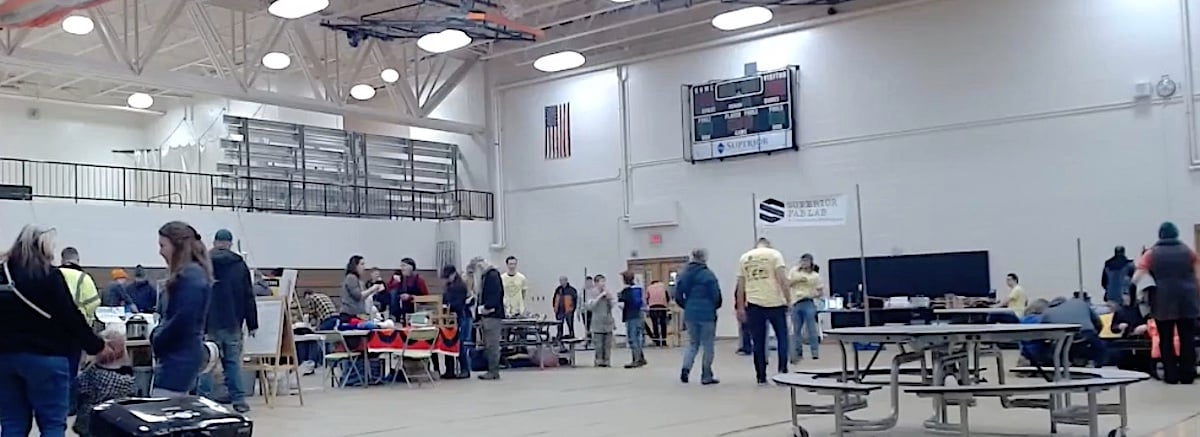
Group of people in an auditorium engaging in activities.
Students and families attend Maker Fest 2024.
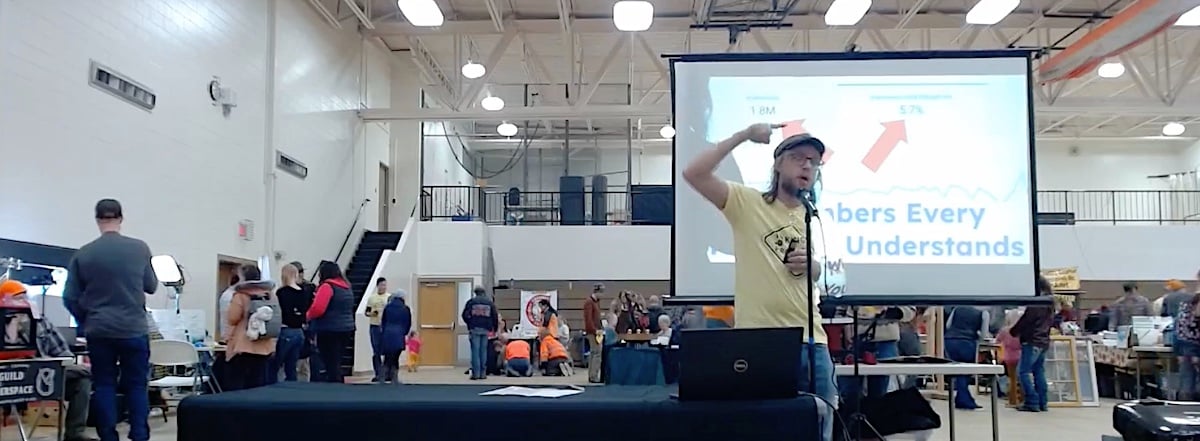
Presenter in front of screen with large group in the background.
Dr. Shane Oberloier gives a presentation on YouTube methods.

Elementary Students Build Circuits

CLK Public School exterior.

Last Friday (Jan. 31, 2020), students from Michigan Tech, along with the Lake Linden-Hubbell eighth grade eCYBERMISSION team, visited the fifth-grade classes at Calumet-Laurium-Keweenaw Elementary. Students in each fifth-grade class learned about electrical engineering by making circuits from Play-Doh, creating a paper circuit, and building a small wiggling “BouncyBOT.”

The fifth graders were very curious about Michigan Tech and what it means to be a college student in engineering. They asked the Tech representatives about projects they had worked on during their time on campus, as well as what they did in high school to get ready for college.

These students—coming together from the Society of Women Engineers (SWE), the Department of Electrical and Computer Engineering and Mind Trekkers—represent the great characteristics of the Tech community: they stepped up to give back through hands-on engagement with engineering and science.

The Nine Oh Six Podcast

Michigan Tech alumna Archita (Sivakumar) Fritz ’06, recently launched and co-founded the Nine Oh Six podcast. The Nine-Oh-Six is a global podcast co-hosted by lifelong friends Meha (Pandey) Chiraya (Houghton High School ’06) and Fritz.

The name of this podcast is the area code (906) of the Upper Peninsula, which is where Meha and Archita’s friendship began, and is an ode to the sense of community they both experienced as young adults in Houghton. This podcast originated from a desire to share the stories of the extraordinary women in their lives, within their networks and communities, who are forging a path forward.

Too often podcasts and interviews are focused on women at the top of the proverbial ‘success ladder’. Yet, they were constantly amazed by women in their lives who are doing extraordinary things as they define success on their own terms. The podcast provides a platform to share and inspire others with these stories.

On the most recent episode they interview a fellow Michigan Tech Alumna, Andrea (Taglione) Bouman ’11 and MBA ’12 who is an ER Physician at UP Health System – Portage in Hancock. She shares how her time at Michigan Tech helped shape her journey towards becoming a physician wanting to serve the community while building a family.

You can tune into the episode. For more inspiring stories about women who are defining success on their own terms, one can subscribe to The Nine Oh Six on any podcast platform such as iTunes, Spotify, Stitchr and others. or you can listen to the episodes at www.thenineohsix. You can follow us on Facebook at The Nine Oh Six Podcast or on instagram @thenineohsix.

ECE Texting Campaign a Success

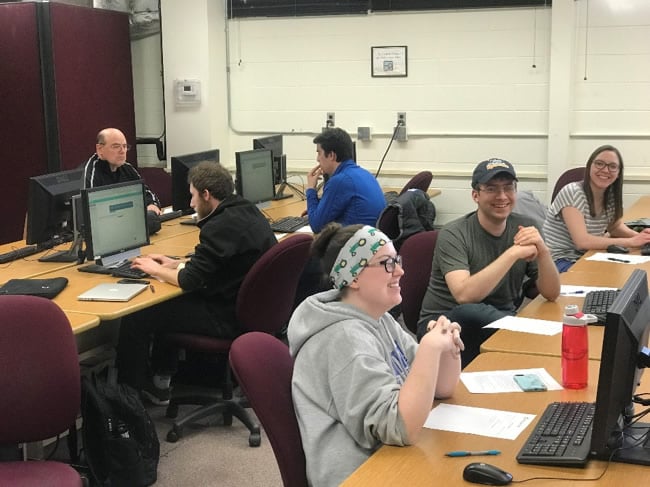
Students at computers
Photo by Glen Archer.

The first Electrical and Computer Engineering department texting campaign was held on March 26, 2019. The texting campaign is similar to the calling campaign the department put on earlier in the semester; however, students were able to send in questions via text.

Five current Tech students held conversations with approximately thirty students who had been accepted to Michigan Tech, answering questions all across the board.

The event was a success, and our students had a great time answering questions and discussing their experiences as a Husky—which can clearly be seen by the smiles.

By Kelsey Robinson, EE senior.

Heart Rate Monitor for Engineers Week 2019

Heart Rate Monitor group
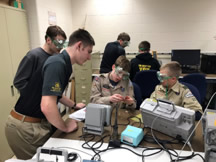
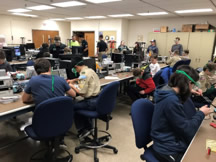
Students working on soldering, with Blue Marble Security members assisting with questions.

Engineers’ Week this year took place February 17 – 23, 2019. Michigan Technological University’s nationally recognized engineering honor society, Tau Beta Pi (TBP), partnered with Blue Marble Security Enterprise to participate in a Heart Rate Monitor (HRM) Event. The event was held on Friday, February 22, where approximately 15 TBP members learned the basics of soldering.

The TBP members had various levels of soldering knowledge, some being beginners and others having plenty of experience. They represented various majors while participating. The Blue Marble Security outreach team supervised for those with little experience and answered questions.

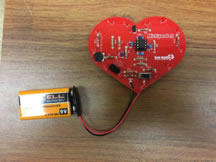
The HRM is a basic circuit used to teach students how to read color bands on resistors. The colors correspond to the resistor ohm value and polarity regarding the device LEDs. Besides basic component knowledge, the students learned the correct and safe process of through hole soldering. Upon the completion of populating and soldering the components in place, students were given an integrated circuit and nine volt battery to check the operation of the board. The TBP members took their completed heart rate monitor boards home as souvenirs of their soldering experiences and of Engineers’ Week 2019.

Related:

Boy Scouts Learn to Solder Heart Rate Monitors

Society of Women Engineers Learn to Solder Heart Rate Monitors

Boy Scouts Learn to Solder Heart Rate Monitors

BMS Tyler Arthur
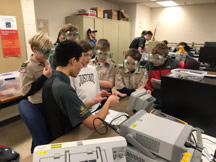
Blue Marble Security member Tyler Arthur is showing the Boy Scouts a soldering demonstration

Blue Marble Security Enterprise assisted the local Boy Scouts on Tuesday November 27th, 2018,  as they participated in a heart rate monitor soldering event. The event is used to teach the basics of electrical engineering components in an interactive and effective manner. The heart rate monitor, once soldered with correct connections, will cause the LEDs to light and with the use of the sensor the LEDs will blink with the operator’s heart rate. Around seventeen boy scouts ranging in the middle school age participated in the event with seven Blue Marble Security members as well as their advisor who monitored and assisted in the lab.

The focus of the heart rate monitor lab is to introduce the basic concepts of electric engineering to those with little experience. Some of the concepts learned are how the color bands on resistors correspond to the resistor’s value, the polarity of diodes, and why it is important to place them correctly. However, the focus of the lab was to make effective through hole soldering connections. Scouts who were unsure about the process got a quick demo from an Outreach team member. All the members got portions of their boards populated with components within the time limit, with a few getting the boards completed and tested. All the boy scouts will get to take a heart rate monitor board home after the Outreach members troubleshoot and finish up some of the boards. The boy scouts had a wonderful time, and learned a new valuable skill.

BMS with Boy Scouts
Michael, John, and Shawn BMS members answering various questions the scouts have.

BMS Soldering Lab
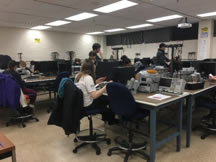
Overview of the lab with the scouts working on their heart rate monitor soldering boards.

Society of Women Engineers Learn to Solder Heart Rate Monitors

Heart Monitor Device
The completed heart rate monitor board SWE members took as a souvenir.

On Friday November 9th, 2018 Blue Marble Security hosted a heart rate monitor soldering lab for the Society of Women Engineers (SWE). The heart rate monitor, once fully soldered with correct connections, would allow the LEDs around the edge to blink with the operator’s heart rate. Sixteen SWE members were present along with six Blue Marble Security members to monitor and assist in the lab.

SWE Students Lab
Students working on the heart rate monitor boards with BMS members supervising.

The focus of the heart rate monitor lab is to introduce basic concepts of electrical engineering to those with little or no knowledge. The SWE members specifically learned how the color bands on resistors correspond to the resistor’s value, as well as the polarity of a diode and why it is present. The main focus of the lab was to teach the SWE members to through hole solder appropriately so that there would be strong connections on the board for current to flow. All of the SWE members completed the lab within the time allowed. Each took a heart rate monitor board as a souvenir to remember their new skill.