Category: DataS

Tim Havens, Tony Pinar Co-Authors of Article in IEEE Trans. Fuzzy Systems

An article by Anthony Pinar (DataS/ECE) and Timothy Havens (DataS/CC), in collaboration with University of Missouri researchers Muhammad Islam, Derek Anderson, Grant Scott, and Jim Keller, all of University of Missouri, has been published in the July 2020 issue of the journal IEEE Transactions on Fuzzy Systems.

The article is titled, “Enabling explainable fusion in deep learning with fuzzy integral neural networks.” Link to the article here.

Abstract:
Information fusion is an essential part of numerous engineering systems and biological functions, e.g., human cognition. Fusion occurs at many levels, ranging from the low-level combination of signals to the high-level aggregation of heterogeneous decision-making processes. While the last decade has witnessed an explosion of research in deep learning, fusion in neural networks has not observed the same revolution. Specifically, most neural fusion approaches are ad hoc, are not understood, are distributed versus localized, and/or explainability is low (if present at all). Herein, we prove that the fuzzy Choquet integral (ChI), a powerful nonlinear aggregation function, can be represented as a multilayer network, referred to hereafter as ChIMP.

We also put forth an improved ChIMP (iChIMP) that leads to a stochastic-gradient-descent-based optimization in light of the exponential number of ChI inequality constraints. An additional benefit of ChIMP/iChIMP is that it enables explainable artificial intelligence (XAI). Synthetic validation experiments are provided, and iChIMP is applied to the fusion of a set of heterogeneous architecture deep models in remote sensing. We show an improvement in model accuracy, and our previously established XAI indices shed light on the quality of our data, model, and its decisions.

Citation
M. Islam, D. T. Anderson, A. J. Pinar, T. C. Havens, G. Scott and J. M. Keller, “Enabling Explainable Fusion in Deep Learning With Fuzzy Integral Neural Networks,” in IEEE Transactions on Fuzzy Systems, vol. 28, no. 7, pp. 1291-1300, July 2020, doi: 10.1109/TFUZZ.2019.2917124.


Tim Havens Gives Talk at Los Alamos National Lab

Dr. Timothy Havens presented the lead talk at the Los Alamos National Laboratory’s ISR-2 Seminar Series on Advancing Toward Modern Detection and Estimation Techniques for Multi-Sensor Scenarios, presented online July 9, 2020.

Tim Havens is associate dean for research for the College of Computing, director of the Institute of Computing and Cybersystems (ICC), and the William and Gloria Jackson Associate Professor of Computer Systems.

The talk, “Explainable Deep Fusion,” described Havens’s sensor fusion systems research that seeks to combine cooperative and complementary sources to achieve optimal inference from pooled evidence.

Havens specifically discussed his innovations in non-linear aggregation learning with Choquet integrals and their applications in deep learning and Explainable AI.

Weihua Zhou Receives PHF Seed Grant

The Michigan Tech Vice President for Research office has announced the Spring 2020 Research Excellence Fund (REF) awards.

Among the recipients is Assistant Professor Weihua Zhou, Applied Computing/Health Informatics, who received a Portage Health Foundation Research Seed Grant.

Zhou’s areas of expertise include image processing and computer vision, machine learning, medical image analysis, health informatics, and text mining.

The proposed project represents Zhou’s continuous research on cardiac resynchronization therapy for patients with heart failure.

His co-investigators are Associate Professor Qing-Hui Chen, M.D., Kinesiology and Integrative Physiology, and Timothy Havens, the William and Gloria Jackson Associate Professor, College of Computing.

Ph.D. candidate Zhuo He, College of Computing, is a research assistant on the project. Rudy Evonich, MD, a cardiologist with the Department of Cardiology at UP Health System Marquette, Mich., is a clinical consultant.

Read the Tech Today announcement here.

Learn more about Michigan Tech REF awards here.

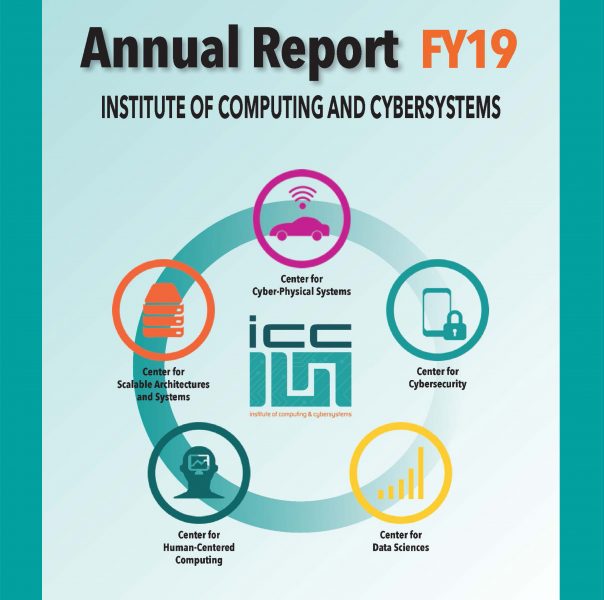
ICC Releases FY19 Annual Report

The Institute of Computing and Cybersystems has released its FY 19 Annual Report, which can be viewed and downloaded on the ICC website.

We had a strong year in 2018-19,” says Timothy Havens, director of the ICC and associate dean for research, College of Computing.

“In FY20, new awards and research expenditures were even stronger, and I look forward to sharing more accomplishments with you in the coming months.”

Tim Havens, ICC Director

Signature Research, Michigan Tech win $1 Million NGA Research Award

Signature Research Inc. has partnered with Michigan Technological University to accomplish a Phase II STTR project sponsored by the National Geospatial-Intelligence Agency. The two-year, $1 Million project is titled, “Algorithms for Look-Down Infrared Target Exploitation-Phase II.” Michigan Tech’s portion of the $1 million contract is $400K.


Principal investigator of the project is Dr. Timothy Havens, director of the Institute of Computing and Cyberystems (ICC) and associate dean of research for the College of Computing. Havens is joined by Signature Research, Inc. (SGR) Program Manager Matt Blanck, who will lead the SGR side of the project.

At Tech, Havens will be assisted in accomplishing the goals of this project by Research Scientist Adam Webb of the Michigan Tech Research Institute (MTRI) and Nicholas Hamilton, a Computer Science Ph.D. candidate.

“This project will identify physics-based novel signatures and data processing techniques to exploit overhead infrared (IR) imagery using machine learning algorithms.”

“The SGR/MTU Team will generate, collect, and label a wide body of data, implement learning algorithms, develop use cases and tests on those data, and perform a comprehensive study to determine ways in which learning algorithms can automate IR imagery recognition tasks.”

Dr. Timothy Havens

And while this effort is focused on overhead IR imagery, Havens says the methods and software developed will have applicability to other sensing modalities, leading to investigations of multi-modal fusion of all-source data.


Signature Research, Inc. (SGR) solutions to DoD and Intelligence Community customers, and specializes in in Signature Phenomenology, Analysis, and Modeling of items of military interest covering the breadth of the electromagnetic spectrum.

The National Geospatial-Intelligence Agency (NGA) is a combat support agency under the United States Department of Defense and a member of the United States Intelligence Community, with the primary mission of collecting, analyzing, and distributing geospatial intelligence in support of national security.

The Institute of Computing and Cybersystems (ICC) promotes research and learning experiences in the areas of cyber-physical systems, cybersecurity, data sciences, human-centered computing, and scalable architectures and systems for the benefit of Michigan Tech and society at large.

The Michigan Tech Research Institute (MTRI) is an innovator in building information from data through the marriage of phenomenological understanding and implementation of mathematically rigorous algorithms. Together with University and other national and international collaborators, MTRI researchers and scientists work to solve critical problems in national security, protecting and evaluating critical infrastructure, bioinformatics, Earth sciences, and environmental processes, according to their website.

Sergeyev, Students Earn ASEE Conference Awards

Professor Aleksandr Segeyev (DataS), Applied Computing, and a group of Michigan Tech students presented two papers at the 2020 American Society for Engineering Education (ASEE) Gulf-Southwest Annual conference, which was conducted online April 23-24, 2020. Both papers received conference awards.

Faculty Paper Award

“Pioneering Approach for Offering the Convergence MS Degree in Mechatronics and Associate Graduate Certificate”
by Sergeyev, Professor and Associate Chair John Irwin (MMET), and Dean Adrienne Minerick (CC).


Student Paper Award

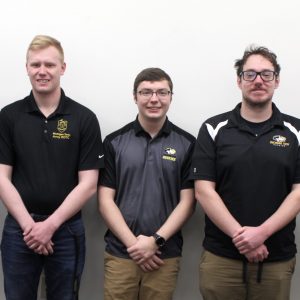
“Efficient Way of Converting outdated Allen Bradley PLC-5 System into Modern ControlLogix 5000 suit”, by Spencer Thompson (pictured), Larry Stambeck, Andy Posa, Sergeyev, and Lecturer Paniz Hazaveh, Applied Computing.

Sergeyev is director of the Michigan Tech Mechatronics Graduate Program and FANUC Certified Industrial Robotics Training Center.

Founded in 1893, the American Society for Engineering Education is a nonprofit organization of individuals and institutions committed to furthering education in engineering and engineering technology.

Thomas Oommen PI of 41K RD Contract

Professor Thomas Oommen (DataS, GMES, EPSSI) is the principal investigator on a one-year project that has been awarded a $41K research and development contract with the University of Nebraska-Omaha.

The project is titled “Flood Hazard Map to Water Management & Planning.”

Oommen’s research focuses on developing improved susceptibility characterization and documentation of geo-hazards (e.g. earthquakes, landslides) and spatial modeling of georesource (e.g. mineral deposits) over a range of spatial scales and data types.

To achieve his research interests, he has adopted an inter-disciplinary research approach joining aerial/satellite based remote sensing for obtaining data, and artificial intelligence/machine learning based methods for data processing and modeling.

Recap: Virtual Parallel-in-Time Workshop 2020

The virtual 2020 Parallel-in-Time conference, co-organized by Assistant Professor Benjamin Ong (DataS, Mathematics), took place June 8 to 12, 2020.

The conference consisted of 20 presentations, including one by Mathematics department graduate student, Nadun Dissanayake.

140 participants in more than a dozen countries registered and participated in the conference. View the conference video lectures and program information here.

The primary focus of the Parallel-in-Time Workshop was to disseminate cutting-edge research and facilitate scientific discussions on the field of parallel time integration methods.

Download the conference program booklet here.

GSG to Present Webinar Series in Computer Programming

The Graduate Student Government (GSG) Professional Development Committee has organized a free webinar series in Computer Programming, which begins Tuesday, July 14, 2020.

July 14: “Introduction to Machine Learning with Python,” by Timothy Havens (CC)

July 15: “Managing Data” (Data Mining)” by MS Data Science candidate Sneha Nimmagadda

July 16: “Introduction to Deep Learning,” by Timothy Havens (CC)

Seats are not limited, but participants are asked to register so webinar organizers know how many attendees to expect.

Find more information, including links to register and join Zoom meetings, visit the GSG website.

Michigan Tech Team Places 4th Overall in TiM$10K Challenge

A team of five Michigan Tech students received Honorable Mention honors in the second annual SICK Inc. TiM$10K Challenge, a national innovation and design competition. University students from around the country participated in the event designed to support innovation and student achievement in automation and technology.

The Michigan Tech team members — Brian Parvin (ME), Paul Allen (EE), David Brushaber (CompEng), Kurtis Alessi (CompEng) and Alex Kirchner (CompEng) — earned Honorable Mention (fourth place overall) for their project, “Evaluating Road Markings (the Road Stripe Evaluator). Their project was sponsored by SICK Inc. Watch a video about the project below.

Play SICK's TiM$10K Challenge 2020 – Evaluating Road Markings (The Road Stripe Evaluator) video
Preview image for SICK's TiM$10K Challenge 2020 - Evaluating Road Markings (The Road Stripe Evaluator) video

SICK's TiM$10K Challenge 2020 – Evaluating Road Markings (The Road Stripe Evaluator)


Adrienne Minerick, dean of Michigan Tech’s College of Computing, said in a June 1, 20920, Tech Today article that the accomplishments of these outstanding students illustrates Michigan Tech’s creativity and tenacity when faced with a challenge. “Our rapidly growing presence in cybersecurity is built upon our students deep knowledge of the fundamentals combined with the learning environment that promotes agility to meet (and exceed) any challenge. These hardworking and bright students deserve this recognition of their competitiveness. All of us in the College of Computing are proud.”

For the competition, teams were supplied with a 270-degree SICK LiDAR sensor and accessories, and challenged to solve a problem, create a solution, or bring a new application to any industry that utilizes the SICK LiDAR.

Each team submitted a video and paper for judging upon completion of its project. A panel of judges decided the winning submissions based on creativity and innovation, ability to solve a customer problem, commercial potential, entrepreneurship of the team, and reporting.

The Tech team developed an innovative product to help resolve issues caused by poor road markings, while reducing maintenance costs and improving motorist safety. Their new software uses reflectivity values obtained using a SICK LiDAR unit to identify deterioration of road stripes and recommend timely repainting, also aiding in the safety and reliability of self-driving vehicles on roadways.

They constructed a prototype to demonstrate functionality, in the form of a pushable cart that evaluates road markings. An intuitive user interface displays the markings being evaluated, and indicates if they meet necessary levels of reflectivity.

Pinar said the team was well organized and demonstrated an excellent work ethic from day one. “It was exciting to watch them identify a salient problem and develop a functional proof-of-concept solution despite the setbacks that affected us all after spring break,” he said.

“This was a unique project in that the team was required to identify a problem and develop a solution to it that is based on SICK’s TiM LiDAR, while most teams are handed a problem and asked to create a solution,” Pinar noted. “I think this format allowed the team to exercise even more innovation than on a ‘typical’ project.”

The same team of students was awarded Honorable Mention honors at this spring’s Design Expo Senior Design competition for their project, “Road Marking Reflectivity Evaluator.”

SICK, Inc. is one of the world’s leading manufacturers of sensors, safety systems, machine vision, encoders and automatic identification products for industrial applications.