The pace of the academic semester picks up in mid April, with students and faculty alike realizing that the end of the semester is looming. Students hustle to complete projects and papers, but I am especially impressed by the number of research activities in which CSA undergraduates are involved.

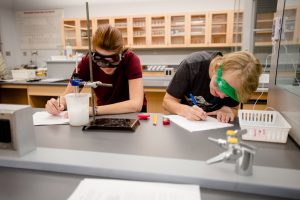
Michigan Tech has sought to connect students to research as early as possible in their time here, believing that research, like other experiential activities, can transform their education. The following list of their work is, I believe, impressive.
In Biological Sciences, fourth-year Biological Sciences student Rebecca Hobmeier recently presented a department seminar on “Drosophila Gene Regulation in the Formation of Complex Color Patterns in Yellow Evolution of Guttifera.” Thomas Werner was her adviser.
In the Physics Department, a number of seniors presented summaries of their projects at a department colloquium. These included:
- Floyd Johnson — “Free-standing and Substrate-Supported Cytosine Molecules: Molecular Dynamics Study, advised by department chair Ravi Pandey
- Austin Hermann — “Quantum Confinement Effect in Silicon,” advised by Ranjit Pati
- Colin Sheidler —”Unidirectional Emission from Microring Lasers,” advised by Ramy El-Ganainy
- David Russell — “A Search for Exotic Particles Using AUGER Data”, advised by Brian Fick
- Michael Foetisch — “Iron Electrowinning: Proof of Concept and Optimization,” advised by Timothy Eisele
- Nick Videtich — “Pico-second Pulsed Laser System Using Neodymium-doped Yttrium Vanadate Crystal,” advised by Jae Yong Suh
- Kelci Mohrman — “Searching for Emission from the Geminga Pulsar Wind Nebula in GeV Engines,” advised by Petra Huentemeyer.
And in Social Sciences, three students presented their undergraduate theses in anthropology to the department.
- James Wezensky — Stamp Mill Technologies: The Industrial Past of Isle Royale National Park, advised by Pat Martin
- Jakob Williams — The Party of Trump: Understanding the Rise of the Billionaire Populist, advised by Melissa Baird
This list could be multiplied many times, as faculty in the life sciences (especially Biological Sciences, Chemistry and Kinesiology) eagerly recruit undergraduates to work in their labs, so that some of them leave Michigan Tech as co-authors or contributors to a publication in an academic journal. These outcomes explain why many of us talk about the unity of teaching and research and see them as deeply complementary activities. These student projects offer only the most recent example of effort to integrate these core responsibilities.


Kathy Halvorsen
Anne Beffel
Stephanie Dietrich
Two KIP students-
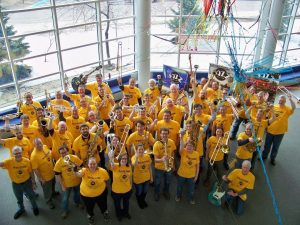
Considering that Michigan Tech offers no degrees in music, the variety of quality musical groups here is quite amazing. Jazz and vocal groups, an orchestra and bands — students can participate in all of these, often in more than one venue. But for the typical student here, the 


The drummer is Libby Welton, a December 2016 MTU grad in Mechanical Engineering. She started her first job in Wausau, WI immediately after the tour was over.

I’ve recently returned from a trip to India – my 6th in the past eight years. The purpose of the trips has been to develop connections between faculty and universities there and at Michigan Tech.
At each place, I was warmly received, as has been true during each stop in my earlier visits. Normally I deliver a seminar on a topic appropriate to the university; typically I have talked about the societal implications of nanoscale science and engineering. This subject matches the world-wide interest in nanotechnology, but often the audience hears for the first time the perspective of a historian of technology on this topic. The resulting discussions have been useful and interesting – and provide a springboard to examine ways in which Tech’s faculty and research activities might align with faculty and students at the universities in India. There are many other areas where the research interests of faculty in India and the U.S overlap, and developing collaborative arrangements built from that common int
erest are the primary target of these visits. This trip, Michigan Tech and NITC signed an agreement to strengthen shared research programs in atmospheric science and applied physics. Similar linkages seem very likely to emerge from the visits to AISECT and IIT Bombay as well.
e so proud of the students — as they should have been! The students had prepared a science fair for me, as well as crafts exhibit. And after a short talk from me, they asked questions for an hour about all kinds of topics. It was a wonderful experience, as was the second school visit, this time to the Government Girls High School in Balussery in Kerala State. I met with a group of 10th graders from a gifted and talented program – and they certainly lived up to that billing! Self-assured and confident, these young women asked me about the differences between India and the U.S., about inequality, democracy and technology, and about the differences and similarities between our two countries. I was honored to be the first American to visit them, and urged them to never let anyone suggest they could not do something simply because they were women. Impressive!