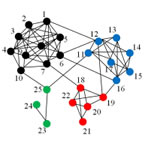
 Sakineh Yazdanparast (ECE) and Timothy Havens (ECE/CS) coauthored the article, “Modularity Maximization Using Completely Positive Programming,” in Physica A: Statistical Mechanics and its Applications.
http://dx.doi.org/10.1016/j.physa.2016.11.108

Sakineh Yazdanparast (ECE) and Timothy Havens (ECE/CS) coauthored the article, “Modularity Maximization Using Completely Positive Programming,” in Physica A: Statistical Mechanics and its Applications.
http://dx.doi.org/10.1016/j.physa.2016.11.108
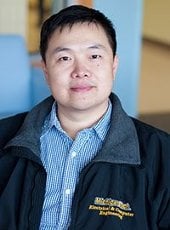
Online outlets from the National Science Foundation to Science Daily to Electronic Product Design and Test have featured a research keynote paper led by Shiyan Hu (ECE) on cyber-physical systems. Other outlets include: Communications of the ACM, Industrial Safety and Security Source, Michigan Ag Connection and close to a dozen other science blogs.
Science 360, a science news website published by the National Science Foundation (NSF), featured a Michigan Tech research news story about Shiyan Hu’s (ECE) research as its top headline story of the day on Jan. 4.
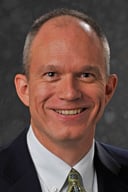 Dr. Paul Juodawlkis, assistant leader of the Quantum Information and Integrated Nanosystems Group at MIT Lincoln Laboratory, and ECE alumnus, has been named a Fellow of the IEEE (Institute of Electrical and Electronics Engineers).
Fellow is the IEEE’s highest grade of membership and only one-tenth of 1 percent of the entire membership can be awarded the honor in a given year. The Fellows program honors “those who have contributed greatly to the advancement of engineering, science, and technology.”
Juodawlkis is recognized for his contributions to optically sampled converters and waveguide amplifiers.
“I am happy and deeply honored to be named an IEEE Fellow,” says Dr. Juodawlkis. “I’ve been a member of the IEEE since my undergrad days in electrical engineering at Michigan Tech. Those days were critical to sparking my technical interests in solid-state devices and optoelectronics through classes taught by faculty like Professor Emeritus Anand Kulkarni. More recently, I’ve truly enjoyed having a front-row seat to watch the development and growth of the Department of Electrical and Computer Engineering over the past 16 years as a member of the department’s External Advisory Committee. When I am on campus, I am sometimes jealous of the opportunities and resources available to today’s Michigan Tech students, and wish that I could go back and do it all over again. Well, maybe except for finals. When I get a chance to offer advice to today’s students, I usually recommend that they make time to meet with their professors even if they don’t need help to learn the course material or to get the grade that they want. One of the main advantages of Michigan Tech is that most of the faculty care about teaching the students, and this teaching involves both explaining the course material and sharing the life lessons that they have learned outside of the classroom.”
Dr. Juodawlkis is also a Fellow of the Optical Society (OSA). He has authored or coauthored more than 130 peer-reviewed journal and conference publications. He has participated on a number of technical program committees, including serving as program co-chair (2010) and general co-chair (2012) of the Conference on Lasers and Electro-Optics (CLEO). He was an elected member of the IEEE Photonics Society Board of Governors (2011–2013), served as vice president of membership for the society (2014-2016), and is currently secretary-treasurer for the society. Juodawlkis holds a BS degree from Michigan Technological University, an MS degree from Purdue University, and a PhD degree from the Georgia Institute of Technology, all in electrical engineering.
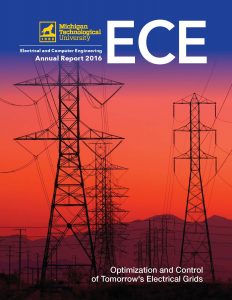 We are happy to share with you our newly released ECE Annual Report 2016. A look back at our past year highlights research activities by Profs. Bo Chen, Durdu Guney, Saeid Nooshabadi, Sumit Paudyal, and Reza Zekavat; along with Paul Bergstrom’s Faculty Fellow Program appointment and an interview with HKN’s Professor of the Year, Kit Cischke. Staff profile this edition is Michele Kamppinen, honored in May for her 25 years of service to the University. Our graduate student story features recent PhD, Jennifer (Jenn) Winikus, who made great contributions in STEM outreach during her time at Michigan Tech. Once again the year included a wide variety of hands-on student projects in our Senior Design and Enterprise programs and we thank our sponsors for making it all possible! We invite you to read about these stories and more. From all of us at ECE, best wishes for 2017!
Wayne Weaver (ECE/AIM) is the principal investigator on a project that has received a $46,000 research and development contract from Sandia National Laboratories.
The title of the project is “Meta-Stability of Pulsed Load Microgrids.” This is a six and a half month project.
By Sponsored Programs.
Three Michigan Tech students are among 169 students from 49 higher education institutions worldwide to be named University Innovation Fellows. They are: Rachel Kolb (MEEM), Kyle Ludwig (ECE), and Adam Weber (CNSA).
The University Innovation Fellows program empowers students to become agents of change at their schools. Fellows work to ensure that their peers gain the knowledge, skills and attitudes required to compete in the economy of the future and make a positive impact on the world. To accomplish this, the Fellows advocate for lasting institutional change and create opportunities for students to engage with innovation, entrepreneurship, design thinking and creativity at their schools.
Fellows design innovation spaces, start entrepreneurship organizations, host experiential learning events and work with faculty to develop new courses.
The program is run by Stanford University’s Hasso Plattner Institute of Design. With the addition of the new Fellows, the program has trained 776 students at 164 institutions since its creation.
Ludwig, a computer engineering major from Traverse City, Michigan is involved in Michigan Tech’s Entrepreneurs Club, the Electrical and Computer Engineering Undergraduate Advisory Board, and the Pavlis Honor’s College. Ludwig would like to use his education in computer engineering, along with his passion for health and fitness, to improve health using technology.
“We believe that students can be so much more than just the customers of their education. They can be leaders of change and they can co-design the higher education experience,” said Humera Fasihuddin, co-director of the University Innovation Fellows program.
“This core belief has driven the program since its inception, and we’ve seen the results of this belief put to action at schools around the world. Fellows are collaborating with their peers, faculty and administrators to create more educational opportunities for students at their schools. They are making measurable gains, both in the number of resources and the students served by the innovation and entrepreneurship ecosystem.”
Individual Fellows as well as institutional teams of Fellows are sponsored by faculty and administrators and selected through an application process twice annually.
Throughout the year, they take part in events and conferences and have opportunities to learn from one another, Stanford mentors and leaders in academia and industry.

Retired Michigan Tech Professor Theodore “Ted” Grzelak of Dollar Bay passed away Sunday at St. Mary’s Hospital in Grand Rapids following a lengthy illness. He was 78.
He was born in Detroit and earned his bachelor’s of science in electrical engineering from the Michigan College of Mining and Technology in 1960. While at Tech, he was involved with Phi Kappa Tau fraternity. He received his master’s and PhD degrees from the University of Wisconsin-Madison.
He married the former Mildred Savalox in 1959 and in August the couple celebrated their 57th anniversary.
In 1965 he accepted a position with Cornell Aeronautical Laboratory near Buffalo, New York. According to his obituary, concern about heavy local pollution at the time convinced him to accept a position in the department of electrical and computer engineering at Michigan Tech.
He taught here from September of 1966 until his retirement in 2000. He was a coach for the Copper Country Junior Hockey Association, a member of the the Copper Country Ski Club and an official of the Central Division of the United States Ski Association. He was Dollar Bay’s Little League and Senior League baseball coach for several years.
He was an active member of Gloria Dei Lutheran Church in Hancock where he sang in the choir for nearly 40 years.
He is survived by his wife, Mildred, his three sons and eight grandchildren.
Funeral Services for Ted Grzelak will be held at 11 a.m. Friday (Nov. 18) at Gloria Dei in Hancock. Friends may call from 5 to 8 p.m. tomorrow at the Memorial Chapel Funeral Home in Hancock and Friday from 10 a.m. until the time of the service at the church.
A complete obituary can be found on the Memorial Chapel website.
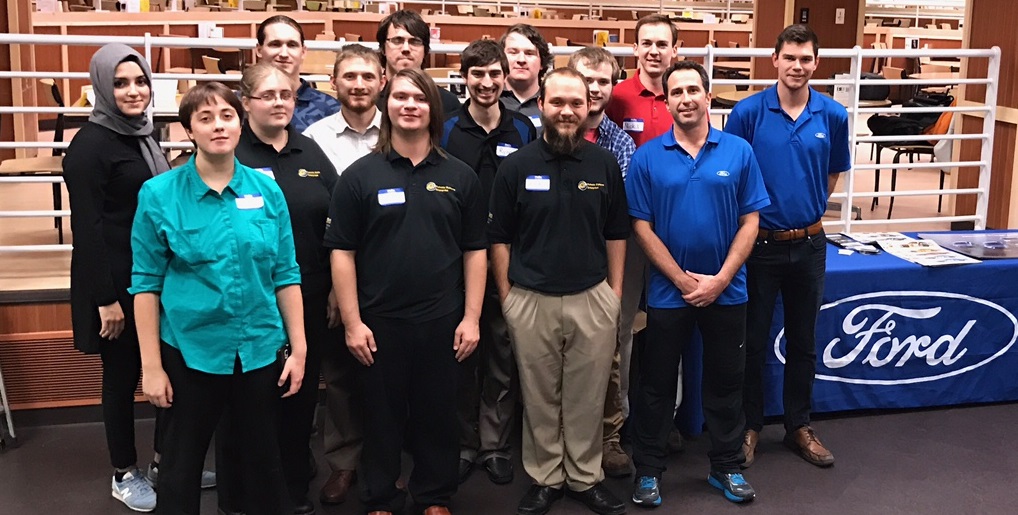 ECE’s Robotic Systems Enterprise (RSE) was host to the first annual Controlathon sponsored by Ford Motor Company on Saturday, November 12. Ten teams competed in the inaugural one-day event held on the Michigan Tech campus, Memorial Union Building.
Ford’s purpose of the event was to raise the interest of controls engineers in the automotive industry. The students competed against each other as individuals or teams to see who could program an Arduino-based robot to complete pre-assigned tasks, such as solving a maze and following an object. The goal of the Controlathon was to create a unique solution to the presented problems in a limited amount of time. The teams were tasked to complete three separate events, scores were assigned for each event.
At the end of the day, Sirius Cybernetics came away with first place; 2nd Desert, 3rd 2CS & an EE, 4th C Dogs, and 5th place was Team Mine.
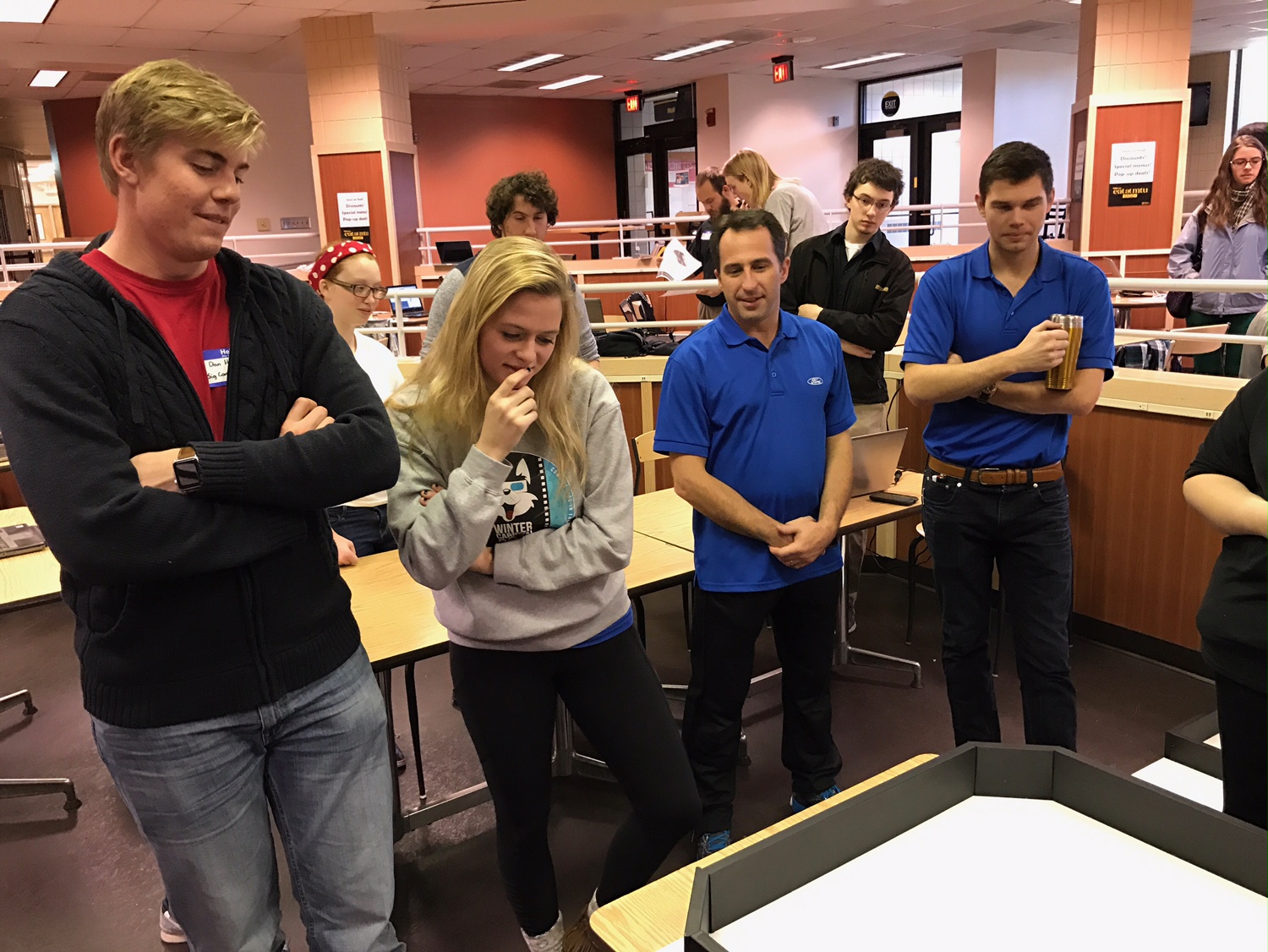
RSE is advised by Dr. Glen Archer.
Check out @mtuECE for more highlights from the event.
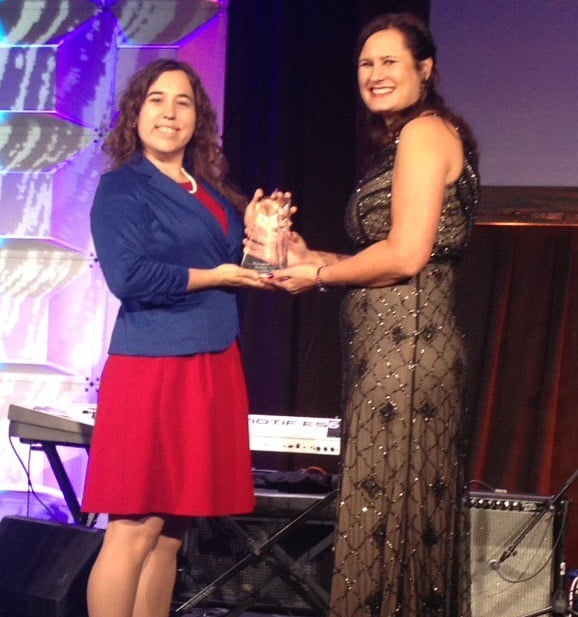
Elizabeth (Cloos) Dreyer, BSEE 2012, was selected SWE Outstanding Collegiate Member by the Society of Women Engineers for outstanding contribution to SWE, the engineering community and their campus. Dreyer was honored at the WE16 conference held in Philadelphia, PA this past week.
Elizabeth is an electrical engineering PhD candidate at University of Michigan.
The ECE Department at Michigan Tech congratulates Elizabeth for this well-deserved recognition!
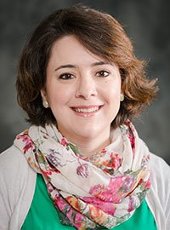
Lucia Gauchia (ECE, ME-EM) discusses graphene batteries in a Business Insider post about Henrik Fisker’s new electric car model. A number of other business, tech and science news media picked up the story including Yahoo! News, the San Francisco Chronicle, seattlePI.com and Latest Nigerian News.
We took a closer look at the battery technology Fisker is promising to use, which he refers to as “the major leap, the next big step.”
Rather than working with conventional lithium-ion batteries, Fisker is turning to graphene supercapacitors.
Graphene is both the thinnest and strongest material discovered so far.
“Graphene shows a higher electron mobility, meaning that electrons can move faster through it. This will, e.g. charge a battery much faster,” Lucia Gauchia, an assistant professor of mechanical engineering and energy storage systems at Michigan Technological University, told Business Insider. “Graphene is also lighter and it can present a higher active surface, so that more charge can be stored.”