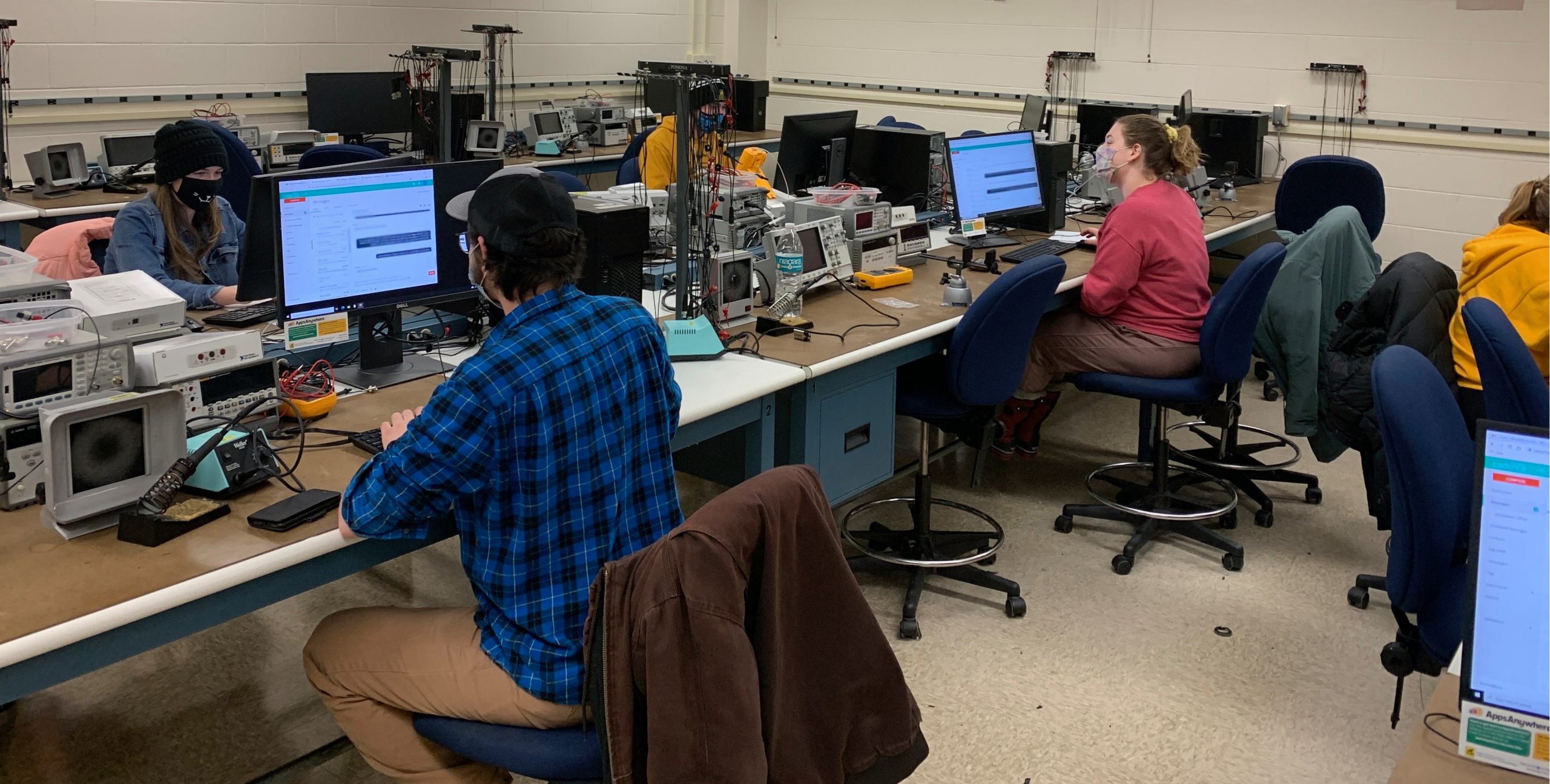
ECE student volunteers reached out to nearly 300 prospective students last week in the first texting campaign of the year. Volunteers answered a wide range of questions such as, “What has been your favorite class?” and “How hard IS college actually?” and “Why do you like Michigan Tech?” Photo credit: Liz Fujita, ECE academic advisor and outreach specialist.
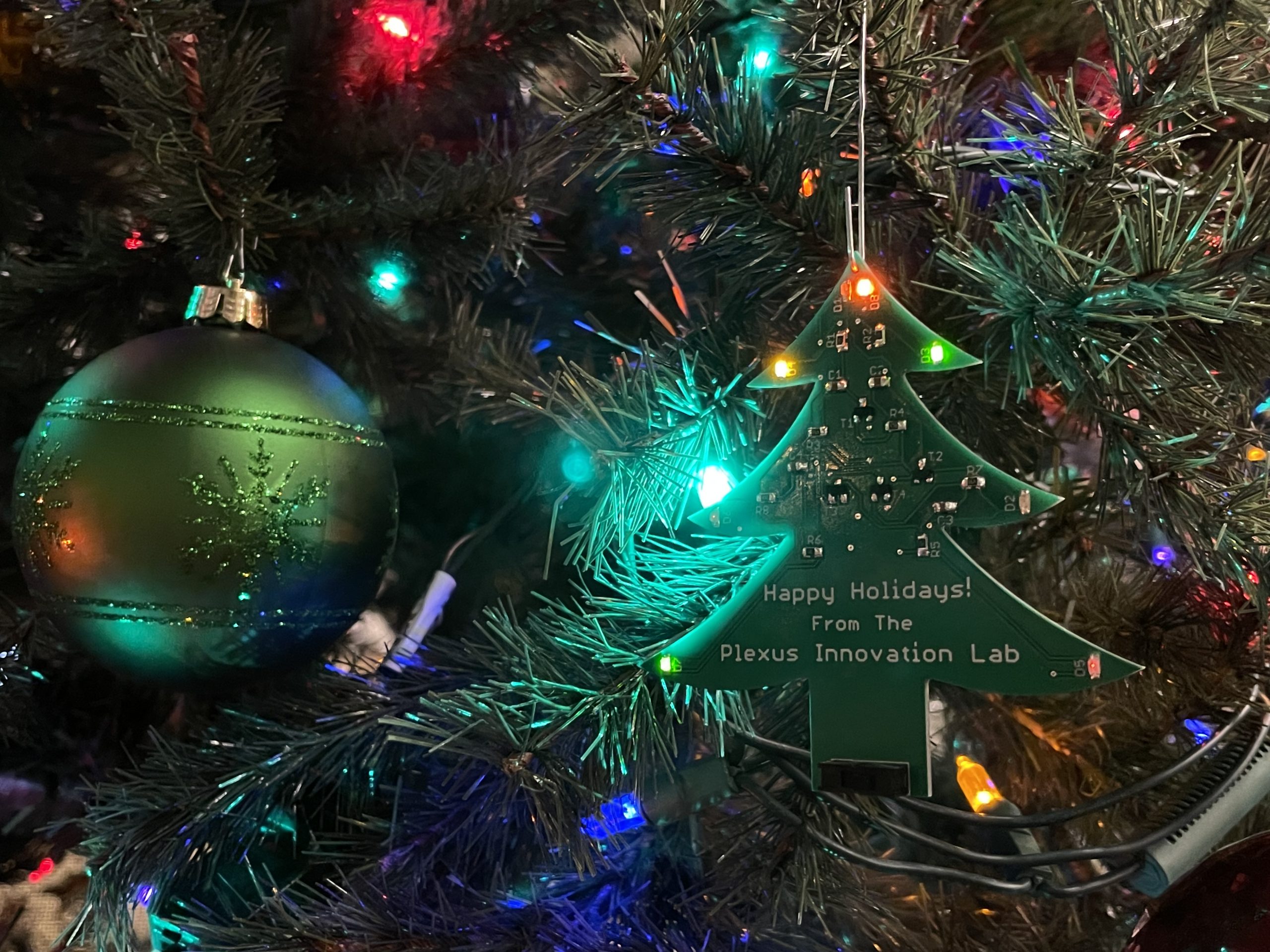
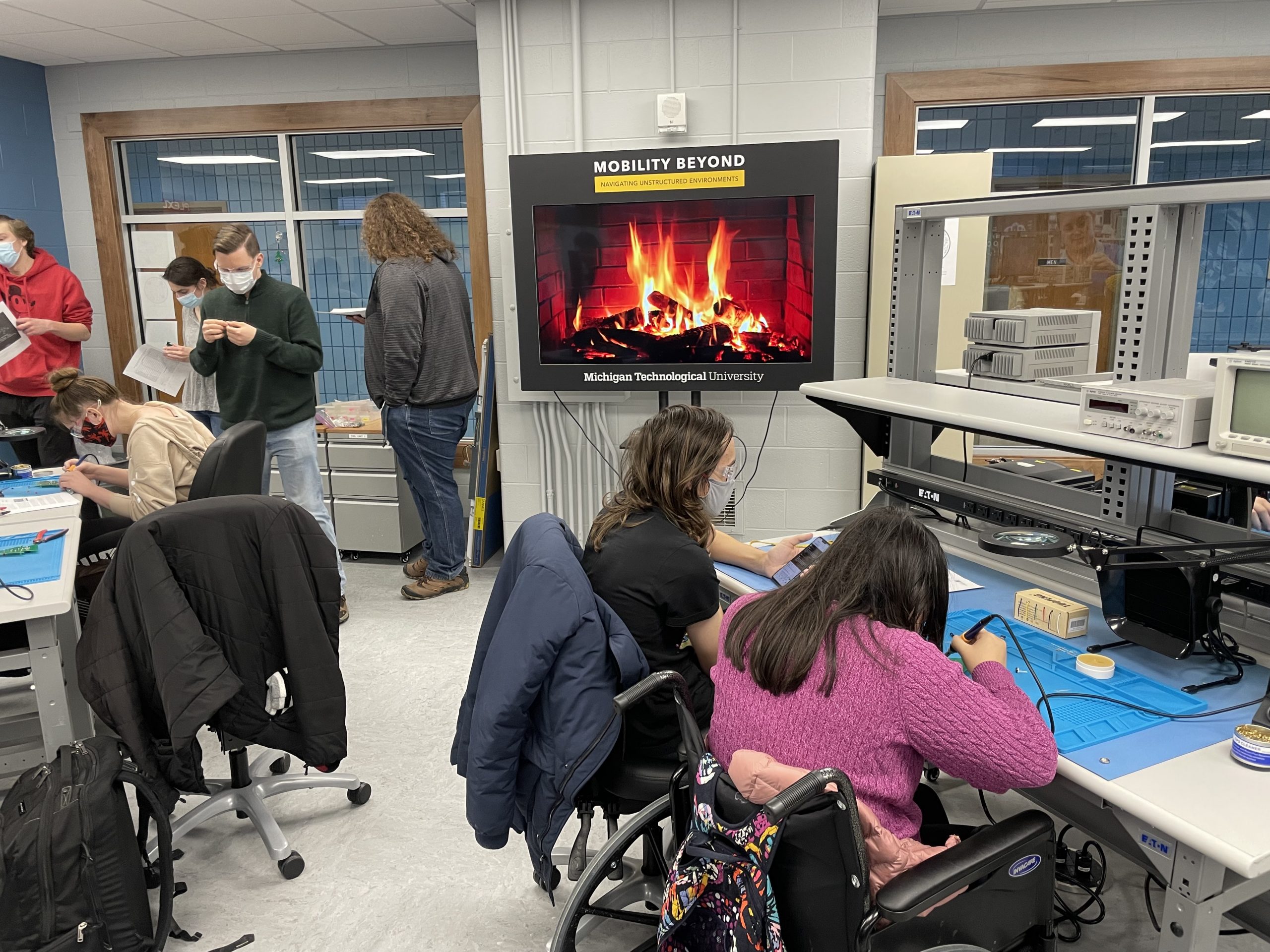
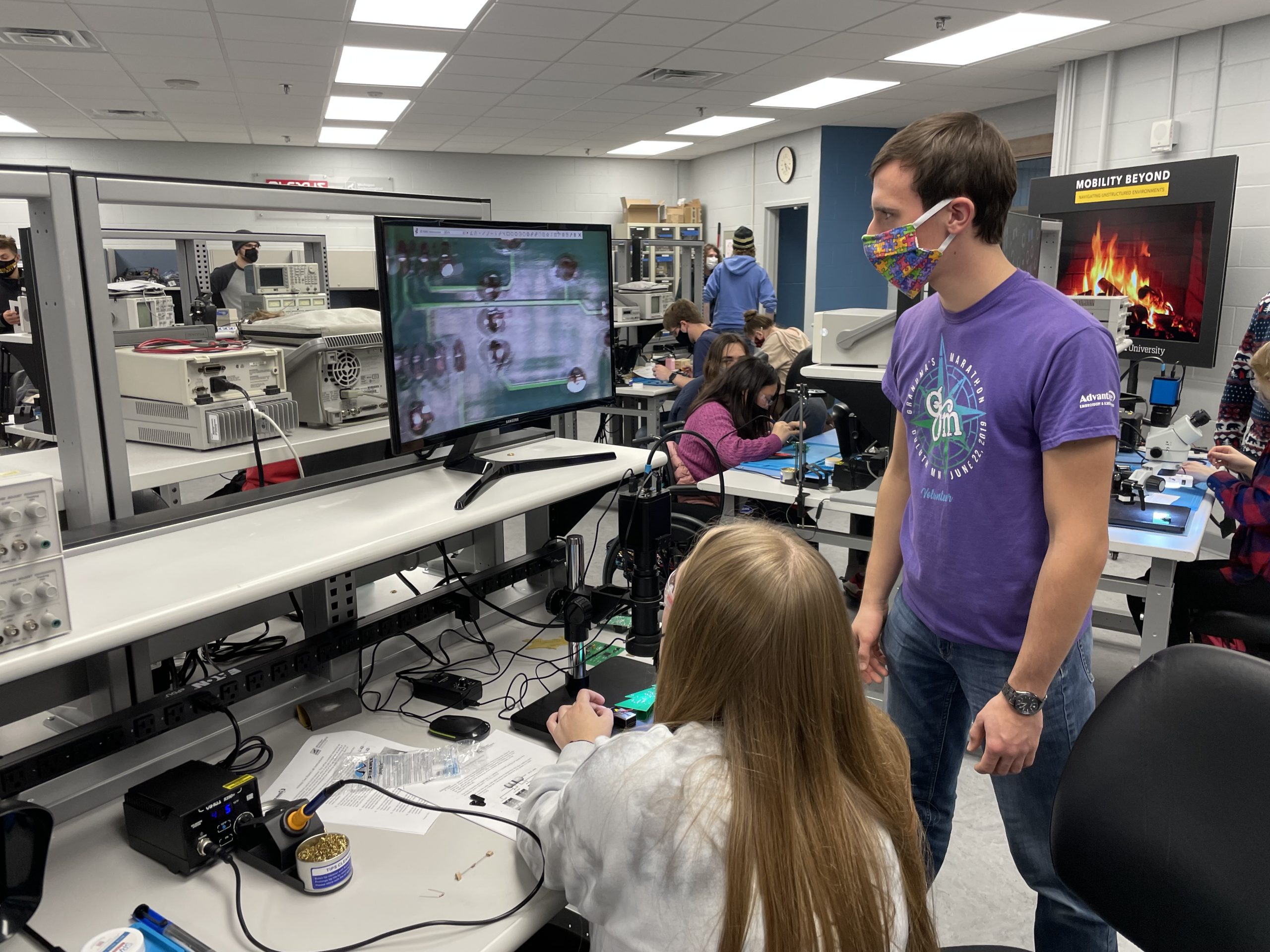
Participants gathered in the Plexus Innovation Lab late last week to create Christmas tree ornaments, an event sponsored by the IPC & Electronics Student Chapter at Michigan Tech with some help from the Blue Marble Security Enterprise. Pictured are students creating their ornaments using the pick and place machines within the lab, and others optically inspecting the boards’ soldered connections to detect and identify defects. https://www.involvement.mtu.edu/organization/ipc-electronics
Husky Innovate Students Win Top Prizes in New Venture Online Competition
For the 11th year running, Central Michigan University and Michigan Tech collaborated to offer Tech students a chance to compete at CMU’s New Venture Competition. 2021 marked the second year the pitch competition was held online as the New Venture Online Competition (NVOC).
Despite the challenges of a pandemic and a virtual platform, our students persevered, honed their pitches and won top prizes. This year’s NVOC winners were also winners at the 2021 Bob Mark Business Model Pitch Competition held at Tech in January. All of their hard work and effort paid off!
Congratulations to this year’s MTU winners:
- In the 2020-track 10-minute pitch category, Team Focus with Ranit Karmakar won the Best Overall Venture Award for $25,000. Watch Karmakar’s pitch. Karmakar is a PhD student in Computer Engineering.
- In the two-minute pitch category, Team The Fitting Room with Jordan Craven won third place for $1,000. Watch Craven’s pitch.
- Team Recirculate with Hunter Malinowski won an honorable mention award for $750. Watch Malinowski’s pitch.
Read more in the NVOC 2021 Booklet.
By Husky Innovate.
Outstanding students, staff, and a special alumni were honored Friday (April 16, 2021) during Michigan Tech’s 27th Annual Student Leadership Awards Virtual Ceremony.
Anna Browne was selected to receive the President’s Award for Leadership. Brown is pursuing a degree in electrical engineering with a concentration in electrical power. She has shown excellent success during her time as a student. Her involvement and contributions to Michigan Tech’s campus are numerous and cast such a wide net as shown in her 13 nominations.
Anna, who has had multiple internships at Black & Veatch and Westwood Professional Services, has served in project and team leader roles with the Alternative Energy Enterprise on projects like the Baraga Community solar and the on-campus mine water geothermal system. She’s been an active part of the residence education and housing services community as a senior student resident assistant and resident assistant for three years.
She’s also been a valuable contributing member to the Center for Diversity and Inclusion community. Anna has left a mark on Michigan Tech’s community. In her essay she writes how she strived to be a role model for others through community building.
She wrote, “Through my Michigan Tech Experience, my values of leadership, community, openness, and integrity have been demonstrated through every aspect of my involvement. In trying to create a supportive community, I have strived to give a sense of comfort and belonging to those without a place. Michigan Tech has helped me find my values and my identities, and I hope through my involvement that I have left a positive mark on Michigan Tech as it has left on me.”
By Student Leadership and Involvement.
Outstanding students, staff, and a special alumni were honored Friday (April 16) during Michigan Tech’s 27th Annual Student Leadership Awards Virtual Ceremony.
Keynote speaker Kaitlyn Bunker ’10 ’12 ’14 (BS, MS, PhD Electrical Engineering), won the Outstanding Young Alumni Award along with Megan Kreiger ’09 ’12 (Mathematics and Materials Science and Engineering).
By Student Leadership and Involvement.
Dr. Anindya Ghoshroy (PhD ’20) begins the new year with a postdoctoral researcher position at California Institute of Technology. Ghoshroy will be working under the direction of Dr. Lihong Wang, a world-renowned researcher in the imaging field, and the inventor of the fastest optical technology in the world, called compressed ultrafast photography (CUP), capable of 10 trillion frames per second.
Wang and Ghoshroy are interested in the next big step – investigating the near field implementations of ultrafast photography, and the resolution of nanoscale transient scenes. An integration of the CUP framework with “active convolved illumination” (ACI), an image-capturing technology that Ghoshroy and his PhD advisor Dr. Durdu Guney have been developing, and will potentially lead to a significant first step towards this direction.
ACI, being immune to “noise” will potentially enable imaging of live cells, virus, and bacteria with fine details, not accessible with the state-of-the-art imaging systems.
On a Mission to Make Hundreds of Outreach Kits, ECE Hosts Work Bees
by Liz Fujita
On multiple evenings in October, the lab space in EERC 722 was the image of organized chaos. Bags of LEDs, resistors, capacitors, switches, and batteries spilled out on lab benches, waiting to be counted out into bags. Soldering irons heated up, fume-extracting fans whirring. Empty boxes steadily filled with kits ready to bring to pre-college students. With 600 hands-on outreach kits to prepare, the Department of Electrical and Computer Engineering has been hard at work this fall with the help of phenomenal student volunteers, and there is still plenty more to go.
Interim chair Dr. Glen Archer is the PI on a grant from the Michigan Space Grant Consortium (MSGC) for the 2020-21 academic year that focuses on getting electrical engineering projects out to pre-college students at multiple levels. Along with co-PI Dr. Gretchen Hein (MMET) and academic advisor Liz Fujita (ECE), the program centers on multiple layers of mentorship.
“It’s an ambitious idea,” says Fujita, who in addition to advising helps to coordinate outreach efforts in the ECE department. “Michigan Tech has a lot of successful outreach programs that rely on this idea of near-peer mentoring—that idea that college students presenting information is more engaging, cooler, and better-received by high school students.” The MSGC proposal calls for several layers of near-peer mentoring to take place at several schools:
College students teach high school students how to solder and the basics of electronic components with the heart rate monitor boards.
Under the guidance of those college mentors, the high school students teach middle school students similar skills on the (slightly easier) tree circuit boards.
And, lastly, the middle schoolers take bouncy bot kits to their elementary school to teach 4th and 5th graders the basics of circuits.
All of this requires a tremendous amount of preparation. In October alone, members of Blue Marble Security Enterprise and the Society of Women Engineers spent a combined 50+ hours soldering, counting, stuffing bags, and organizing materials.
ECE has on multiple occasions joined forces with the Society for Women Engineers. Funding for this project includes support for not only the activity kits themselves (circuit boards, LEDs, resistors, batteries, etc.), but also for soldering stations, storage bins, and travel to schools in the local area as well as downstate. The combined funding secured by SWE and ECE will enable them to prepare 200 of each activity kit.
Notes Archer, “Near-peer mentoring allows younger students to picture themselves in a future state. They see this person in front of them and imagine their own life, in that role.” Although current COVID-19 restrictions leave the group unsure of when they will be able to visit schools, they remain optimistic. And, as work bees continue, they will be more than ready!
Associate Professor Chee-Wooi Ten, Electrical and Computer Engineering, recently finalized contracts to write two books for CRC Press, a major publisher of humanities, social science, and STEM books and textbooks. Ten is a member of the Institute of Computing and Cybersystems’s Center for Cyber-Physical Systems.
The first book is titled, Electric Power Distribution System Engineering, 4th edition. Ten has been teaching EE5250 Distribution Engineering I at Michigan Tech for 10 years.
The second book, Modern Power System Analysis, 3rd Edition, is used to accompany a senior-level power engineering elective. Both books are tentatively scheduled to be published in January 2022.
Read more at the Institute for Computing and Cybersystems, by Karen S. Johnson.
Chris Middlebook (ECE) was one of the winners of the Gentec-EO Laser Lab Awards. Middlebrook won a Beamage-4M laser beam profiler.
The Gentec-EO Laser Lab Awards contest aims to support optics laboratories in universities and colleges in the United States. Its goal is to ensure students have access to the same quality measurement instruments that are used today in the industry.
A Michigan Tech team is among the winners of the SICK Inc. TiM$10K Challenge. For the second year, students from universities around the country were invited to participate in the challenge, designed to support innovation and student achievement in automation and technology.
For the competition, teams were supplied with a 270-foot SICK LiDAR sensor and accessories, and challenged to solve a problem, create a solution or bring a new application to any industry that utilizes the SICK LiDAR.
The Tech team members — Brian Parvin, Kurtis Alessi, Alex Kirchner, David Brushaber and Paul Allen — earned Honorable Mention (fourth place overall) for their project, Evaluating Road Markings (the Road Stripe Evaluator). The innovative product aims to help resolve issues caused by poor road markings while reducing maintenance costs and improving motorist safety.
Each team was asked to submit a video and paper for judging upon completion of its project. A panel of judges decided the winning submissions based on creativity and innovation, ability to solve a customer problem, commercial potential, entrepreneurship of the team, and reporting.
“This was a unique project in that the team was required to identify a problem and develop a solution to it that is based on SICK’s TiM LiDAR — most teams are handed a problem and asked to create a solution,” said team advisor Tony Pinar, senior design coordinator in the Department of Electrical and Computer Engineering. “I think this format allowed the team to exercise even more innovation than a ‘typical’ project.”
Pinar said the team was well organized and demonstrated an excellent work ethic from day one. “It was exciting to watch them identify a salient problem and develop a functional proof-of-concept solution despite the setbacks that affected us all after spring break,” he said.
SICK is one of the world’s leading manufacturers of sensors, safety systems, machine vision, encoders and automatic identification products for industrial applications.