
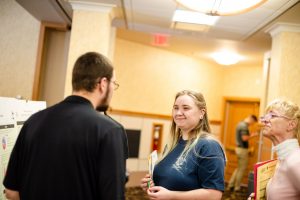
 If you want to know if you have a passion for something, you should gain experience in it. Thankfully, Michigan Tech’s University Marketing and Communications department, or UMC, was my opportunity. I spent the past two semesters working in the department as a student writer. I had come into it with no idea what I would gain, but left with some important lessons.
First: planning. Being a college student already requires balance, but put a job on top of that and you have someone in need of Google Calendar. After adding in time for interviews, writing, and meetings, my time soon became thin. Meeting deadlines and creating content I was proud of was crucial to me. If I didn’t make the time, then the words would be bland and unimaginative.
Then I moved into learning about communication. There are so many people within the UMC, from writers to editors to those that make the content accessible. Making sure people know your intentions and plan of attack clearly is important. While this was great to learn, I also found out that sometimes people just won’t answer you and there is nothing that you can do about it.
Lastly, I would say I gained much more respect for people in my field. Of course, not being a part of it before meant I never knew much, but I didn’t realize the amount of work put in. It opened my eyes for me to see that writing wasn’t something that anyone could do, but something people with passion could do. Those who helped make my writing better knew exactly where I was at and gave wonderful ideas to aid me. If it wasn’t for them, I’m not sure I would have continued to love writing. The UMC made me fall in love with being a writer all over again.

 The Department of Humanities congratulates
  Anna K. Swartz, a graduate of Rhetoric, Theory & Culture, participated as an invited panelist at the 2018 Saks Institute for Mental Health Law, Policy and Ethics Spring Symposium: “Held Against My Will: Conversations About Involuntary Commitment and Forced Treatment” at the University of Southern California Gould School of Law in Los Angeles, California on April 16.
 Nancy Henaku, a fourth-year Ph.D. student in the RTC program, has received one of three inaugural Feminist Research Grants awarded by the Coalition of Feminist Scholars in the History of Rhetoric and Composition. This will support her travel to archives for her dissertation research on the rhetoric of Nana Konadu Agyeman-Rawlings, the first female candidate for president of Ghana. The review committee “expressed great enthusiasm for [her] dissertation project, which is poised to bring important perspective from the global South and specifically from Ghana to ongoing research in transnational feminist rhetoric.”
 Brilliant Books in Traverse City, recently interviewed Rhetoric, Theory and Culture PhD student, writer and poet Edzordzi Agbozo about his writing. Two of Agbozo’s poems appear in the spring 2018 issue of Northern Michigan’s premier literary journal, Dunes Review. See the full interview
  RTC PhD student Sarah Potter received a top paper award and presented the paper on the panel, Top Papers in the Communication Ethics, Activism, and Social Justice Interest Group at the Central States Communication Association Conference. The paper title is “Different Rights (in)Different Times: Rendering the Invisible Visible in a Comparative Iconographic Analysis of the Women’s Suffrage Parade of 1913 and the 2017 Women’s March on Washington.” She was also a panel member for the graduate student discussion session, “When the Experts Don’t Agree: Navigating Differences in Faculty Advice.” The conference was held April 5-8, 2018 in Milwaukee, Wisconsin.