Category: students

RTC Research Forum: “Rediscovering Ownership and Agency: Shifting from Private to Public Performance” Lior Rosenfeld

What:

The RTC Research Forum, formerly known as the RTC Brown Bag, is a colloquium series sponsored by the Rhetoric, Theory, and Culture graduate program in the Michigan Tech Department of Humanities. Each month, faculty and students in the program present research on a wide range of topics. The forum offers an opportunity for colleagues and peers to discuss current research, prepare for formal conference presentations, and for students to receive feedback on presentation practices.

Abstract:

The claims made by technology companies regarding the advancement of autonomous machines raise significant concerns about their implications for democratic governance. A machine that is capable of independent thought and action poses a potential threat to democratic judicial and political systems, as it undermines the autonomy of the people. Drawing on phenomenological insights, I will first clarify why some of these concerns may be misplaced by emphasizing that autonomy must be achieved rather than presupposed. I will then argue that the recent deployment of Artificial Intelligence (AI) systems highlights that ownership and agency are constituted through public speaking rather than being intrinsically tied to autonomy or self-rule. While the former gives the power to begin anew, the latter is marked by territoriality, exploitation, and coercion.

An autonomous entity supposedly possesses an identity, always returns to itself since it thinks—calculates the world independently of social-political engagements. As such, it remains unaffected by contingency, allowing it to justify its beliefs and actions through established rules. Additionally, autonomy presupposes agency, as a self-ruling entity is necessarily the cause of its own actions. And as Jacques Derrida explains, since the people in a democracy are autonomous or self-rulers, they have the force to determine the law (Derrida, 2025, p.13). In contrast, in our liberal tradition, which dates back to John Locke, democratic citizens are seen as individuals or natural entities, and therefore free from legal constraints. This freedom grants them the right to own property and other natural rights, empowering them to resist any claims of ownership made by authorities. However, with the rise of AI systems, individuals in democratic nations are increasingly losing their natural rights. The reduction of experience to thinking—calculating across all sectors by AI systems violates individual rights, for instance, by scraping texts without the authors’ consent. Moreover, due to the widespread use of AI systems, nation-states can no longer effectively protect copyrights. As Derrida argues in the context of cloning, techno- scientific reason undermines today its foundation—the nation-state, which is responsible for distributing rights and protecting the dignity of its citizens (Derrida, 2005, p. 146).

The deployment of AI systems increasingly blurs the distinctions between nation-states and private technology companies. This phenomenon indicates a potential erosion of the nation-state’s power in contemporary governance and social organization. Nevertheless, the support that nation-states extend to technology companies developing artificial intelligence systems that exploit and oppress their citizens is not merely a historical phenomenon; rather, it reflects an intrinsic characteristic of any entity that claims autonomy. As the political writings of Derrida and Hannah Arendt illustrate, autonomy is constituted by private performances within the household, which can therefore be authoritative, ethnic, and exploitative. However, Derrida’s deconstruction of democracy illustrates that citizens can achieve democratic autonomy by responding to the imperative of justice and, thereby, superseding familial, natural, and irrational laws.

According to Derrida, the conflict between the rule of law and freedom within modern democracy is irreconcilable. The question of what a democratic citizen is — whether a subject of the law or a free individual — remains undecided. This undecidability allows citizens to face one another, constituting an ultra-political experience. Within this pluralistic and uncertain realm of meaning, complete autonomy—independence from contingency is unattainable. As a result, the concept of equality under the law, the meaning of justice in a democracy, turns unfounded, uncovering justice as fundamental. Since justice cannot be ruled, justice calls democratic citizens to rule, thereby achieving autonomy.

However, claims for justice lack the necessary political power to effectively resist an AI regime. According to Arendt, public speaking or public performances enact intersubjective political experiences which are fundamental to selfhood and agency, and therefore the meaning of the power of the demos. Public speaking is non-territorial, allowing citizens to appear before others unconditionally and to act uniquely. Moreover, since public performances are contextual, the self always appears anew, simultaneously generating the past and the future. The temporality of shared existence, which Arendt refers to as natality, constitutes the process of narration, calling to keep a record. Thus, public performance is agonistic—pluralistic, giving rise to new senses of self and agency, in contrast to private performance, which constitutes self-mastery and, therefore, is antagonistic—divisive.

Who:

Presented by RTC PhD canditate Lior Rosenfeld.

Lior Rosenfeld obtained an M.A. in Philosophy from the New School in 2020. Currently, Lior is a fourth-year Ph.D. Candidate at Michigan Technological University. In his research, Lior investigates how the phenomenological description of the life-world alleviates the tension between democracy and science as illustrated by contemporary examples such as climate change denial and vaccine skepticism.

All are welcome to attend!

When:

Friday, December 5, 2025

Where:

Petersen Library, Walker Arts & Humanities Center

RTC Research Forum: “Language and Artificial Understanding: Stress Tests for the Uniqueness of Human Intelligence” Ronald Klingler

What:

The RTC Research Forum, formerly known as the RTC Brown Bag, is a colloquium series sponsored by the Rhetoric, Theory, and Culture graduate program in the Michigan Tech Department of Humanities. Each month, faculty and students in the program present research on a wide range of topics. The forum offers an opportunity for colleagues and peers to discuss current research, prepare for formal conference presentations, and for students to receive feedback on presentation practices.

Abstract:

This essay concerns contributions made by David Braine  in Language and Human Understanding (2014) and their bearing on contemporary discussions of artificial intelligence. The first is his proposal that human linguistic capacity has the shape of sense as understood by James J Gibson, where senses must be understood in their relation to the organism as a whole, and that organism must be understood in relation to its environment. The second is his understanding of Wilhelm von Humboldt’s famous line that “language makes infinite use of finite means,” where he takes the infinity to mean indefinite, contrary to the more common recursive interpretation. These contribute to a third regarding malleability and the brain, where its plasticity reaches such an extent that pragmatics and semantics begin to determine, rather than be determined by, neurological structures. Braine takes this malleability to be distinctively human. From the view of 2014, he argued “it will still never be possible for the statements of linguistic science to enable one to calculate or compute the linguistically public significance or sense of the utterances we make” (149). Here I assume Braine’s three contributions, but put pressure on his proposition of computational-impossibility in light of the advances in artificial intelligence in the years since. From the view of today, Braine’s account of malleability reads as anticipatory of LLMs. I argue that the primary intuition-pump he uses to explain malleability cannot differentiate what’s distinctly human from contemporary machine learning attempts. I question whether it matters whether the significance is computable, or if probabilistic attempts can approximate said significance to an arbitrary degree; I argue Braine’s view can defend against this. I also consider advancements in embodied and multimodal reasoning, and whether they can imitate the environmentally oriented nature of speech in Braine’s proposal; I consider this the strongest possibility for defending the uniqueness of language.

Who:

Presented by RTC PhD student Ronald Klingler.

Ronald Klingler is a PhD student in the Rhetoric, Theory, & Culture program. He considers the positions around the uniqueness of human language use, and evaluates them in light of recent advances in artificial intelligence. 

All are welcome to attend!

When:

Friday, October 24, 2025

Where:

Petersen Library, Walker Arts & Humanities Center

RTC Research Forum: “Vital Necroscenes: Internet Memes as Visual Tools for Environmentalism” Samantha Stein-Brevitz

What:

The RTC Research Forum, formerly known as the RTC Brown Bag, is a colloquium series sponsored by the Rhetoric, Theory, and Culture graduate program in the Michigan Tech Department of Humanities. Each month, faculty and students in the program present research on a wide range of topics. The forum offers an opportunity for colleagues and peers to discuss current research, prepare for formal conference presentations, and for students to receive feedback on presentation practices.

Abstract:

Understanding how we can approach environmentalism from a humanities perspective calls for an interdisciplinary approach that encompasses not only our place in the world but everything’s place in the world—human and non-human. There is no question about the cruciality of a comprehensively ethical and conscious means of interacting with the planet. There have been multiple attempts and approaches to a better method to the human ways of existing on this planet. Recognizing how to course correct is easier said than done, however. This concept is large and, in and of itself, sublime. The visual analysis offered in this work will specifically work to break down and interpret common, widespread Internet meme formats, thus presenting how they can evoke a need for environmentalism in daily life. The pieces guiding my research are the “This is fine” dog as well as a variant of another common Internet meme, Spiderman(s) pointing at himself. Though these works are ambiguous and can be used in multiple contexts, the power of their messages can be used to approach a call for better environmentalism. Additionally, it reiterates the very real threat of contemporary climate disasters which can thus be used to reexamine the power and vitality expressed within these Internet memes. Guiding my definition and understanding of the vital necroscene, I specifically connect Immanuel Kant’s Critique of Judgement with Jane Bennett’s Vibrant Matter as well as Jill H. Casid’s “Necrolandscaping”. Both Kant, Casid, and Bennett emphasize the limitlessness in life and in death. Additionally, Kant writes about the judgment that is assigned to Nature. Nature, he insists, is viewed as this aimless mechanism—though it should not be that way. Taking this notion of purposiveness, I connect it directly to the attempts made by vital materialism and the necroscene to dismantle and trouble the black/white binary of life. The goal of vital materialism is to present the purposiveness within non-human phenomena. Further, these concepts connect to demonstrate that Nature is an assemblage of multiple and boundless human and non-human actants—to borrow from Bruno Latour. The presented research aims to demonstrate ways Internet memes can evoke a vital necroscenic approach, creating more awareness for the call to environmental humanities. In understanding the vitality of Internet memes, we can develop an understanding and potentially even an increased appreciation for the interconnectedness of both human and non-human lives.

Who:

Presented by RTC PhD student Samantha Stein-Brevitz.

Samantha’s research aims to explore the connections between Internet memes and the necrocene that is the death of the planet. Through humor, Internet memes serve as a communication tool to emphasize the vital need to recognize and act on planetary crises and assist in dismantling Nature vs Human. In an effort to evoke change, the images presented show the irony that “this is fine” and life goes on. 

All are welcome to attend!

When:

Friday, September 19, 2025

Where:

Venue changed to Petersen Library, Walker Arts & Humanities Center

Presentation Focuses on User Experience Collaborations In the Applied Chemical and Morphological Analysis Laboratory

Timothy Keirnan, Assistant Teaching Professor of Humanities
Timothy Keirnan, assistant teaching professor of humanities
Liz Miller, 
Director of The Applied Chemical and Morphological Analysis Laboratory (ACMAL)
Liz Miller,
ACMAL director

Presented by the RTC Brown Bag Program
November 8th, 2024, noon–1:00 p.m.
Petersen Library, Walker 318

Timothy Keirnan, assistant teaching professor in the Humanities Department, and Applied Chemical and Morphological Analysis Laboratory (ACMAL) Director Liz Miller will present a case study of collaboration between Humanities and Material Science at the next Brown Bag Program presentation. ACMAL is a facility serving both Michigan Tech and external researchers that houses an extensive array of electron microanalytical and X-ray instruments. Services are available for user training, sample preparation, and sample analysis. The collaboration with ACMAL focuses on the piloting of a new software application, Facility Online Manager (FOM), to help facilities across Michigan Tech manage their equipment and lab spaces to better serve students, faculty, and staff.

In cooperation with Assistant Teaching Professor Jenni Nance and her HU3121 students, Keirnan wrote FOM user guides for both students and lab supervisors. Nance and her students will be on hand for the presentation to lend their perspectives on the combination of service work and student projects for Michigan Tech’s Scientific and Technical Communication program. Keirnan and Miller are currently collaborating on the navigation and UX (user experience design) writing of the new FOM website, which will be rolled out to the university in the near future. They’ll also discuss future collaborations to measure and enhance the ACMAL customer experience.

Lindsay Hiltunen Appointed to Ottawa National Forest Resource Advisory Committee

RTC PhD student and archivist in the University Archives, Lindsay Hiltunen, has been appointed to the advisory committee for the Ottawa National Forest.


University Archivist Lindsay Hiltunen (VPOL) has been appointed by Secretary of Agriculture Thomas Vilsack to the new Ottawa National Forest Resource Advisory Committee (RAC). Members of the RAC are vetted and designated by the secretary of agriculture and meet under Federal Advisory Committee Act regulations. All meetings are open to the public.

A Secure Rural Schools RAC provides recommendations to the U.S. Forest Service on the development and implementation of special projects on federal lands as authorized under the Secure Rural Schools Act and Community Self-Determination Act in Public Law 110-343. This act was most recently reauthorized for two years by section 41202 of Public Law 117-58 (Infrastructure Investment and Jobs Act) and signed into law by President Joe Biden on Nov. 15, 2021.

Vilsack appointed Hiltunen, along with 14 others, to serve four-year terms on the Ottawa National Forest RAC. The inaugural meeting will be called in summer 2024.

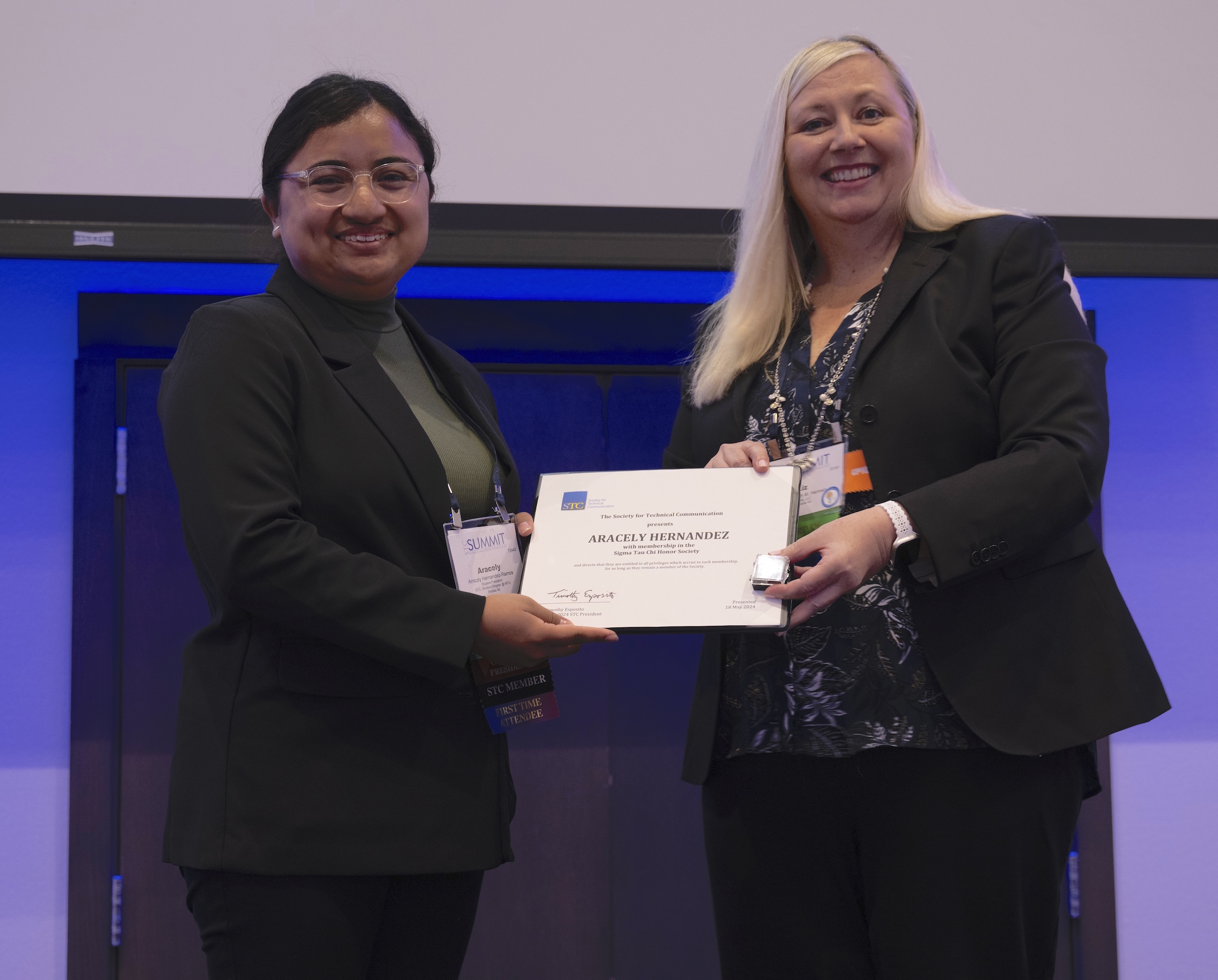
Hernandez-Ramos Inducted into STC Student Honorary Society

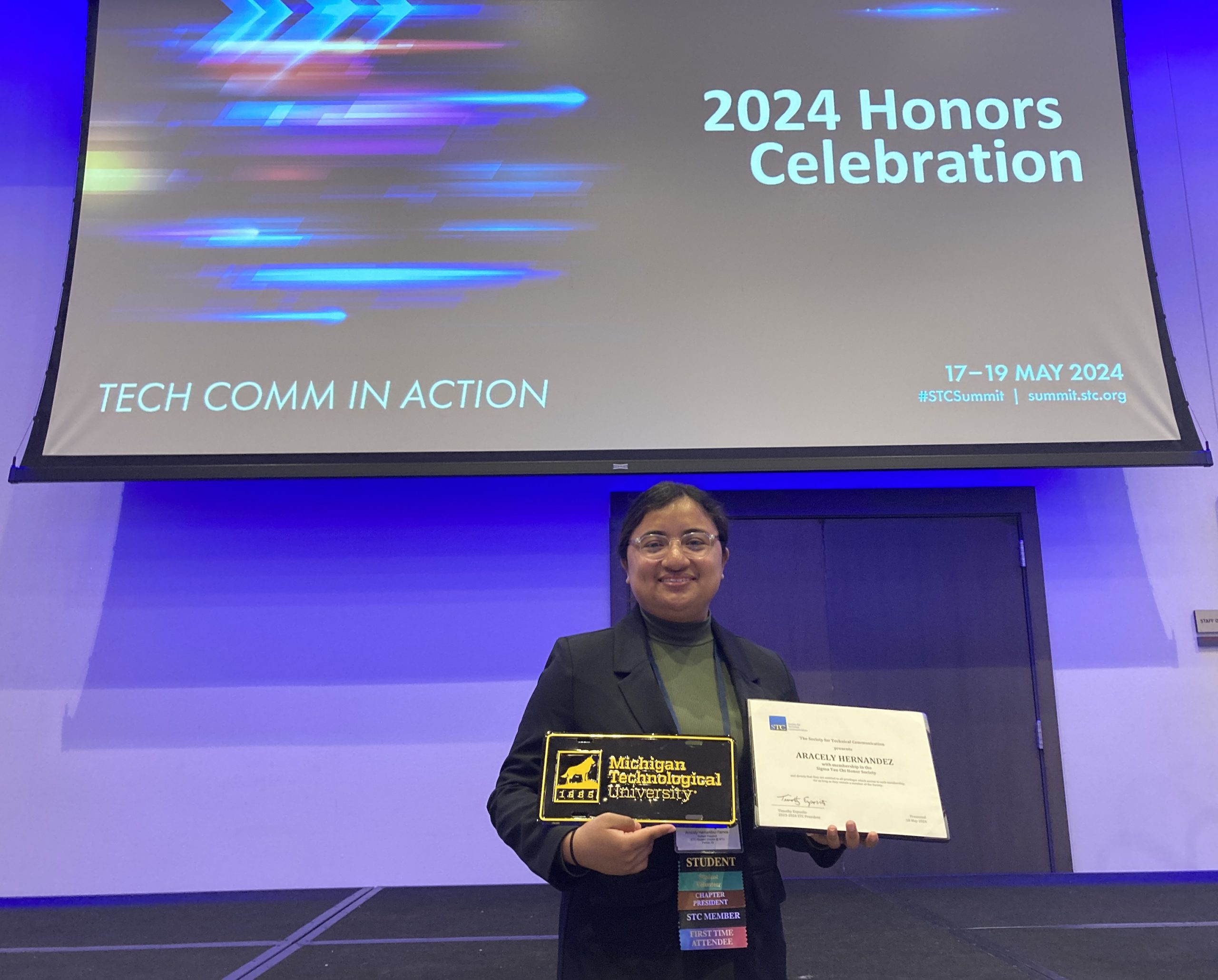
Scientific and Technical Communication major Aracely Hernandez-Ramos was inducted into the Society for Technical Communication’s student honorary society Sigma Tau Chi.

Aracely Hernandez-Ramos was inducted into the Society for Technical Communication’s student honorary society Sigma Tau Chi in a ceremony at the society’s annual conference on May 18th. Membership into the society is an honor awarded to students enrolled in a technical communication program who “[…] have a cumulative grade point average of 3.5 or above, are exemplary in participation in STC, and demonstrate a potential for significant contribution to the profession. In 2024, only two STC student members were awarded this distinction.”

Hernandez-Ramos is an undergraduate in humanities’ scientific and technical communication program, as well as the president of MTU’s student chapter of the Society for Technical Communication. She is also a coach at the Michigan Tech writing center, and can commonly be seen around the department.

Our heartfelt congratulations to Aracely!

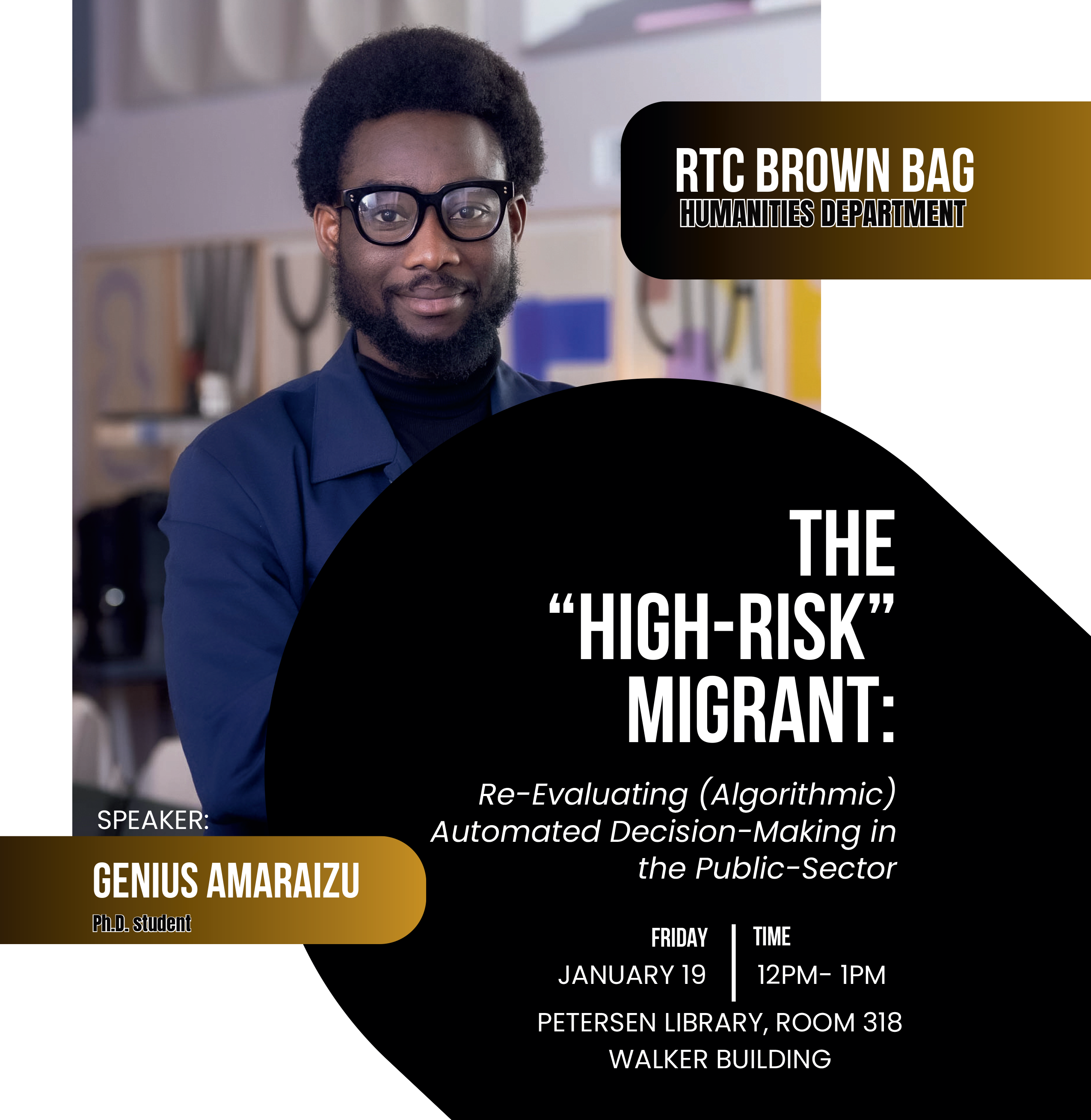
Brown Bag Talk: The “High-Risk” Migrant: Re-Evaluating (Algorithmic) Automated Decision-Making in the Public Sector

What:

Abstract:

For almost a decade, the Netherlands secretly used the variables of gender, nationality, and age, to profile migrants as “high-risk,” subjecting them to extensive investigations and eventual visa denial in many cases. Drawing from frameworks of algorithmic episteme, and algorithmic inclusion and exclusion, this presentation examines algorithmic deployment in the public sector.

Who:

Presented by PhD Student Genius Amaraizu

All are welcome to attend!

When:

Friday, January 19 2024

Where:

Petersen Library, Walker Arts & Humanities Center

Play The “High-Risk” Migrant: Re-Evaluating (Algorithmic) Automated Decision-Making in the Public-Sector video
Preview image for The “High-Risk” Migrant: Re-Evaluating (Algorithmic) Automated Decision-Making in the Public-Sector video

The “High-Risk” Migrant: Re-Evaluating (Algorithmic) Automated Decision-Making in the Public-Sector

Congratulations to Humanities 2024 Graduates!

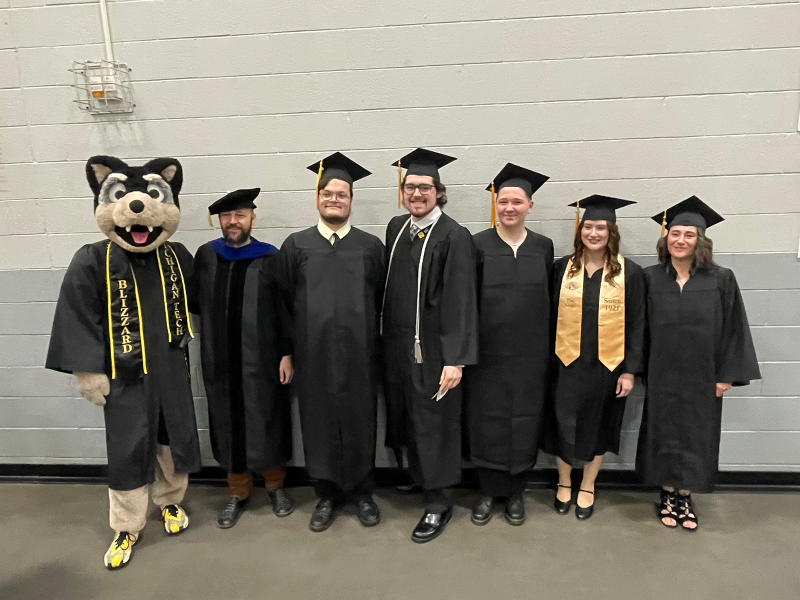
Humanities undergraduates posed with department head Scott Maratto at spring commencement on Saturday. Back row: Scott Maratto, Michael Bunker (CCM), Daniel Ryan (STC), Austin McFarlane (STC), Elsie Burton (STC). Front Row: Charlotte Haanela (English), Karissa Sanders (English), Kara Laramore (English), Cameron Gorelick (English), Aspen Stampfler (English), Maddie Nass (STC), Grace Parsekian (STC), Mindy Pierre (STC).

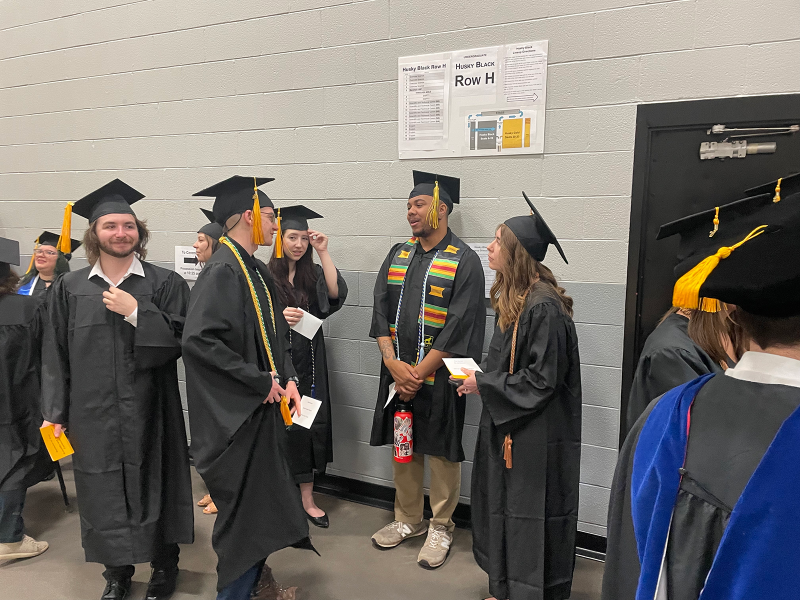
A total of 21 graduate and undergraduate students crossed the stage on Friday and Saturday at Michigan Tech’s annual spring commencement ceremonies.

18 Undergraduates, one masters, and two PhD students were honored over the weekend for having completed, or nearly completed, their degrees across four humanities programs.

Our 2024 graduates will go on to a wide variety of pursuits, from careers in communications, media, and academia; to graduate study in fields like law & policy, and archival studies; to traveling and studying abroad. We are so proud to see our students representing the diversity a humanities degree has to offer!

The department would like to offer our heartfelt congratulations to the following students:

Communication, Culture, and Media: Melissa Dowler, Lyndsay Lagreid, Elijah Poirier, Cole Risko, Ashton Verduin.

English: Cameron Gorelick, Charlotte Haanela, Kara Laramore, Karissa Sanders, Aspen Stampfler.

Scientific and Technical Communication: Michael Bunker, Elsie Burton, Joshua Jongema, Austin McFarlane, Maddie Nass, Grace Parsekian, Mindy Pierre, Daniel Ryan.

Rhetoric, Theory & Culture: Genevieve Delali Antonio (MS), Samantha Quade (PhD), Tori Reeder (PhD).

2024 Commencement Photos

Brilynn Janckila Awarded Finishing Fellowship

A hearty congratulations to RTC PhD candidate Brilynn Janckila, who has been awarded a finishing fellowship for the summer of 2024!

Finishing fellowships are awarded by the graduate school to outstanding PhD students in their final semester. During that time, the student’s work is fully funded as they finish and defend their dissertation.

Brilynn’s research topics include girlhood studies, Barbie and Barbie media, feminist research methods, fan culture, writing studies, and writing program/writing center administration, usability and social justice in technical communication.

Great work, Brilynn!

Humanities Names 2024 Departmental and Program Scholars

A hearty congratulations to our humanities departmental and program scholars! These awards recognize outstanding performance of one undergraduate student in each of our three programs, as well as the department as a whole.

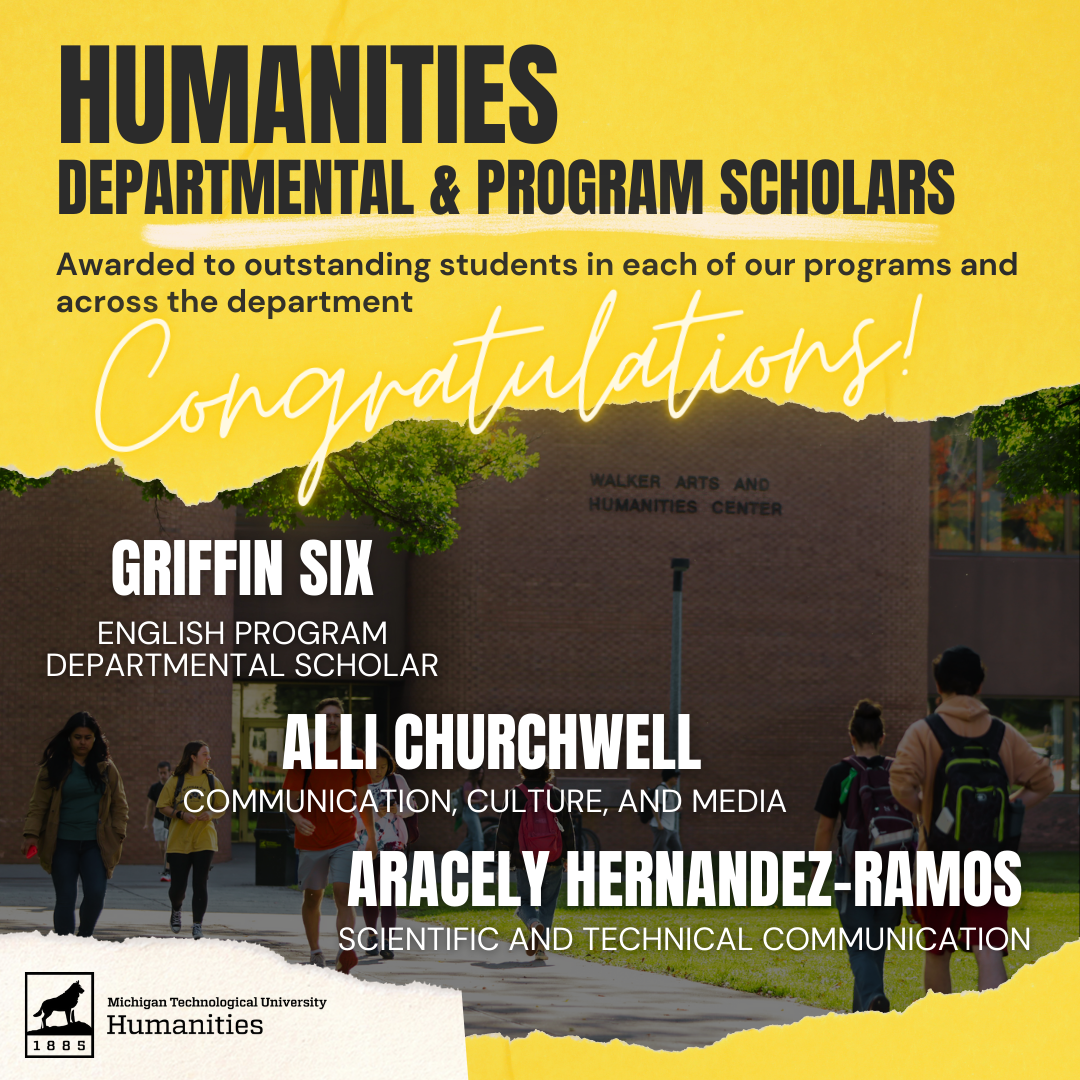
Congratulations to Griffin Six, our English program scholar, Alli Churchwell, our communication, culture, and media program scholar, and Aracely Hernandez-Ramos, our scientific and technical communication program scholar! Each program scholar receives $100 from the department in recognition of their achievements.

Griffin Six has also been named our humanities departmental scholar! Griffin will receive an additional $200 from the department, as well as eligibility for the Provost’s Award for Scholarship, which awards an additional $800 to recipients.

Congratulations and excellent work to all of our amazing humanities scholars!