Tag: rhetoric theory & culture

RTC Research Forum: “Life Before Death: Reframing Reproductive Ethics in the Bioethics Classroom” Trish Grosse Brewer

What:

The RTC Research Forum, formerly known as the RTC Brown Bag, is a colloquium series sponsored by the Rhetoric, Theory, and Culture graduate program in the Michigan Tech Department of Humanities. Each month, faculty and students in the program present research on a wide range of topics. The forum offers an opportunity for colleagues and peers to discuss current research, prepare for formal conference presentations, and for students to receive feedback on presentation practices.

Abstract:

Although pregnancy provides the context for many of biomedical ethics’ most enduring controversies, it is often treated primarily as the backdrop for debates about abortion, assisted reproduction, and genetic testing rather than as a morally significant experience in its own right. While most courses devote substantial attention to abortion, assisted reproductive technologies, and genetics, pregnancy is often treated merely as the setting for these debates rather than as a morally significant experience deserving sustained ethical inquiry. Miscarriage and stillbirth, if discussed at all, are usually only discussed through the lens of abortion debates. The order in which we teach reproductive ethics shapes students’ ethical imagination.

This paper offers a transferable curricular model for instructors seeking to broaden how reproductive ethics is taught in their biomedical ethics and medical humanities classrooms through a four-week instructional unit. This unit, “Pregnancy, Life, and Death,” has been developed for undergraduate biomedical ethics courses and begins not with abortion or reproductive technology, but with pregnancy and miscarriage. The opening week introduces pregnancy as a unique bioethical state by examining maternal morbidity and mortality, the ethical significance of the maternal-fetal relationship, informed consent during pregnancy, and the challenges of caring for what clinicians often describe as the maternal-fetal dyad. Students then explore miscarriage and stillbirth through patient narratives and clinical case studies, considering questions of grief, uncertainty, personhood, compassionate care, and justice. In the next three weeks, students move on to the more traditional topics of reproductive technologies, euthanasia, and abortion.

Rather than advancing a new theory of reproductive ethics, this presentation argues that how we sequence topics in the biomedical ethics classroom shapes how students understand them. Beginning with pregnancy rather than with contested moral questions invites students to encounter reproductive ethics first through the lived realities of embodiment, vulnerability, dependence, and care. Only then do they engage the more familiar legal and political debates that dominate public discourse. By centering the lived experience of pregnant people before engaging the more familiar legal and political debates surrounding reproduction, educators can cultivate greater empathy, intellectual humility, and ethical nuance in their students.

Who:

Presented by Trish Grosse Brewer, Assistant Teaching Professor of Philosophy, Department of Humanities

Trish Grosse Brewer is an Assistant Teaching Professor at Michigan Technological University, where she teaches courses in ethics, biomedical ethics, logic, and introductory philosophy.  She earned her PhD in Philosophy from Villanova University in 2017 with a dissertation titled Embodied Love and Extended Desire. Her research interests include biomedical ethics, Early Christian moral philosophy (especially that of Augustine of Hippo), and the philosophy of love and sex. Her most recent publication is a chapter in Augustine and the Frontiers of Pluralism: “Dominating Grief: An Ambiguously Augustinian Approach to Pregnancy Loss.” She has five cats.

All are welcome to attend!

When:

Friday, September 25, 2026

12pm-1pm

Where:

Petersen Library (318), Walker Arts & Humanities Center
RTC Research Forum: “Creative Work in Progress”, HU Faculty & Graduate Students

What:

The RTC Research Forum, formerly known as the RTC Brown Bag, is a colloquium series sponsored by the Rhetoric, Theory, and Culture graduate program in the Michigan Tech Department of Humanities. Each month, faculty and students in the program present research on a wide range of topics. The forum offers an opportunity for colleagues and peers to discuss current research, prepare for formal conference presentations, and for students to receive feedback on presentation practices.

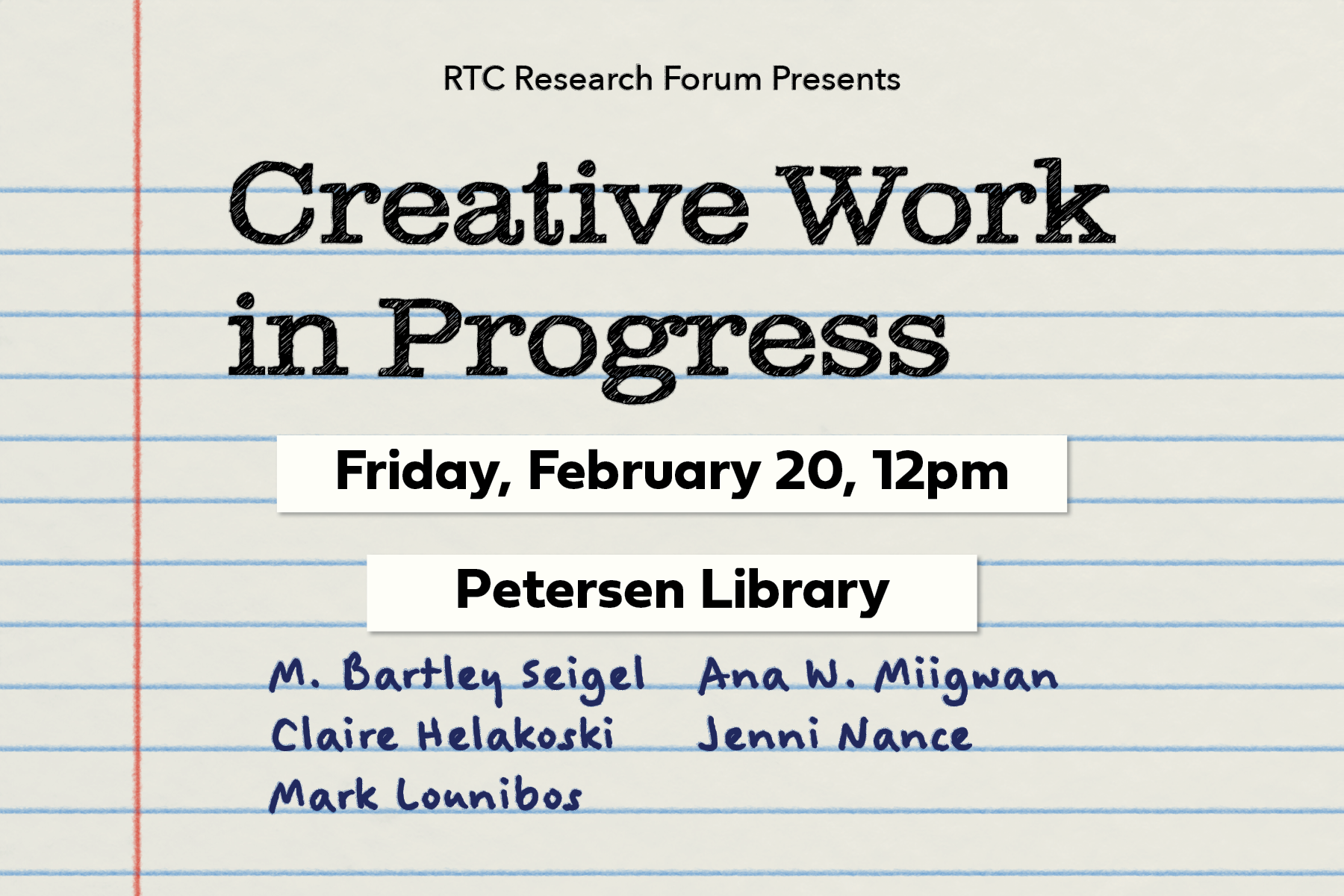
Join us for a dynamic literary session, as creative writers from the Humanities Department share recent poetry and prose, either published or in progress.

Who:

Presented by:

M. Bartley Seigel, Professor of Humanities & Director of the Michigan Tech Writing Center

Claire Helakoski, Adjunct Assistant Professor of Writing Studies & Assistant Director of the Michigan Tech Writing Center

Jenni Nance, Assistant Teaching Professor of Humanities & Humanities Academic Advisor

Mark Lounibos, Assistant Teaching Professor of Humanities

Ana W. Miigwan, MS, Rhetoric Theory, and Culture ’26

All are welcome to attend!

When:

Friday, February 20, 2026

Where:

Petersen Library (Walker 318), Walker Arts & Humanities Center

RTC Research Forum: “The Border Is Everywhere: Phenomenological Reflections on Space, Agency, and Democracy” Scott Maratto

What:

The RTC Research Forum, formerly known as the RTC Brown Bag, is a colloquium series sponsored by the Rhetoric, Theory, and Culture graduate program in the Michigan Tech Department of Humanities. Each month, faculty and students in the program present research on a wide range of topics. The forum offers an opportunity for colleagues and peers to discuss current research, prepare for formal conference presentations, and for students to receive feedback on presentation practices.

Abstract:

The fall of the Berlin Wall in 1989 led to predictions of an increasingly borderless world, or at least to one with fewer border fortifications. In fact, the opposite has happened. Where there were fifteen border walls along international boundaries in 1989, there are over seventy today, with many more planned or under construction. Border fortifications are many nations’ largest infrastructure investments in the twenty-first century. And whereas borders were once understood to mark edges between sovereign nation states, borders today are better understood as diffuse sets of functions, including securitization, interdiction, and surveillance. As philosopher Étienne Balibar has noted, borders have moved from the edges to the very centers of political spaces, including cities far from any international border. Henri Lefebvre famously observed that “there is a politics of space because space is political.” Drawing on phenomenologies of embodied and political agency, I argue that the new global border regime signals a new politics of space, new logics of sovereignty and citizenship, and an unprecedented threat to democratic agency.

Who:

Presented by Scott Marratto, Associate Professor of Philosophy in the Department of Humanities

Scott Marratto is Associate Professor of Philosophy at Michigan Technological University. He is President of the Canadian Society for Continental Philosophy and author of The Intercorporeal Self: Merleau-Ponty on Subjectivity (State University of New York Press, 2012). He is also co-author (with Lawrence E. Schmidt) of The End of Ethics in a Technological Society (McGill-Queen’s University Press, 2008). Challenging a prevalent modern idea of the self as, essentially, a discrete, interior consciousness, Marratto has argued that self-consciousness emerges on the basis of the living, expressive movement by which our bodies are situated in a world with others. Beginning from this insight into the nature of self-consciousness and cognition, he critically evaluates neoliberal thinking about selfhood, agency, and choice, and proposes new ways of thinking about the spatial and material conditions of political community and human development.    

All are welcome to attend!

When:

Friday, February 13, 2026

Where:

Petersen Library (Walker 318), Walker Arts & Humanities Center

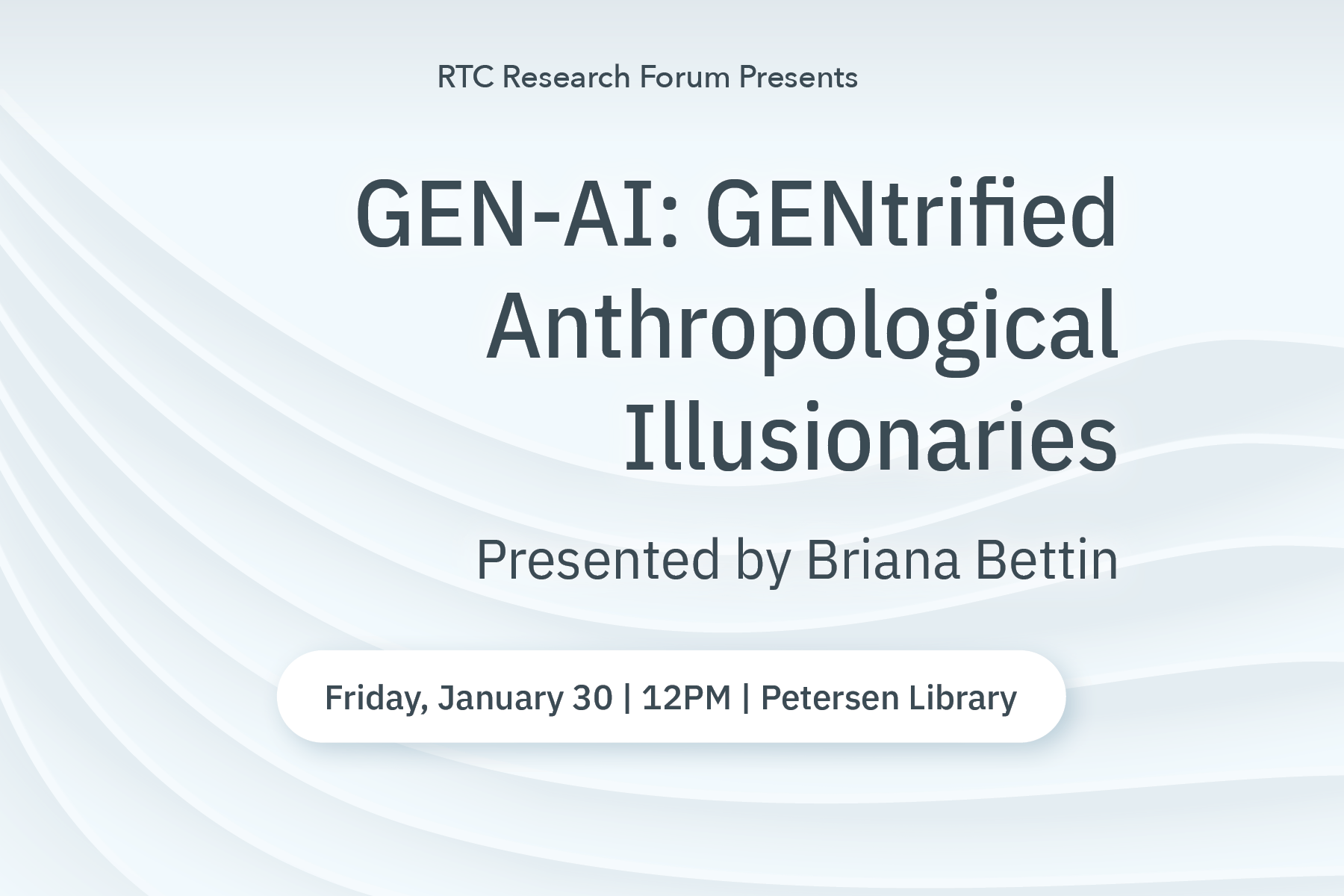
RTC Research Forum: “GENtrified Anthropological Illusionaries” Briana Bettin

What:

The RTC Research Forum returns Friday, January 30, 2026 at noon in the Petersen Library with GEN-AI: GENtrified Anthropological Illusionaries, presented by Briana Bettin of Computer Science and Psychology and Human Factors at MTU!

Abstract:
Gentrification impacts a wide array of neighborhoods and communities within our analog world. While the same physical impacts may not be present, our computationally connected digital world may not be so different. In this talk, the aesthetics, process, and impacts of physical gentrification will begin to be critically compared and metaphorically mapped to aspects of Internet history, web communities, and application developments. Through this lens, we will further explore the current state of generative artificial intelligence (“gen-ai”), and the ways these software artifacts presently contribute to re-producing and re-presenting gentrification.

We hope you will join us for this highly anticipated talk, and for the exciting presentations we have scheduled for February and beyond!

Who:

Presented by Briana Bettin, Associate Professor of Computer Science and Psychology and Human Factors at MTU.

Briana Bettin’s research blends user experience methodologies with education research to better understand programming students and the impacts of the classroom environment. Her research interests span education, experiential design, and human factors.

All are welcome to attend!

When:

Friday, January 30, 2026

Where:

Petersen Library, Walker Arts & Humanities Center
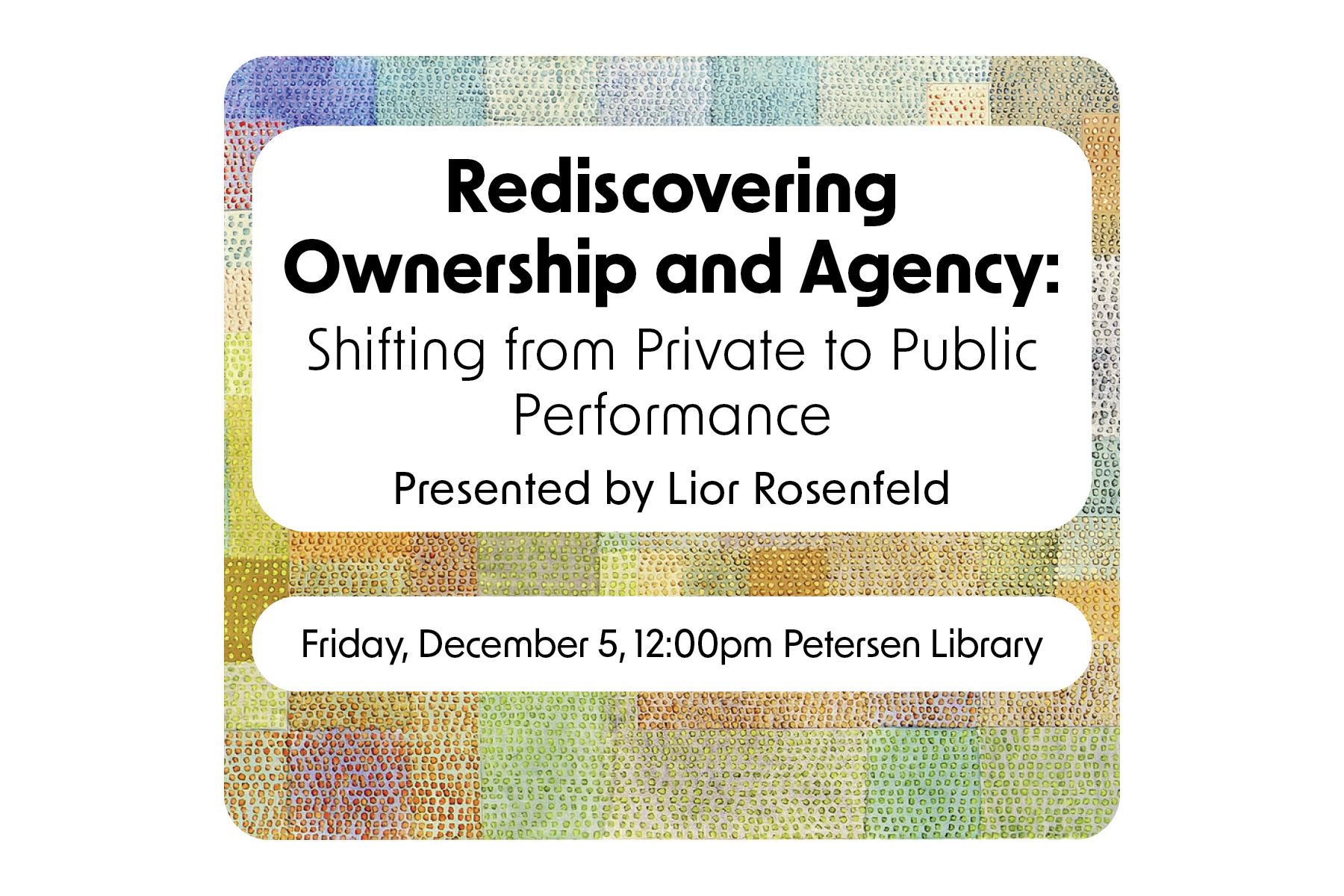
RTC Research Forum: “Rediscovering Ownership and Agency: Shifting from Private to Public Performance” Lior Rosenfeld

What:

The RTC Research Forum, formerly known as the RTC Brown Bag, is a colloquium series sponsored by the Rhetoric, Theory, and Culture graduate program in the Michigan Tech Department of Humanities. Each month, faculty and students in the program present research on a wide range of topics. The forum offers an opportunity for colleagues and peers to discuss current research, prepare for formal conference presentations, and for students to receive feedback on presentation practices.

Abstract:

The claims made by technology companies regarding the advancement of autonomous machines raise significant concerns about their implications for democratic governance. A machine that is capable of independent thought and action poses a potential threat to democratic judicial and political systems, as it undermines the autonomy of the people. Drawing on phenomenological insights, I will first clarify why some of these concerns may be misplaced by emphasizing that autonomy must be achieved rather than presupposed. I will then argue that the recent deployment of Artificial Intelligence (AI) systems highlights that ownership and agency are constituted through public speaking rather than being intrinsically tied to autonomy or self-rule. While the former gives the power to begin anew, the latter is marked by territoriality, exploitation, and coercion.

An autonomous entity supposedly possesses an identity, always returns to itself since it thinks—calculates the world independently of social-political engagements. As such, it remains unaffected by contingency, allowing it to justify its beliefs and actions through established rules. Additionally, autonomy presupposes agency, as a self-ruling entity is necessarily the cause of its own actions. And as Jacques Derrida explains, since the people in a democracy are autonomous or self-rulers, they have the force to determine the law (Derrida, 2025, p.13). In contrast, in our liberal tradition, which dates back to John Locke, democratic citizens are seen as individuals or natural entities, and therefore free from legal constraints. This freedom grants them the right to own property and other natural rights, empowering them to resist any claims of ownership made by authorities. However, with the rise of AI systems, individuals in democratic nations are increasingly losing their natural rights. The reduction of experience to thinking—calculating across all sectors by AI systems violates individual rights, for instance, by scraping texts without the authors’ consent. Moreover, due to the widespread use of AI systems, nation-states can no longer effectively protect copyrights. As Derrida argues in the context of cloning, techno- scientific reason undermines today its foundation—the nation-state, which is responsible for distributing rights and protecting the dignity of its citizens (Derrida, 2005, p. 146).

The deployment of AI systems increasingly blurs the distinctions between nation-states and private technology companies. This phenomenon indicates a potential erosion of the nation-state’s power in contemporary governance and social organization. Nevertheless, the support that nation-states extend to technology companies developing artificial intelligence systems that exploit and oppress their citizens is not merely a historical phenomenon; rather, it reflects an intrinsic characteristic of any entity that claims autonomy. As the political writings of Derrida and Hannah Arendt illustrate, autonomy is constituted by private performances within the household, which can therefore be authoritative, ethnic, and exploitative. However, Derrida’s deconstruction of democracy illustrates that citizens can achieve democratic autonomy by responding to the imperative of justice and, thereby, superseding familial, natural, and irrational laws.

According to Derrida, the conflict between the rule of law and freedom within modern democracy is irreconcilable. The question of what a democratic citizen is — whether a subject of the law or a free individual — remains undecided. This undecidability allows citizens to face one another, constituting an ultra-political experience. Within this pluralistic and uncertain realm of meaning, complete autonomy—independence from contingency is unattainable. As a result, the concept of equality under the law, the meaning of justice in a democracy, turns unfounded, uncovering justice as fundamental. Since justice cannot be ruled, justice calls democratic citizens to rule, thereby achieving autonomy.

However, claims for justice lack the necessary political power to effectively resist an AI regime. According to Arendt, public speaking or public performances enact intersubjective political experiences which are fundamental to selfhood and agency, and therefore the meaning of the power of the demos. Public speaking is non-territorial, allowing citizens to appear before others unconditionally and to act uniquely. Moreover, since public performances are contextual, the self always appears anew, simultaneously generating the past and the future. The temporality of shared existence, which Arendt refers to as natality, constitutes the process of narration, calling to keep a record. Thus, public performance is agonistic—pluralistic, giving rise to new senses of self and agency, in contrast to private performance, which constitutes self-mastery and, therefore, is antagonistic—divisive.

Who:

Presented by RTC PhD canditate Lior Rosenfeld.

Lior Rosenfeld obtained an M.A. in Philosophy from the New School in 2020. Currently, Lior is a fourth-year Ph.D. Candidate at Michigan Technological University. In his research, Lior investigates how the phenomenological description of the life-world alleviates the tension between democracy and science as illustrated by contemporary examples such as climate change denial and vaccine skepticism.

All are welcome to attend!

When:

Friday, December 5, 2025

Where:

Petersen Library, Walker Arts & Humanities Center
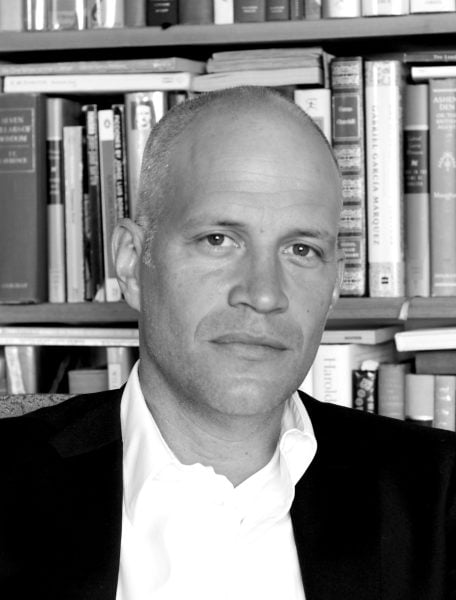
RTC Research Forum: “Language and Artificial Understanding: Stress Tests for the Uniqueness of Human Intelligence” Ronald Klingler

What:

The RTC Research Forum, formerly known as the RTC Brown Bag, is a colloquium series sponsored by the Rhetoric, Theory, and Culture graduate program in the Michigan Tech Department of Humanities. Each month, faculty and students in the program present research on a wide range of topics. The forum offers an opportunity for colleagues and peers to discuss current research, prepare for formal conference presentations, and for students to receive feedback on presentation practices.

Abstract:

This essay concerns contributions made by David Braine  in Language and Human Understanding (2014) and their bearing on contemporary discussions of artificial intelligence. The first is his proposal that human linguistic capacity has the shape of sense as understood by James J Gibson, where senses must be understood in their relation to the organism as a whole, and that organism must be understood in relation to its environment. The second is his understanding of Wilhelm von Humboldt’s famous line that “language makes infinite use of finite means,” where he takes the infinity to mean indefinite, contrary to the more common recursive interpretation. These contribute to a third regarding malleability and the brain, where its plasticity reaches such an extent that pragmatics and semantics begin to determine, rather than be determined by, neurological structures. Braine takes this malleability to be distinctively human. From the view of 2014, he argued “it will still never be possible for the statements of linguistic science to enable one to calculate or compute the linguistically public significance or sense of the utterances we make” (149). Here I assume Braine’s three contributions, but put pressure on his proposition of computational-impossibility in light of the advances in artificial intelligence in the years since. From the view of today, Braine’s account of malleability reads as anticipatory of LLMs. I argue that the primary intuition-pump he uses to explain malleability cannot differentiate what’s distinctly human from contemporary machine learning attempts. I question whether it matters whether the significance is computable, or if probabilistic attempts can approximate said significance to an arbitrary degree; I argue Braine’s view can defend against this. I also consider advancements in embodied and multimodal reasoning, and whether they can imitate the environmentally oriented nature of speech in Braine’s proposal; I consider this the strongest possibility for defending the uniqueness of language.

Who:

Presented by RTC PhD student Ronald Klingler.

Ronald Klingler is a PhD student in the Rhetoric, Theory, & Culture program. He considers the positions around the uniqueness of human language use, and evaluates them in light of recent advances in artificial intelligence. 

All are welcome to attend!

When:

Friday, October 24, 2025

Where:

Petersen Library, Walker Arts & Humanities Center
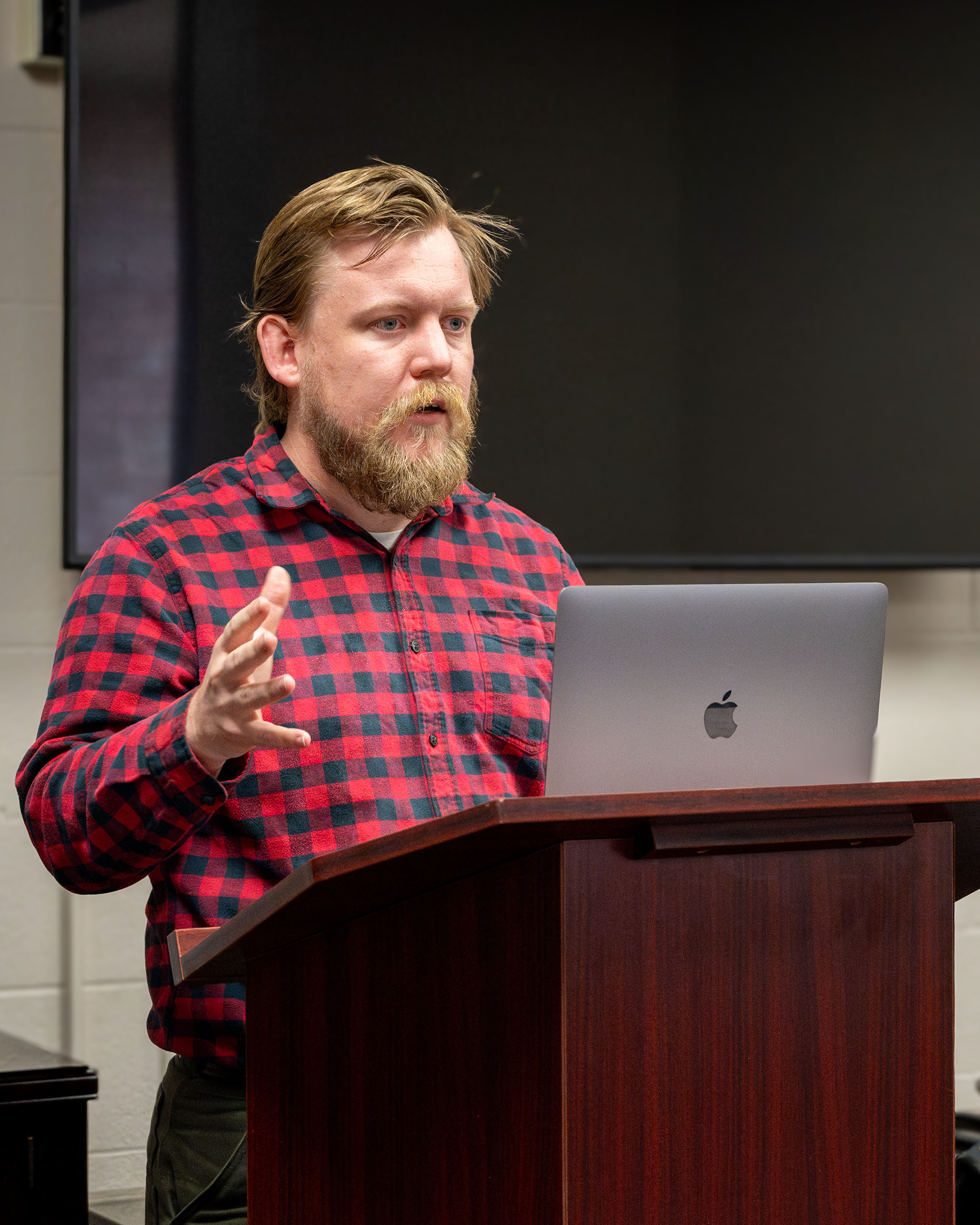
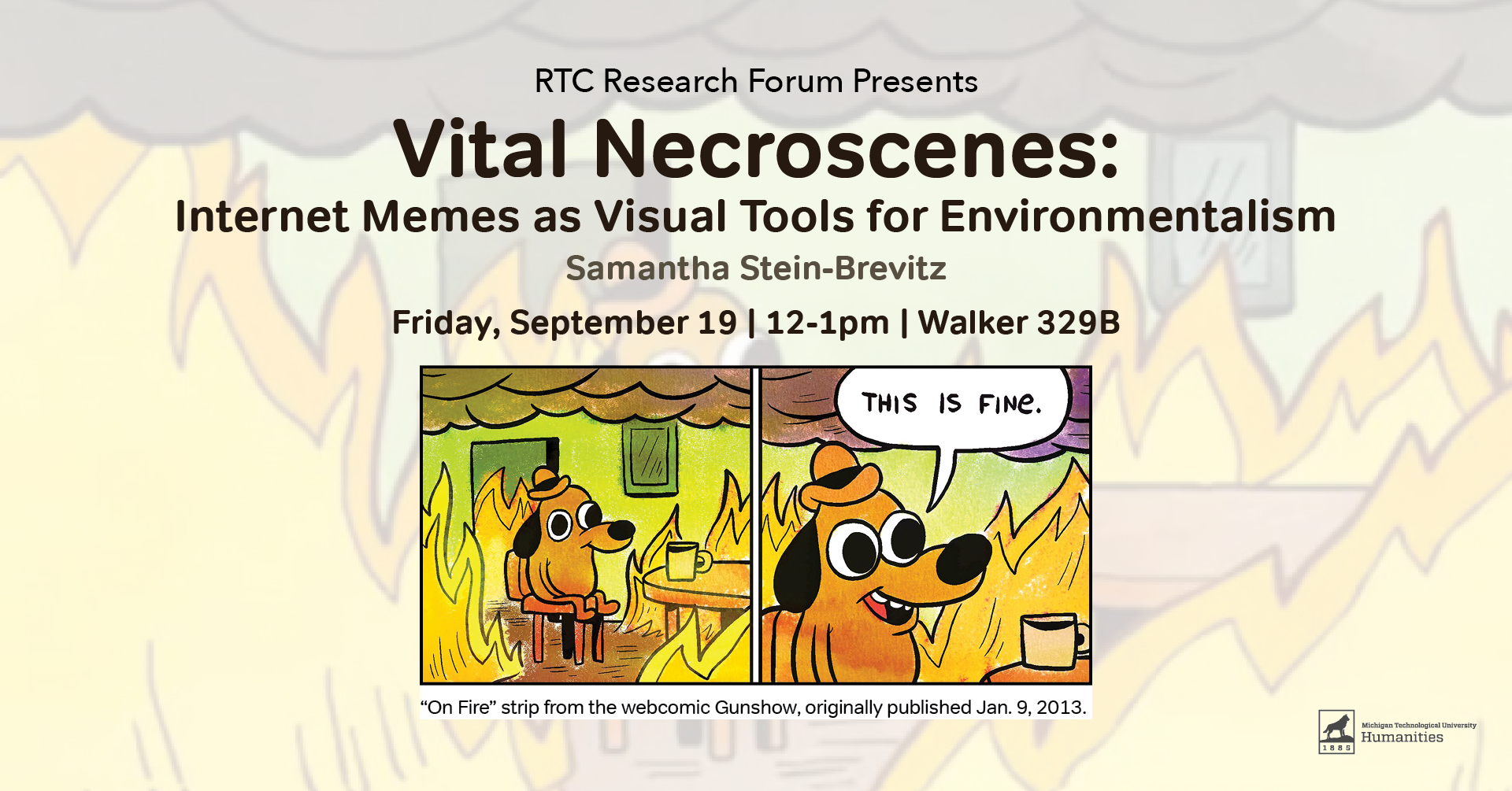
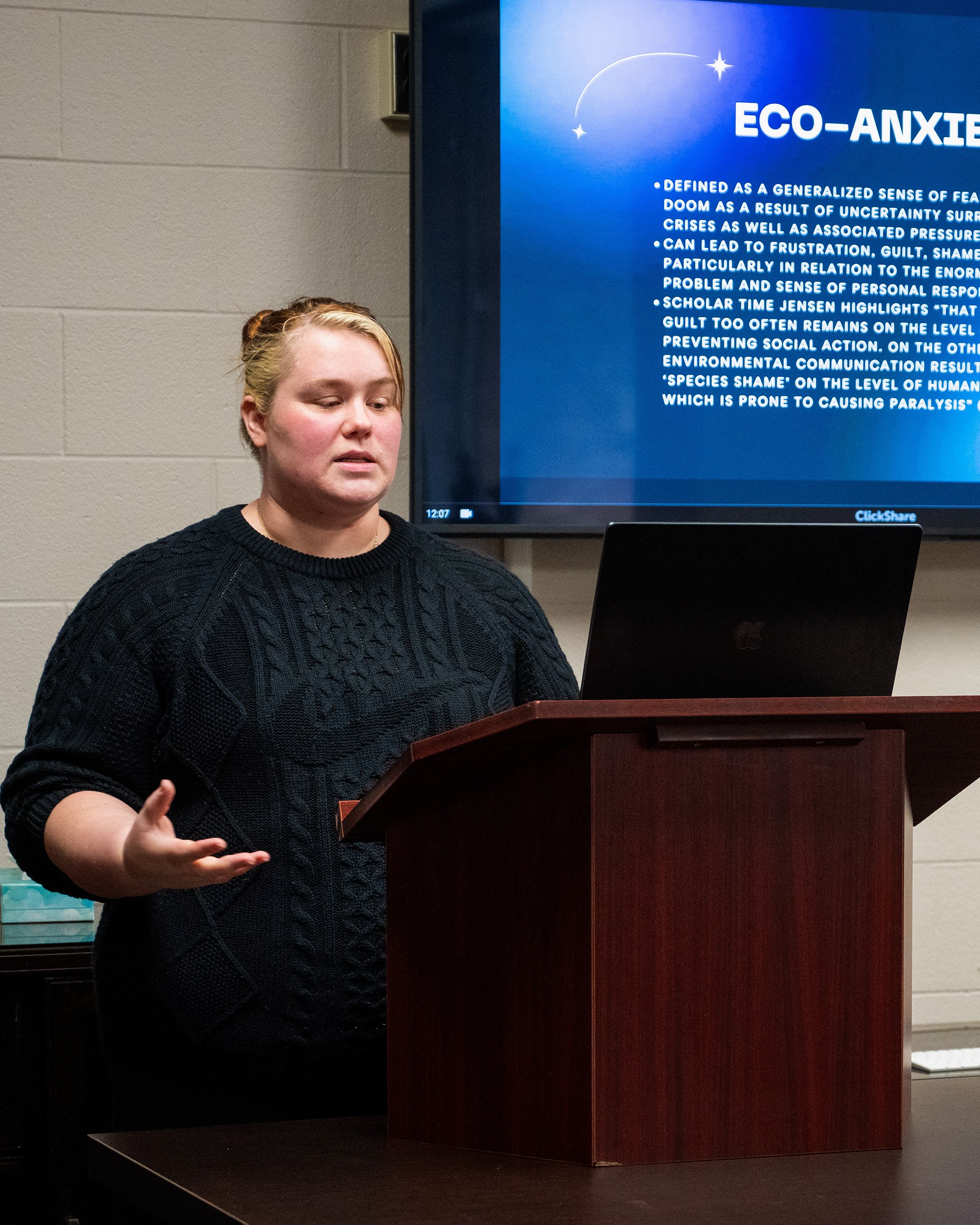
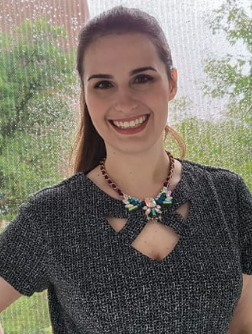
RTC Research Forum: “Vital Necroscenes: Internet Memes as Visual Tools for Environmentalism” Samantha Stein-Brevitz

What:

The RTC Research Forum, formerly known as the RTC Brown Bag, is a colloquium series sponsored by the Rhetoric, Theory, and Culture graduate program in the Michigan Tech Department of Humanities. Each month, faculty and students in the program present research on a wide range of topics. The forum offers an opportunity for colleagues and peers to discuss current research, prepare for formal conference presentations, and for students to receive feedback on presentation practices.

Abstract:

Understanding how we can approach environmentalism from a humanities perspective calls for an interdisciplinary approach that encompasses not only our place in the world but everything’s place in the world—human and non-human. There is no question about the cruciality of a comprehensively ethical and conscious means of interacting with the planet. There have been multiple attempts and approaches to a better method to the human ways of existing on this planet. Recognizing how to course correct is easier said than done, however. This concept is large and, in and of itself, sublime. The visual analysis offered in this work will specifically work to break down and interpret common, widespread Internet meme formats, thus presenting how they can evoke a need for environmentalism in daily life. The pieces guiding my research are the “This is fine” dog as well as a variant of another common Internet meme, Spiderman(s) pointing at himself. Though these works are ambiguous and can be used in multiple contexts, the power of their messages can be used to approach a call for better environmentalism. Additionally, it reiterates the very real threat of contemporary climate disasters which can thus be used to reexamine the power and vitality expressed within these Internet memes. Guiding my definition and understanding of the vital necroscene, I specifically connect Immanuel Kant’s Critique of Judgement with Jane Bennett’s Vibrant Matter as well as Jill H. Casid’s “Necrolandscaping”. Both Kant, Casid, and Bennett emphasize the limitlessness in life and in death. Additionally, Kant writes about the judgment that is assigned to Nature. Nature, he insists, is viewed as this aimless mechanism—though it should not be that way. Taking this notion of purposiveness, I connect it directly to the attempts made by vital materialism and the necroscene to dismantle and trouble the black/white binary of life. The goal of vital materialism is to present the purposiveness within non-human phenomena. Further, these concepts connect to demonstrate that Nature is an assemblage of multiple and boundless human and non-human actants—to borrow from Bruno Latour. The presented research aims to demonstrate ways Internet memes can evoke a vital necroscenic approach, creating more awareness for the call to environmental humanities. In understanding the vitality of Internet memes, we can develop an understanding and potentially even an increased appreciation for the interconnectedness of both human and non-human lives.

Who:

Presented by RTC PhD student Samantha Stein-Brevitz.

Samantha’s research aims to explore the connections between Internet memes and the necrocene that is the death of the planet. Through humor, Internet memes serve as a communication tool to emphasize the vital need to recognize and act on planetary crises and assist in dismantling Nature vs Human. In an effort to evoke change, the images presented show the irony that “this is fine” and life goes on. 

All are welcome to attend!

When:

Friday, September 19, 2025

Where:

Venue changed to Petersen Library, Walker Arts & Humanities Center
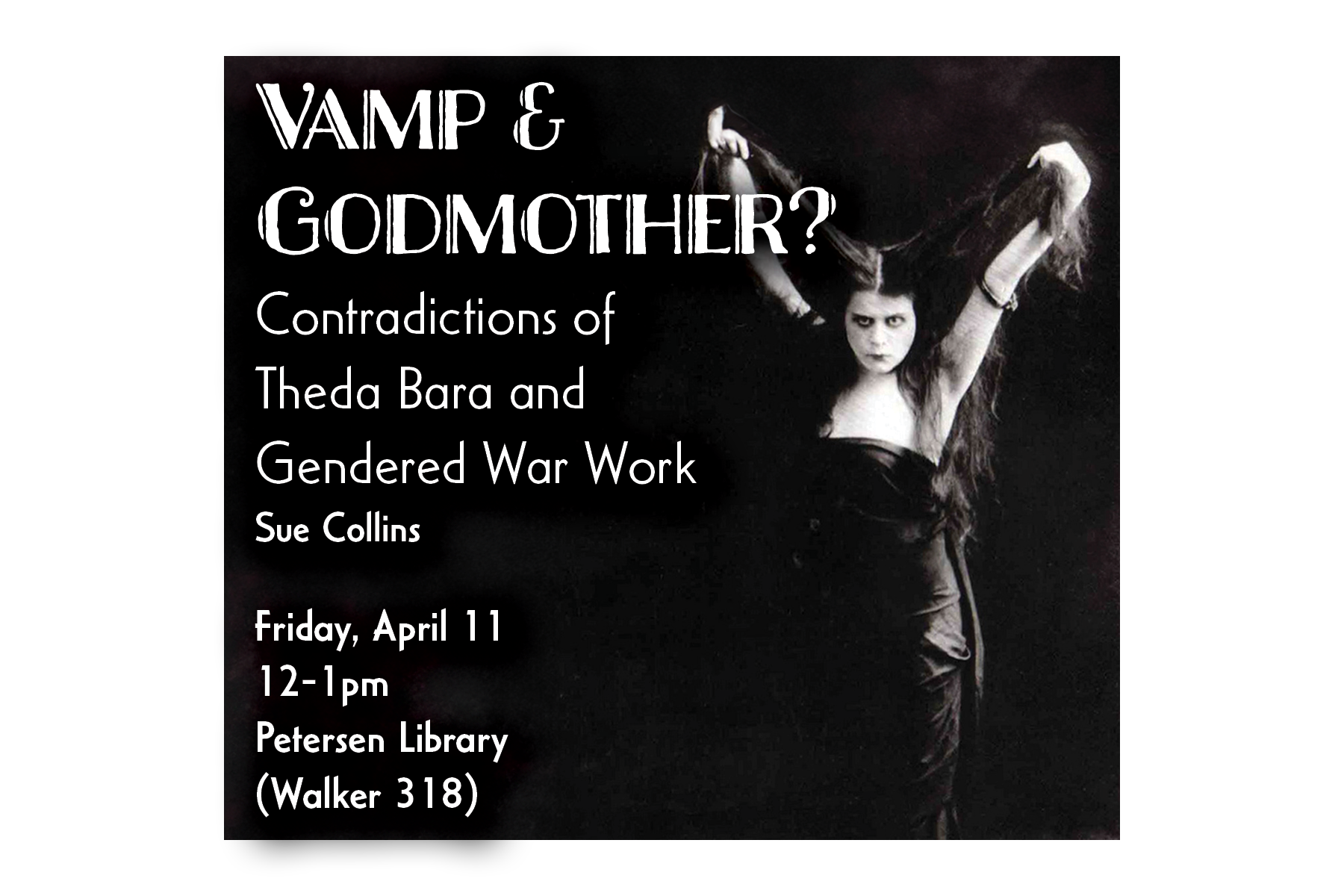
Brown Bag Talk: Vamp & Godmother? Contradictions of Theda Bara and Gendered War Work

What:

Abstract:

This talk focuses on the peculiar case of Theda Bara, a Hollywood actress who became famous for her ethnic-Other “vamp” movie character and public persona. In 1918, Bara was appointed “Godmother” to the 158th Infantry Regiment from Arizona. The practice of godmothering had started early in World War I but was prohibited in France and Britain after 1915 due to suspicions of sexual misconduct between women and their “godsons,” as well as fears about its potential for espionage. When the U.S. intervened in 1917, godmothering was discouraged by the Department of War, with exceptions made for female screen idols who offered government officials a useful mechanism by which to help promote troop morale and the will to fight. Bara’s promiscuous, even adulterous persona, however, ostensibly threatened conventional morality among men and women, and the “wholesome” model of “soldier-citizen” the camps aimed to cultivate among the men. Accordingly, her films were banned in the training camps. I explore the logic of Bara as godmother through an analysis of Hollywood’s star system in the 1910s and how its discursive construction of stardom intersects with Foucault’s discussion of discourse and sexuality.  

Who:

Presented by Sue Collins, Associate Professor of Communication, Culture, and Media.

All are welcome to attend!

When:

Friday, April 11 2025

Where:

Petersen Library, Walker Arts & Humanities Center
Brown Bag Talk: “Beauty, Excess, and the Grotesque in the Late-Capitalism Critique of Lauren Greenfield”, Emma Johnson

What:

Abstract:

Embracing slow cinema and focusing on women are both underappreciated approaches to filmmaking when it comes to representing the financial crisis. One filmmaker who explores the financial crisis through these underused techniques is Lauren Greenfield. In this paper, I will explore three of Greenfield’s films through the lens of theorists Jill Godmilow and Nicholas Mirzoeff to show how alternative ways of looking provide a new critique of capitalism. Typically, films on financial crises are fast paced. Juliette Feyel and Clémence Fourton’s 2019 article “Post-2008 Films: The Financial Crisis in Fictions and Documentaries” argues that 2008-crisis films are represented in specific structures and patterns. Clichéd quick cuts show phone calls, graphs, and skyscrapers. These visual depictions are limiting, often excluding how crisis affects daily life and women. An alternative approach is found in the work of Greenfield, including the films The Queen of Versailles (2012), Generation Wealth (2018), and The Kingmaker (2019). I argue that Greenfield uses beauty, excess, and the grotesque to critique late capitalism. Greenfield favors mundane daily life with long shots of mansions with neglected pools, motivational posters in a vacated office, and dog poop left on the carpet after the nannies are laid off. She pays attention to women in a sub-genre where women are largely absent and uses slow-cinema techniques in a sub-genre that mostly embraces fast-paced narratives. Interviewees who would typically be depicted in quick clips are given screen time to humanize themselves. Greenfield juxtaposes excess with relatable reasons for its pursuit, drawing attention away from subjects and toward the system that creates it, coming close to accomplishing what Godmilow terms postreal filmmaking and Mirzoeff Visuality 2. Ultimately, Greenfield invites the audience to sit with her subjects, identify with them, and begin to imagine an alternative world.

Who:

Presented by RTC PhD student Emma Johnson.

All are welcome to attend!

When:

Friday, March 28 2025

Where:

Petersen Library, Walker Arts & Humanities Center
Academic Job Market Roundtable Discussion, Humanities Brown Bag Series

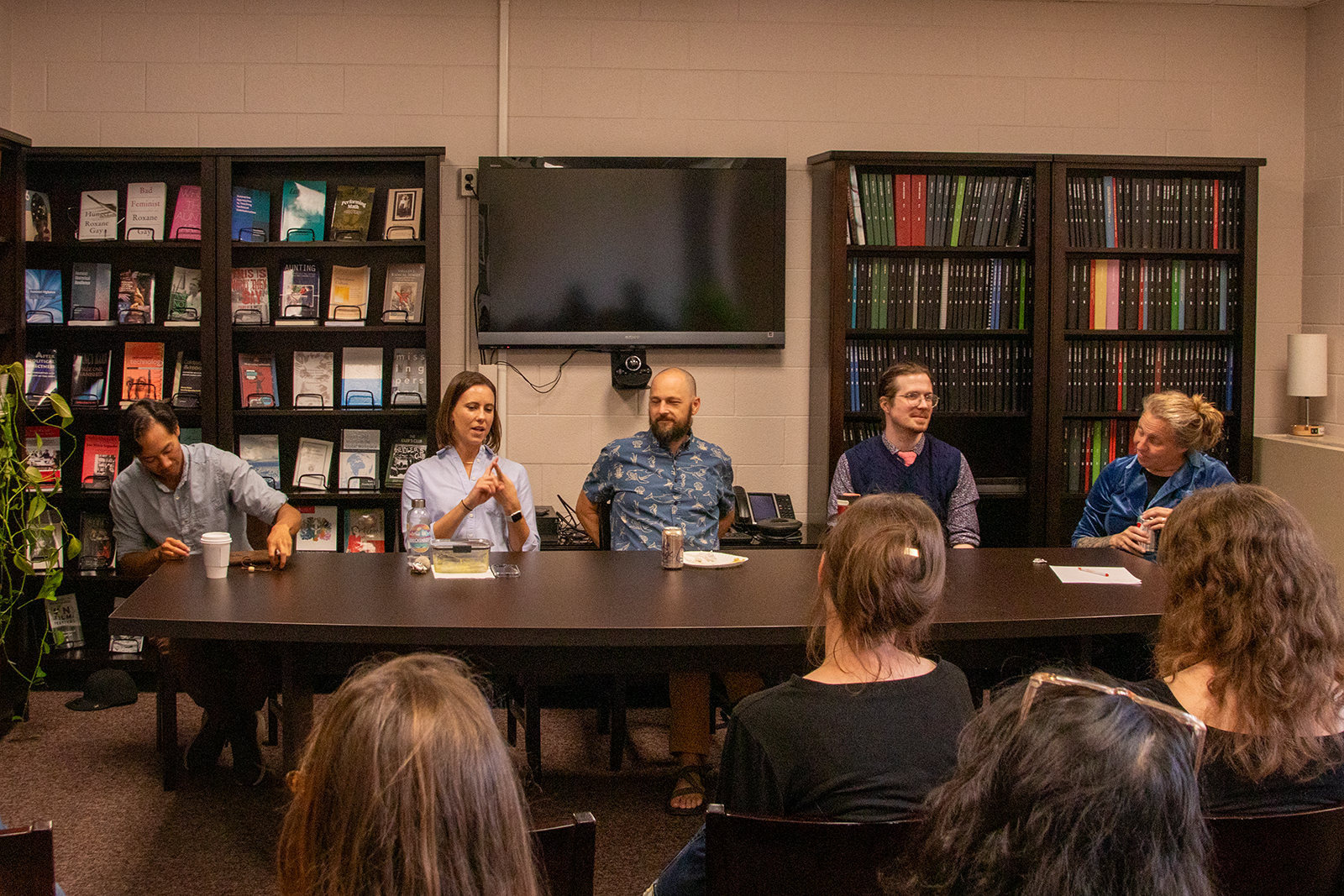
Richard Canevez, Jennifer Nish, Jason Archer, James Hammond, and Holly Hassell participated in a panel discussion on the academic job market.

What:

A panel discussion featuring new tenure-track faculty hired in 2022/2023 to discuss the academic job market within the humanities, and their individual experiences with the academic job search that led them to Michigan Tech. Featuring Jason Archer, Richard Canevez, James Hammond, Holly Hassell, and Jennifer Nish.

Who:

Recent tenure-track faculty Jason Archer, Richard Canevez, James Hammond, Holly Hassell, and Jennifer Nish.

All are welcome to attend!

When:

Friday, September 22, 2023

Where:

Petersen Library, Walker Arts & Humanities Center