Sustainability

Posts under the ‘Sustainability Research’ category

Sustainable development of the manufacturing industry: casting and forging

Monday, May 6th, 2013

This is a guest blog post from Minglei Guan, one of my students in the “Sustainability Science, Policy and Assessment” course this spring:

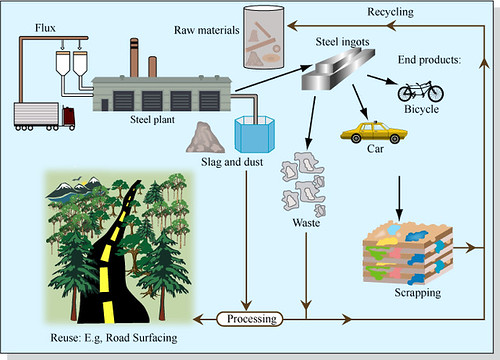
Sustainability is an important development goal for humanity in modern society. Manufacturing is a central feature of many economic development pathways, and in this sense casting and forging are therefore a necessary focus for sustainable development strategies. Casting (pouring hot metal into a mold) and forging (pressing metal into a certain shape) are two ways that all metal tools and products are made.

The economic issues for the casting and forging manufacturing industry can be summarized as low profit margins with high cost of capital, and market volatility. Low profit margins are common for small manufacturers when they lack an ability to improve their production processes, training and equipment. This issue can result in bankruptcy for small manufacturers, which then negatively impacts society through the loss of jobs. Economic support from government and industrial organizations can help alleviate this issue. For the second issue, the high cost of capital, is mainly driven by the cost of raw materials, labor, and energy. For the casting and forging manufacturing industry, the cost of materials is the most important. Efforts such as waste reduction and improved production methods are good ways to solve the issue, using approaches such as production life cycle improvement and TNS zero waste strategy.  Finally, the market volatility needs to be dependent upon local market requirements.

The casing and forging industries also have a large impact on the environmental dimension of sustainable development. High energy usage, materials resources waste and environmental damage are common to the casting and forging manufacturing industry.  High energy usage and materials resources waste are both resource issues; production life cycle improvement and TNS zero waste approaches can also be used to solve them. Emissions are also a serious problem for the industry. New technologies such as the “CRIMSON” model can be used to reduce emissions from the sand casting process. However, typically either new laws or environmental decrees are needed to limit greenhouse gas and smoke emissions or to filter them before they are released.

Finally, from social dimension, the industry has significant social impacts such as those related to labor costs and environmental damage as it impacts human health. To solve social, environmental and economic issues for the casting and forging manufacturing industry, one needs to considered relationships among these three views. Balanced development for society, the environment and the economy can push the manufacturing industry towards sustainability.

Bad news delivered well

Tuesday, March 5th, 2013

This semester I am teaching a class on sustainability (Sustainability Science, Policy and Assessment), and I am struggling to decide whether I should show probably the most dispiriting and disconcerting documentary currently available on the topic of societal collapse, a very common topic in our class discussions.

Titled simply “Collapse“, the documentary is an interview with Michael Ruppert, one of the tallest lightning rods in the peak oil and sustainability circles. Ruppert’s methodology and conclusions are controversial, but that is not what makes his work so difficult to teach. There is a fatalistic quality to his work; that connecting fact A to B to C inevitably leads us all to D (collapse of civilization), when there are significant unknowns that may make those events truly unconnected and therefore D just one of many possible outcomes.

Indeed, it is the work of groups like The Resilience Alliance that try to understand these different pathways through destruction and renewal, and The Transition Network that tries to prevent D from becoming an inevitable outcome by guiding communities down different pathways.

I suppose I can understand how Ruppert’s history and career could lead him to see the worst in humanity…. his years in the Los Angeles police force surely required him to be open to the worst possibilities…. but hopefully I can teach my students the reality of the challenges we face without losing hope for kinder, gentler pathways through them.

The new Pointillism

Thursday, January 24th, 2013

Brandon Martin-Anderson would have made Seurat proud; using US Census Bureau data (and a very large server), he recreated US and Canadian population patterns by representing each person as one dot.

What really struck me on this map is how the gridded road network in the Midwestern US dictates population settlement pattern, while natural features (such as the interior valleys in California) drive population settlement elsewhere. Of course major cities are obvious, but obvious too are the millions of people on the Florida coast who are at great risk of sea level rise from climate change (as well as more intense hurricanes).

What do you see?

Ninth Floor Farms

Thursday, September 20th, 2012

Michigan Tech has launched itself into the urban ag movement with an aquaponics set-up in the ninth floor greenhouse in the Dow. Established by Robert Handler (in the Sustainable Futures Institute) and Nancy Auer (Biological Sciences), the farm is producing basil, tomatoes, peppers, eggplants, and more than three dozen tilapia (in the large blue bins with the mesh on top). The water from the fish bins (filled with fish poop) circulates to the planted containers, where the plants use the fish fertilizer to grow. The water trickles through the soil, leaving through the bottom as clean water that is then circulated back into the fish tanks. Given the great success of its inaugural year, I can envision a steady flow of fresh, local veggies and fish appearing in the campus dining halls in the near future.

Prof. Nancy Auer and Dr. Robert Handler discussing the aquaponics system at Michigan Tech

All of this has happened before

Saturday, July 14th, 2012

Although summers are quite busy, usually I try to find the time to read several books that have been occupying the corner of my desk during the academic year. I have finally read a book on my “meaning to get to” list for years: “Prehistoric Native Americans and Ecological Change,” (Cambridge University Press), by the professors who taught me landscape ecology, Paul and Hazel Delcourt.

Originally published in 2004, the book combines archaeology and paleoecology to describe how landscapes in North America were changed by human societies long before Europeans arrived. Ecologists especially have always believed that pre-European societies had little lasting impact on ecosystems in North America. This belief underpins many conservation biology targets for habitat and species restoration. However, the Delcourts describe thriving human societies in Ontario, southern Illinois and Eastern Tennessee that used fire and forest harvesting to support their agriculture-based societies, dramatically increasing nut-bearing trees and pioneer species (such as ragweed) at the expense of species adapted to mature forests. These changes, made at increasingly large scales, may have also increased herbivore species such as white-tailed deer that thrive in early-successional and edge woodland habitats.

The book is framed by Panarchy theory, and explains how these changes, when they reached a critical proportion of the surrounding landscape, created greater disturbances (such as floods) that likely led to the area being abandoned by these societies, long before Europeans arrived on the scene. These events are a reminder that humans, like all species, alter their environments. Sometimes these alterations are beneficial in the short term, but often they are detrimental in the long term. Even with small-scale disturbances (such as slash-and-burn agriculture), if the period allowed for ecosystem regeneration is too short, soil fertility can decline and ultimately the practice becomes unsustainable.

Of course, the lessons we gain from the distant past (14,000 to 500 years before present) are limited in their applicability. North America is now home to over 400 million people, almost two orders of magnitude larger than it has ever supported before. It may be that the agricultural and settlement practices of even the most sustainable of these early societies would be completely unsustainable today. But what we can learn is that our impacts will certainly be available for study for a long, long time.

Loss

Saturday, June 30th, 2012

Maya Lin, creator of the Vietnam Veterans’ Memorial in Washington, D.C., is developing a lovely and moving web memorial to global biodiversity loss. Moving your mouse to click different dots, you can see single stories of species that have already disappeared, or click yourself into a “wormhole” with a story about once-abundant species now drastically reduced (and – too rarely – on their way back from the brink).

I suspect that for most people, staring at the possible loss of majestic species such as Siberian tigers helps to drive the point home. Stories of flocks of billions of passenger pigeons darkening the North American skies for days succinctly captures the destruction that a million guns can do to even the most abundant of species. But for ecologists, it is the smaller, less grandiose species we have studied that pull on our heart strings. I’ve worked on two species close to the edge (the California gnatcatcher and the Cape Sable seaside sparrow), and if and when they disappear it will be forever (as the failed attempts at saving the Dusky seaside sparrow illustrate). For ecologists, the loss of “our” species inspires a unique feeling of failure among us.

Keeping up with the Jones’

Tuesday, June 19th, 2012

In this week’s Proceedings of the National Academy of Sciences, Easterlin et al. have published a study on changes in “life satisfaction” (a.k.a. happiness) in Chinese villages during their economic transition over the past several decades. One might predict that as the Chinese have increased their incomes, they would become happier.

But as this study and a growing body of research demonstrates, money really can’t buy happiness. Prior to the conversion of a state economy to something resembling a market economy, Chinese life satisfaction was highest. As the country began its economic transition in the mid-1990′s, life satisfaction declined, possibly due to the increased level of uncertainty in many people’s lives. After 2000-2005 life satisfaction began to increase, but only for those in the upper income brackets. Even for those in the highest income brackets, life satisfaction has not yet approached what it was before the transition.

Over the transition, China had moved from one of the most egalitarian societies in terms of wealth distribution to one of the least. Although it is possible that the poor were left even poorer by the transition (or at least their economic stability declined), the results suggest that it is relative wealth that creates a decrease in life satisfaction. When you are surrounded by individuals as poor as you, the poverty doesn’t sting quite as bad. This phenomenon has been found often in past studies, suggesting that we humans can be a ferociously jealous lot.

This study (and others like it) has two implications for sustainability.

1. For a majority of people, “life satisfaction” is at the top of their list of characteristics of a sustainable life, right up there with adequate food and water, shelter and clothing, family and friends. Therefore, if researchers in sustainability science can figure out a way to accurately measure this characteristic, they can then use it to measure the current sustainability of a community, region, or nation, and help inform policies, programs and activities that might help a community move towards sustainability by increasing their general life satisfaction. For a long time, per capita Gross Domestic Product (GDP) was used as a proxy for this characteristic, but now a measure of income or wealth inequality called the Gini index has also been added to better capture this notion of happiness, mainly due to studies like Easterlin et al.’s.

2. Since excess consumption in luxury items (i.e., those things we want but don’t need) is one of the main drivers of resource depletion, studies like this one reinforce the lesson that happiness (and therefore sustainability) is unlikely to reside in things but rather in community and one’s place in it. The applied side of sustainability efforts often focus on replacing luxury consumption with activity and community work (e.g., volunteering, local governance, etc.). Indeed it was not long ago when this idea was prevalent in America; Victory Gardens (and war rations), the Peace Corps, and other activities that emphasized community contributions over consumption received popular support. Many of these new sustainability movements (e.g., Transition Towns, the Slow Movement) are actually repurposed efforts from previous eras to increase the life satisfaction component of our lives.

Ostrom (1933-2012): Beyond the Commons

Tuesday, June 12th, 2012

Indiana University announced today that Prof. Elinor Ostrom, winner of the Nobel Prize in Economics in 2009, died today of pancreatic cancer.

Ostrom was a textbook example of why diversity in perspectives and ideas always benefits any profession. At a time when Garrett Hardin’s “Tragedy of the Commons” (when commonly owned resources are unsustainably exploited) was the ruling paradigm of resource management, Ostrom’s studies of resources managed sustainably by local communities pointed out the limitations of the Tragedy paradigm. As stated by the Royal Swedish Academy’s announcement at the time of her award:

“Elinor Ostrom has challenged the conventional wisdom that common property is poorly managed and should be either regulated by central authorities or privatized. Based on numerous studies of user-managed fish stocks, pastures, woods, lakes, and groundwater basins, Ostrom concludes that the outcomes are, more often than not, better than predicted by standard theories. She observes that resource users frequently develop sophisticated mechanisms for decision-making and rule enforcement to handle conflicts of interest, and she characterizes the rules that promote successful outcomes.”

I have been reading the “Northwoods Reader” series by Cully Gage (a.k.a. Charles Van Riper), describing life in the Upper Peninsula of Michigan at the turn of the last century. At that time, land and waterways in the UP were a patchwork of large land holdings by industry and government (federal, state, and local), and small holdings by private individuals and families. However, no individuals would have been able to survive the long UP winters without subsistence hunting and fishing, which often took place locally on lands other than those owned by the individual. There was a well-developed system of socially acceptable behaviors related to hunting and fishing, regarding the time of year, sex, size, and number of individuals harvested. The irrelevance of land ownership with respect to subsistence-level resource use seemed similar to Finland and Sweden’s ”Everyman’s Rights”, where the concept of “trespassing” is not directly translatable. (No surprise that this system migrated with the many Finns who settled in the UP). I often can’t help but reflect upon Ostrom’s work when I read passages about the local hunting and fishing practices that the “Lansing bureaucrats” called poaching, a concept derided as naïve at best by the locals.

Teeth from every angle

Friday, May 25th, 2012

Ann Gibbons penned an interesting News Focus article in this week’s Science, reviewing research presented at the National Evolutionary Synthesis Center on two Mayan communities on the Yucatan Peninsula of Mexico; one that was relatively wealthy and could afford soda and processed foods with refined sugar and flour, and one that was poorer and subsisted on more traditional maize-based foods. Residents of the wealthier village not only suffered more cavities (as one might expect), but far more problems with overbites, teeth overcrowding, impacted wisdom teeth, and other dental issues that often require the services of an orthodontist. It turns out that having lots of food in the diet that is coarse or difficult to chew (read: unprocessed) is important (especially for children) to help the lower jaw grow larger (allowing all those teeth to come in straight and uncrowded), and for adults to scrape harmful bacteria and plaque off of the surface of the teeth.

This special meeting focused on the “Evolution of Human Teeth and Jaws”, and was very diverse in disciplines represented: paleoarchaeologists, anthropologists, dentists, and food scientists. This area is a bit outside of my expertise, but I enjoyed reading about the findings because these interesting questions, and fascinating answers, really do require a multidisciplinary team looking at the issue from many angles. Indeed, it is not only exciting to work in these kinds of teams, but just as exciting to read about the results of others.

Notes from the Field: David Flaspohler

Friday, May 25th, 2012

Prof. Flaspohler has a New York Times blog entry from Hawai’i, regarding his work on lava flow fragmentation effects on endangered bird communities. Yes, the life of a field ecologist can be rough. :-)

Michigan Technological University is an equal opportunity educational institution/equal opportunity employer

1400 Townsend Drive
Houghton, Michigan 49931-1295

Michigan Technological University

1400 Townsend Drive
Houghton, Michigan 49931-1295
906-487-1885

See a Problem?

Email the Webmaster

Protected by Akismet | Blog with WordPress