Tag: sustainability

Sustainability Film Series Launches 2026 Lineup

The Sustainability Film Series returns to Michigan Tech on Thursday, January 15. Now in its 16th year, the series continues the tradition of bringing timely, informative, and thought-provoking films to campus. The series fosters meaningful dialogue and reflection among Michigan Tech faculty, students, and staff, as well as members of the broader Keweenaw community.

Films will be screened at 7 p.m. on the third Thursday of each month from January through May in Fisher Hall Room 138 on Michigan Tech’s main campus. Each screening is followed by a facilitated discussion, with refreshments provided.

The series is open to the public, and all films are free to attend. A suggested $5 donation is greatly appreciated to help support the continuation of the series. If you make a donation online, please designate gifts to the “Sustainability Film Series”.

2026 Sustainability Film Series
Jane
January 15
Using a trove of never-before-seen footage, the film tells the story of Jane Goodall’s early explorations and research in Tanzania, focusing on her groundbreaking field work, her relationship with her cameraman and husband Hugo van Lawick, and the chimpanzees that were the subject of her study. Add Jane to your Google calendar.
Farming While Black
February 19
A powerful cinematic exploration of the intersectionality of race, class, and agriculture, this film offers a vital lens through which one can examine historical and contemporary issues of land ownership, food sovereignty, and economic inequality.
Add Farming While Black to your Google calendar.
The Invisible Mammal
March 19
Filmmaker Kristin Tièche explores the crucial roles that bats play in our shared environment, and how a team of women bat scientists set out to save a North American bat species from a deadly fungal disease called white-nose syndrome (WNS) to create a better future for both bats and humans.
Add The Invisible Mammal to your Google calendar.
Human Footprint: Shelf Life
April 16
In this PBS series, biologist Shane Campbell-Staton travels from New York City to rural Thailand to explore the Human Footprint of the supermarket – a 20th century innovation that transformed our relationship with food, reshaping our bodies, our society, and our planet along the way. Add Human Footprint: Shelf Life to your Google calendar.
The Fish Thief: A Great Lakes Mystery
May 21
J.K. Simmons narrates The Fish Thief, which explores the mystery behind how and why the fish most prized by people nearly disappeared from the largest freshwater ecosystem on Earth: the Great Lakes.
Add The Fish Thief: A Great Lakes Mystery to your Google calendar.

We’d be grateful if you could help spread the word about the Sustainability Film Series within your network. Attached is a poster showcasing this year’s films, which we encourage you to display and share as you see fit.

October is Campus Sustainability Month at Michigan Tech!

October marks the start of Campus Sustainability Month, a time to celebrate sustainability in higher education. All month long, the Office of Sustainability and Resilience and a crew of passionate student orgs and campus offices are teaming up to put on a lineup of events to inform, engage, and ignite action around sustainability on campus.

Here’s what’s happening across campus:

  • Apple Cider Workshop – October 4, 2-4PM @21880 Woodland Rd
    Press apples and make your own cider
  • Clothing Swap – October 7 & 8, 11AM-3PM @ MUB Commons
    Give your wardrobe a refresh the sustainability way
  • Weigh the Waste – October 8 @ Wadsworth, October 22 @McNair, 11AM-1PM
    Learn how much food we waste in the dining halls and how to waste less
  • Green Campus Enterprise Info Sessions – October 9 & 23, 5-6PM, ChemSci 104
    See what student sustainability projects are brewing and drop in to a Green Campus session to hear mid-semester presentations
  • Sip ‘n’ Stitch – October 21, 6-8PM, Library Cafe
    Bring your clothing items that need a fresh design and let’s embroider together. Chill vibes, tea, and embroidery supplies provided (bring a clothing item or a few)
  • Keweenaw Youth for Climate Action Panel – October 24, 4PM, Fisher 139
    Let’s talk divestment and climate justice

And don’t miss the big event…

Sustainability Fest – A celebration of all things green and sustainable!
Wednesday, Oct 29 | 5:30–7:00 PM | Library East Reading Room

  • Teaching Kitchen hosted by Husky Eats – make pickled vegetables and fridge pickles. Register here for the Teaching Kitchen.
  • Lego Serious Play Session – build Lego models while considering your role in sustainability work
  • Husky Closet Collective – score some thrifted finds at our on-campus thrift store
  • Campus Bike Lab – learn what the bike lab is all about and what they can do for your two-wheeled ride
  • Sustainability Orgs – check out the student orgs involved in sustainability work
  • Free Food & Giveaways!

Come for the Legos, stay for the good vibes – and leave with new ideas, cool connections, and maybe even a fridge pickle.

Follow Sustainable MTU on Instagram and add the MTU Sustainability Events to your Google calendar to stay up to date on all things sustainability at Michigan Tech!

Sustainable Dorm Living Guide

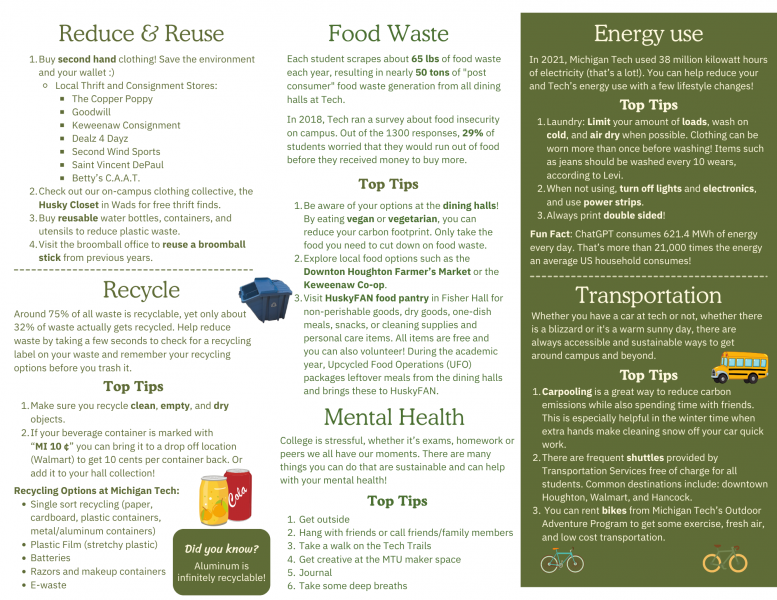
Ever wonder how to make dorm living a little more green? Students in TreeHouse, Michigan Tech’s sustainability learning community, wondered the same thing and developed a Sustainable Dorm Living Guide as a solution during their Sustainable Living Practicum spring course!

Packed with tips, tricks, and resources, the Sustainable Dorm Living Guide is a great reference tool that can help make on campus living more sustainable. The guide has tips for a sustainable move-in experience, advice for how to get involved on campus, ways to lower your carbon footprint, and so much more.
The TreeHouse Sustainable Learning Community offers first-year students from all majors the opportunity to live and learn together in shaping a more sustainable future. Nestled on the fifth floor of East Wadsworth Hall overlooking campus, this dynamic living-learning community offers immersive experiences through seminars, field trips, community-building opportunities, and volunteer projects. Join your fellow students as you transform your sustainability curiosity or passion into action.
2025 CISR Funding for Early Career and New Research Directions

The Center for Innovation in Sustainability and Resilience (CISR) is accepting applications for the Sustainable & Resilient Communities Early Career and New Research Directions Award.

These awards are designed to complement start-up packages for early-career faculty or to support established researchers who are pursuing new ideas or topics around sustainability and resilience themes. Funds are provided by the Tech Forward Initiative on Sustainability and Resilience. Award eligibility requires being an affiliate of CISR (open to anyone on campus) and contributing to the CISR research community through future external funding proposal submissions.

The application deadline is April 1, 2025, but rolling submissions and inquiries are encouraged.

Early Career and New Research Directions Award

In the range of $3,000 – $5,000, this award complements start-up packages for early career faculty or supports established researchers who are pursuing new ideas or topics around sustainability and resilience themes. We anticipate making four to six awards. View the Early Career and New Directions Award Request for Proposal

Proposal narratives, budgets, and budget justifications should be submitted as a single document via email to Chelsea Schelly, cschelly@mtu.edu. Potential submitters are encouraged to reach out with questions or to pitch ideas before developing a proposal. CISR looks forward to receiving your inquiries and applications!

2024 MTU Sustainability Month

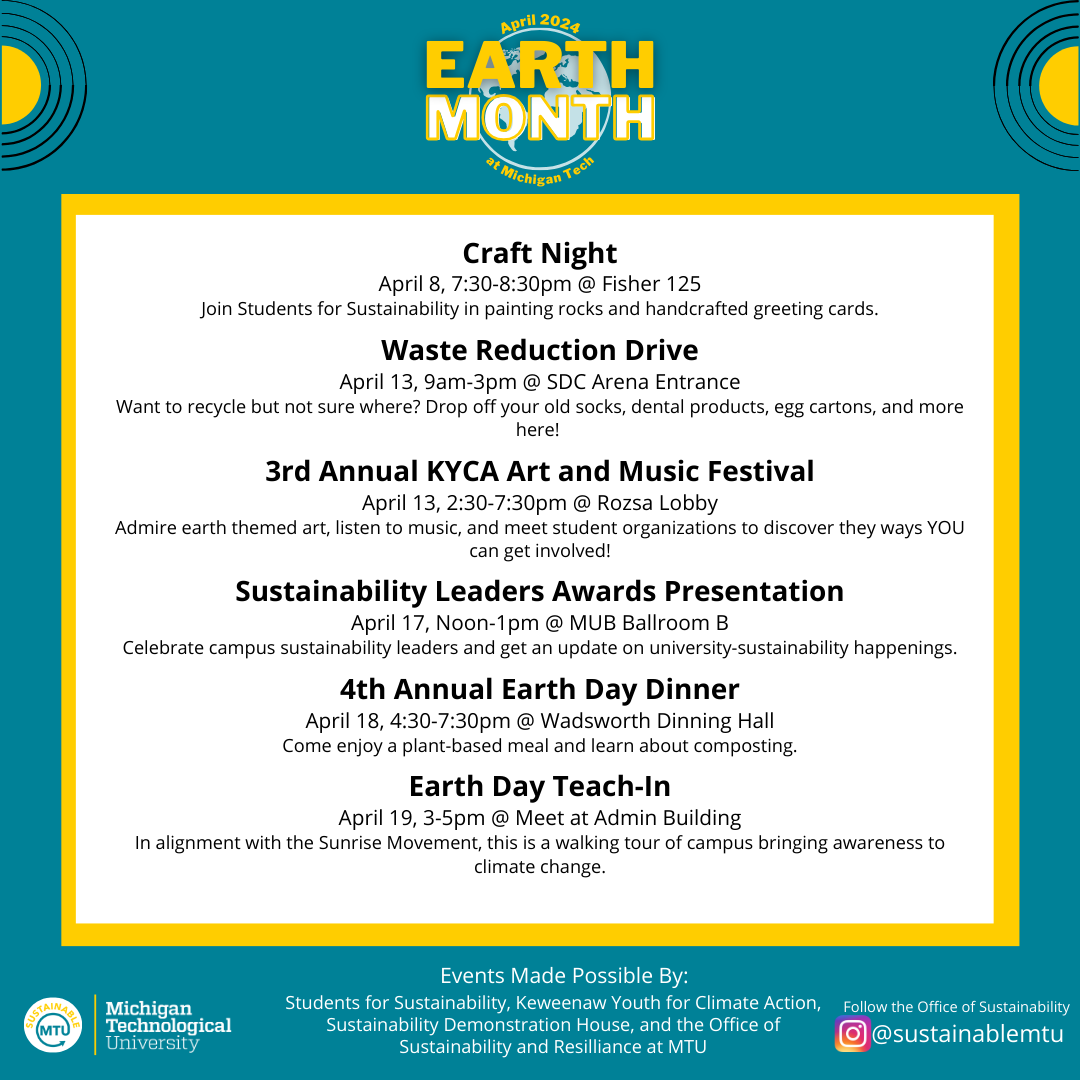
This year, Michigan Tech celebrates the 2nd Annual Sustainability Month with a variety of events put on by our very own Students for Sustainability, Keweenaw Youth for Climate Action, the Sustainability Demonstration House, and the Office of Sustainability and Resilience. Check out the events below to join us in celebrating Earth Month!

  • Craft Night ~ April 8, 7:30-8:30pm @ Fisher 125 Join Students for Sustainability for a chill craft night of painting rocks and making homemade cards with watercolor paints!
  • Waste Reduction Drive ~ April 13, 9am-3pm @ SDC Arena Entrance Want to recycle but not sure where? Drop off your used deodorant tubes, dental products, razors, writing utensils, socks, and egg cartons to the SDC to have them recycled by our awesome sustainability leaders from the MTU Sustainability Demonstration House! Contact Kellin for details at kjgasser@mtu.edu
  • 3rd Annual KYCA Art and Music Festival ~ April 13, 2:30-7:30pm @ Rozsa Lobby Last year was a huge success and we’re doing it again! Listen to local music, meet with sustainability-related enterprises and student organizations, admire earth-themed artwork, and learn about ways to become involved!
  • Sustainability Leadership Awards Presentation ~ April 17, Noon-1pm @ MUB Ballroom B Celebrate campus sustainability leaders and get an update on university-sustainability happenings.
  • 4th Annual Earth Day Dinner ~ April 18, 4:30-7:30pm @ Wadsworth Dinning Hall Come enjoy a plant-based meal and learn about composting.
  • Earth Day Teach-In ~ April 19, 3-5pm @ Admin Building In alignment with the Sunrise Movement, join MTU students to walk in awareness of Climate Change.

For additional sustainability updates from Michigan Tech, follow the Office of Sustainability and Resilience on Instagram, @sustainablemtu .

New MS in Sustainable Communities

The Department of Social Sciences is now home to a new MS degree program in Sustainable Communities!

Sustainability is one of the fastest growing career domains, and this degree program presents an exiting opportunity to get involved. The Sustainable Communities MS helps prepare professionals to work in both private and public sectors. The degree can be completed as a coursework only option or as a research degree with a report. The degree program is also going to be available as an accelerated MS for current Michigan Tech students across any major!

Sustainability is a highly interdisciplinary topic, and this degree program is designed so that students can tailor their MS degree experience to meet their needs. All students complete three core courses in social sciences (one required, two selected from a short list). The rest of the degree can be completed with either individual courses or with existing graduate certificate programs. This allows students to choose to create a stackable set of experiences that build expertise within specific domains or to develop deeper knowledge within social sciences. Students in the Sustainable Communities MS also have opportunities to work with community partners and build projects that contribute to community wellbeing.

Chelsea Schelly, associate professor of sociology and Sustainable Communities MS degree advisor, puts it this way:

“Contributing to more sustainable communities requires that we question all we take for granted in the ways systems and institutions are designed to meet (or deny) human needs and comforts. Faculty in the Department of Social Sciences share a passion for teaching students how to use skills from the social sciences to understand sustainability challenges and contribute to a more sustainable future. The biggest challenges to community-scale sustainability were created by humans—and they can be changed by humans, too.”

For more information about this degree program, you can visit the Graduate School’s program site above and contact Chelsea at cschelly@mtu.edu

Tech Forward Sustainability Listening Session

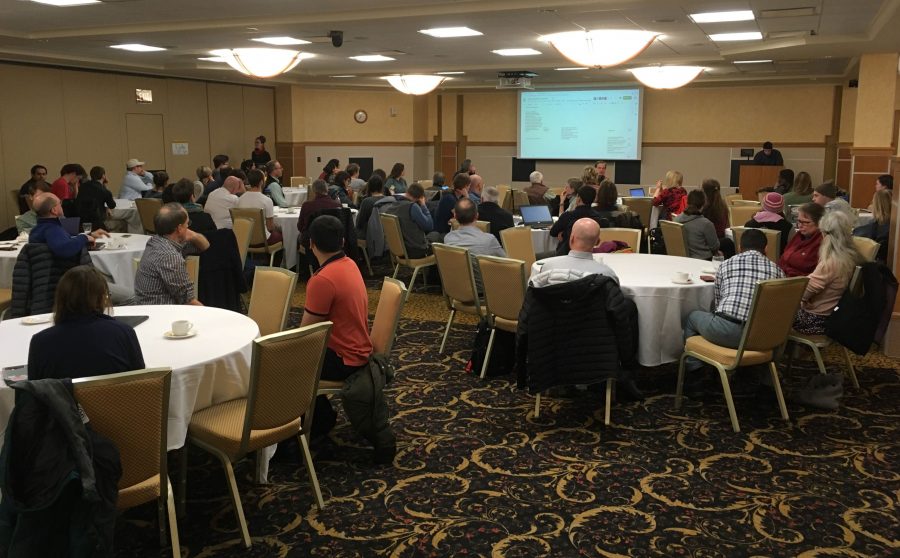
The Tech Forward Initiative on Sustainability and Resilience recently held a campus-wide listening session to hear from more voices across campus. The event was focused on small-group discussions about what Michigan Tech does well, and what can be done differently when it comes to research, education, and campus life issues related to sustainability. Roughly 70 people showed up for a two-hour event on a weeknight, which is a really great indication of just how many people feel strongly about this topic! The folks working within the Tech Forward group are still accepting feedback, so if you did not get a chance to attend the event, please go to this Google Form and share your thoughts about how research, education, or campus life could be improved in regards to sustainability issues – or, feel free to tell us what we are doing that is already going well!

The whole group sharing ideas near the end of the event

Giving farmers a new crop: Solar Farms and expanding BTM methods for farmers


This is a guest post from Lena Stenvig, an undergraduate student at Michigan Tech. Lena is studying Computer Science and minoring in Environmental Studies. Lena took the photos included in this blog post. She can be reached at lsstenvi@mtu.edu


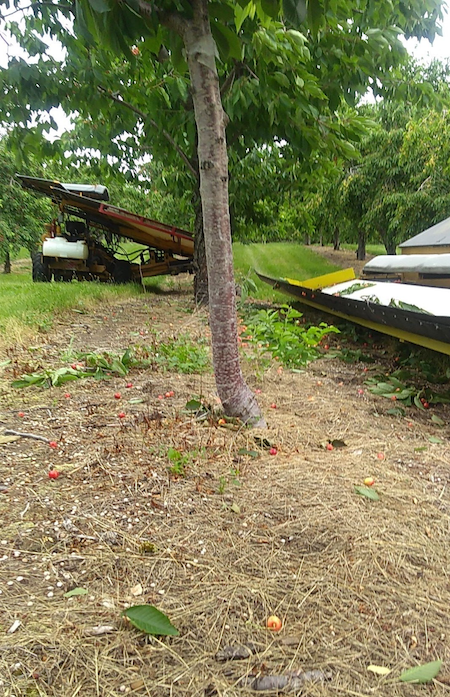
The cherry orchard at Garthe Farms LLC

America is all about its family-owned farms. From its popular food chains serving America-grown burgers to its corn-mazes in the fall attracting people from all around, none of it would be possible without the original small-town humble farmers that do their job equally for supporting their families and for the love of what they do every day; but now our farmers need help. When people moved away from their family farms over to less body-intensive jobs for work, fewer farms began producing more product on more land. Even so, many farmers struggle to produce enough crop to sustain themselves and their family. Around 91 percent of farming families have at least one family member working at a job that is not the farm. This is where Behind the Meter, or BTM comes in.

Behind the meter is a means of producing your own energy so that you are not pulling all of the energy you use from the grid, and as a result pay less for your electricity bill. A popular technique to behind-the-meter is installing solar-panels in one’s yard on upon the roof. In this way a household can produce green energy to lower its carbon footprint and can save on the electricity bill. A typical household has room for a few solar panels. Enough to sustain itself for most of the summer months, but usually not enough when the winter heating bill kicks in. A modern American farm has much more land than your typical resident. Even if most of it is used for farming, there are certainly space that could easily be allocated for a small solar farm. Having worked for Garthe Farms LLC this summer, a cherry farm deep in cherry country near Traverse City, MI, I have seen first-hand where and how this can work. My uncle, Gene Garthe, runs this farm and in recent years invested in four large solar panels that sit in empty space near the driveway nearing the farm house. These four solar panels produce enough energy to run what electricity is needed for the farm, and that is all they desire and need.

Despite producing plenty of energy via solar, Garthe Farms is not a emissions-free facility. Large machinery is used to harvest the cherries from their trees. There are three machines that are necessary in cherry harvesting: the Shaker, which shakes the cherries from the trees, the Catch Frame, which catches the cherries shaken by the Shaker and conveyors them into a tub, and the tractor that takes the tubs when full to the loading dock and brings the Catch Frame a new tub in which to fill more cherries. All three of these machines require diesel fuel to run, and as much work as one can complete towards electric vehicles, it is not economically feasible at the moment to make a machine that chugs through an entire tank of fuel in eight hours of work to operate on an electrically-rechargeable battery. To make up for their fuel usage, perhaps it is better that farms simply produce a form of green energy that can make up for the amount of fossil fuels they consume.


Cherry harvest in motion: The Shaker (far) moves to the next tree while the Catch Frame (near) is receiving a new tub in which to place the harvested cherries.


In this way farmers can reverse the BTM method. If they can produce their usual crop while also producing energy in either the form of solar or wind, they can sustain their household while also receiving return on what they put out to the grid. This can work if they can have some of their own personal solar panels to run what they need to on the farm, and then working with solar or wind companies to lease certain areas of their land to be utilized for said energy production. For wind, this is easy by simply taking up a small portion of land for each windmill. The minimally invasive turbines do not take up much room on the farm and do not hinder the crops from receiving enough sunlight. Solar panels can prove to be trickier. Because of their method of energy production, solar panels would not work well in a field full of crops that also require sunlight in order to grow. For farms that grow plants that take up less room per unit such as potatoes or corn, placing solar panels in spare spaces around the field while mostly utilizing wind power might be the best option. For farms like my uncle’s, it is a different story entirely.

Much of a cherry orchard’s area is taken up by plants and grasses that grow below the trees, and the trees stand spaced approximately ten feet apart within each row. Each row stands about another twenty five feet apart. Where some farms may be only able to place solar panels near roads or at the end of rows, orchards may place the panels in these locations are more. If one row of trees were to be replaced with solar panels, the loss of trees would be fairly minimal while also adding enormous potential for solar production. Even without removing trees, placing solar panels at the end of rows would not affect the production of fruit while also receiving gain on solar production.

If we are to look closer at our American farms and examine the issues they face today, and if we can only look at the potential they hold for energy production, we may not only be able to solve the growing problem of farms going bankrupt, but also for finding a place to produce greener energy without disrupting land that is not being used and additionally would ecologically be better off as it is. In this way farmers can continue to do what they love, and not have to work more than they have to in order to pay bills and keep their farm from dying. With this I might say the path onto greener pastures might just be creating greener pastures.


Tiny House Living at MTU

The latest Humans of Michigan Tech story features Sydney, an undergrad who lives in an ambulance turned tiny home. The story barely touches the surface of the environmental, economic, and personal benefits that can come from tiny home living. Tiny homes are a great example of how environmentally responsible living is also economically beneficial – Sydney doesn’t have to pay rent or utility bills and can take advantage of the shared systems like showers and internet provided by the college campus. Sydney is not the first MTU student to live in a tiny home while completing a degree here – a student who built a tiny home on a trailer used to live in my yard, before she graduated and moved away from Houghton. There have even been discussions of developing a community of tiny houses on campus! Sydney and other students who have lived in tiny homes demonstrate that it’s possible, even in the cold snowy climate of the UP. Her story makes me wonder – How many students would live like this, if provided the opportunity to try? How can we teach more students about this possibility? What are the barriers in our way of making more environmentally and economically sound investments for qualify living through tiny homes and access to shared systems? We’re proud of you, Sydney!


Industrial Ecology

Photo of Shaelyn taken by Daniel Prada (daprada@mtu.edu).


This is a guest post by Shaelyn Koleber, who is an environmental engineering undergraduate student at Michigan Tech. She can be reached at sjkolebe@mtu.edu


Shaelyn took the photos included in her blog post.


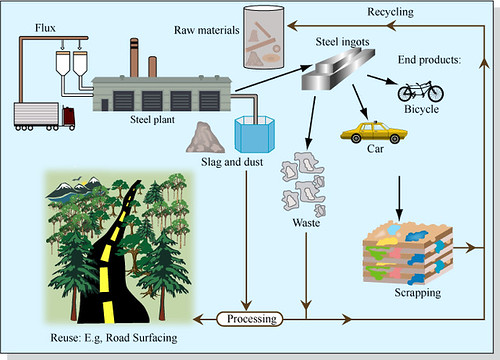
Nature is full of self-sustaining ecosystems; there is a constant recycling of resources. There are complementary functions within nature and the environment is able to completely support itself without outside assistance. For example, trees absorb carbon dioxide and give off oxygen, while animals take in oxygen and give off carbon dioxide—a seemingly perfect complimentary cycle. Whether a plant is eaten by an animal or it dies naturally and decomposes on the forest floor, it is still supporting the ecosystem. Whatever nature produces eventually reaches the end of its life and will be consumed back into the ecosystem. A fallen tree limb, a dead animal, or an uneaten fruit or plant that has fallen to the floor are all absorbed and recycled back as useful forms to support the ecosystem. There is no waste produced from environmental processes and the ecosystem is a closed-loop of resources. This same concept can be applied in buildings and manufacturing where the waste produced from these processes can be used to support the ongoing production. Industrial ecology is a sustainability concept to improve the environmental management of industrial processes. Companies can keep a record of materials throughout a product’s life. There are many subcategories of industrial ecology that are used as analyzation and evaluation techniques to ultimately reduce the impact on the environment, such as: material flow analysis (MFA), life-cycle analysis (LCA), and input-output analyzation. Industrial ecology is an emerging concept that works to mimic the self-sustaining cycle of nature.

Introducing the ecological aspect to industry puts a generalized focus on environmental impact. Industrial ecology is a strategic guideline to use fewer resources while also finding a new purpose for exhausted materials and waste. This does not have to occur within one facility. Different businesses could work together to create networked, ecological industries: waste can be seen as a resource. The saying, “one man’s trash is another man’s treasure,” is demonstrated through the concept of ‘industry partnership.’ The by-product from one industrial process can be used as the input for a separate entity. For example, a coal-firing power plant has a lot of excess heat that can be distributed to a nearby community. This would reduce the energy and resources needed to provide heat services to the town, thus providing environmental and economic benefits. This could only occur with the cooperation of multiple companies independently. The transportation of these materials would have to be a short distance for the net environmental impact to be positive. This idea would have tobe mutually adopted for it to be effective, which could be seen in future years as more industries become conscious of their carbon footprint.


Industrial ecology is also seen in the emerging concept of cogeneration. Cogeneration, also known as combined heat and power (CHP), is when a heat engine is used to generate electricity and heat at the same time. Similar to the previously mentioned example, during the production of electricity, the heat can be harnessed and put to use instead of going to waste. This directly views the heat waste as a source and creates a concept of dual-purpose. Rather than the heat being seen as waste, it is seen as another useful product of the process. Smaller-scale industrial ecology concepts can be seen in the construction of homes or commercial buildings. Current construction techniques and technological resources build each utility with separate input needs and waste disposal. Most housing and commercial buildings do not have any industrial ecology, currently. People who plan on living in a house for an extended period of time or have a desire to live sustainably are more prone to implement advanced technologies. Instead of using an air-source air conditioner, a ground source heat pump can be used as a closed-loop system. These systems pump water from the ground where the temperature is constant year-round. While air-source heat pumps are less expensive and easier to install, ground-source pumps are much more efficient and sustainable. The ground-source pumps are buried pipes that loop around a three-to-six-foot-deep trench. This system is a constant exchange of heat with the ground and can heat or cool a home. Diagrams and explanations of the different heating systems can be found on https://smarterhouse.org/heating-systems/types-heating-systems. It takes less energy to simply move heat around than it is to generate heat; therefore, the ground-source pump does not consume a lot of energy. Since the ground-source heat pumps are more efficient, they are also more cost effective. A consumer that installs this system and plans on living in a home for a long time will see a return on their investment. This is just one example of many technologies/designs that exist as readily-available sustainable systems.

Industrial ecology is a concept that must be practiced by all companies and manufacturers; it must also be well-understood by the general public in order to be fully adopted and implemented into the function of society. Since our society relies heavily on industrial processes, we cannot simply shut them down. However, we can no longer standby and knowingly accept the pollution that companies create through their industrial processes. While it is not reasonable to shut down industrial processes completely, we must keep these companies responsible for the waste and pollution they create. A partial reinvention of industrial processes into industrial ecology will reduce the environmental impact significantly. Without the public’s understanding and demand for such changes, there will be no urgency to place official regulations and therefore create a zero-pollution global industry. This foreseen change will not come easily or naturally; it needs to be talked about and broadcasted on media to mass-educate the public. With a widely supported concept, the engineers, scientists, and policy makers can work together to put the ideas into action. Industrial ecology allows humans to increase their efficient use of ecosystems by mimicking what nature already does. The implementation of this concept will only come with the mutual support from companies, the government, the people, and environmental conservationists. If we continue to move forward with these concepts, the earth can thrive for many eons in our future.